A single worked flint blade, apparently recovered during the construction of a carpark and tennis court at Castle Rushen High School, Castletown (previously Ordnance Survey Field no. 3113, Red Gap).
The blade measures 27mm overall, with a maximum width of 14mm.
The artefact is in the Manx National Heritage collections, accession no. 1984-0090.
The Ordnance Survey 1:2500 large scale mapping of 1867 records a small field at this location used as a stackyard (Manx, 'haggard'). The enclosure still exists but is now occupied by an agricultural yard and building.
The grid reference provided indicates the centre of the stackyard as originally recorded by the OS.
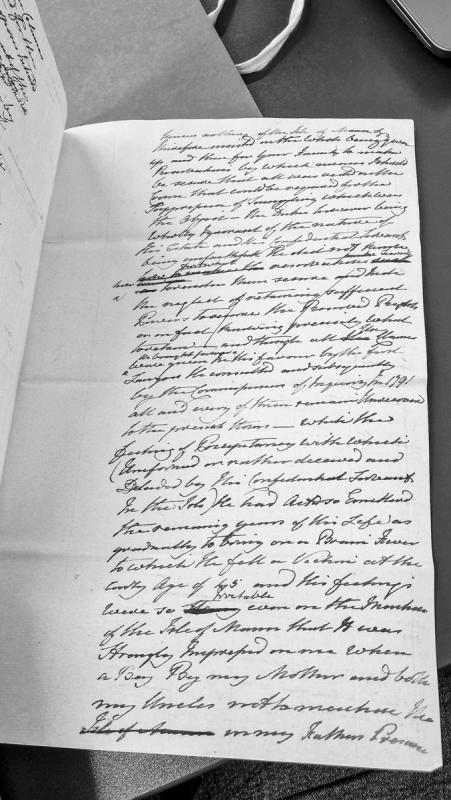
A fragmentary personal account describing the Duke's ignorance of his Isle of Man estate, the unfaithfulness of his confidential servants, and failed attempts to suppress smuggling. The narrator recounts how the Duke's frustration and feelings of incompetency led to illness and death at age 45, and the lasting emotional impact on the narrator's family.
The site of a post-medieval brickworks. A single building at the roadside with a clay pit to its south is shown in the field numbered Plot 2459 on the 1870 1:2500 Ordnance Survey map. The site now lies within the garden of a modern house.
A few worked flints were found in the vicinity of a possible iron working site, but were probably prehistoric and unconnected with the iron working activity.
The findspot of an early prehistoric flint scatter. It included worked flint, 3 end scrapers (bull-nosed type), flakes etc., at least one of which was calcinated. Some fragments of coarse pottery or baked clay were also found.
The site of a medieval iron smelting site. Traces of reddened soil, iron slag and charcoal (but no pottery) were found here, similar to that found at the medieval iron smelting site at Ballavarry.
A few worked flints (PRN 0331.10) were also found at the site, but were probably prehistoric and unconnected with the iron working activity.
The site of a post-medieval horse engine. The circular horsewalk is shown on the 1870 1:2500 scale Ordnance Survey map, located at the southern side of a large L-shaped building range.
6 names listed in alphabetical order; First World War. Bronze plate on wooden backing.
The memorial was unveiled at Douglas Post Office on Sunday, 18 December 1922. It was sponsored by corporate donation. The unveiling was carried out by the Postmaster Mr R.H. Nicholls. The memorial was dedicated by the Reverend H.S. Taggart. The plaque was re-sited within Regent Street Post Office in 2010, following refurbishment of the building. During the refurbishment it was stored temporarily at the Manx Museum. The memorial was designed by Archibald Knox.
4 names listed in alphabetical order; Second World War. Wooden plaque.
The plaque was re-sited within Regent Street Post Office in 2010, following refurbishment of the building. During the refurbishment it was stored temporarily at the Manx Museum.
A comprehensive chronological listing of British military regiments and detachments stationed on the Isle of Man from 1765 to 1896, with documentary evidence from Manx newspapers, census returns, and parish records. The document traces the shift from no British garrison pre-Revestment to permanent military presence post-1765, including Fencible forces, Royal Veterans, and line regiments. It is directly relevant to understanding the military occupation and control mechanisms following the 1765 Revestment.
A comprehensive chronological list of British military regiments and detachments stationed on the Isle of Man from the 1765 Revestment through 1896, compiled from newspaper reports, census records, parish registers, and historical sources. Includes recruitment areas, commanding officers, and notes on troop movements, accommodations, and local impacts.
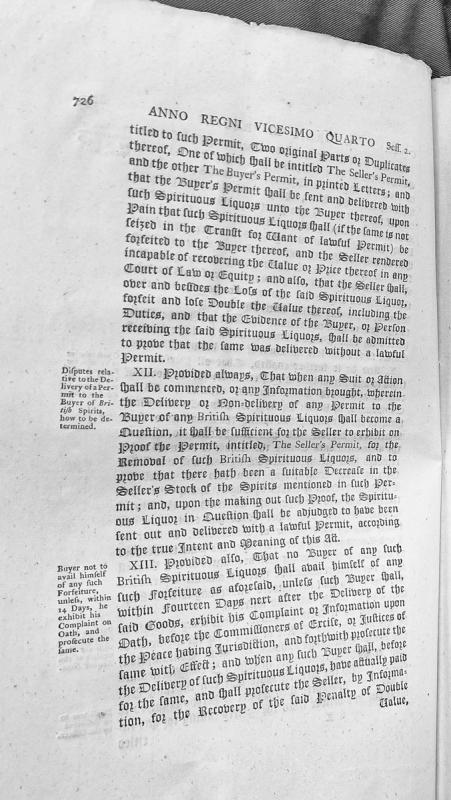
This is a legislative excerpt (page 726) from an Manx act regulating the sale and delivery of British spirituous liquors. It details the requirements for seller's and buyer's permits, penalties for non-compliance, procedures for dispute resolution, and conditions under which buyers may claim forfeitures. The text appears to be from the 24th year of a royal reign, session 2.
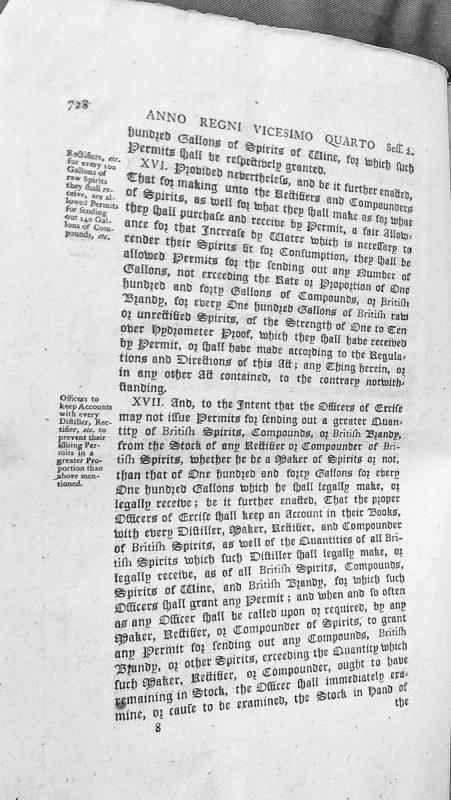
This is an excerpt from legislation (sections XVI and XVII) governing the permit system for spirits rectification and compounding. It establishes that rectifiers and compounders may issue permits for spirits at a ratio of 140 gallons of compounds per 100 gallons of raw spirits received, accounting for necessary dilution with water. It further requires excise officers to maintain detailed accounts with distillers, rectifiers, and compounders to prevent over-issuance of permits.
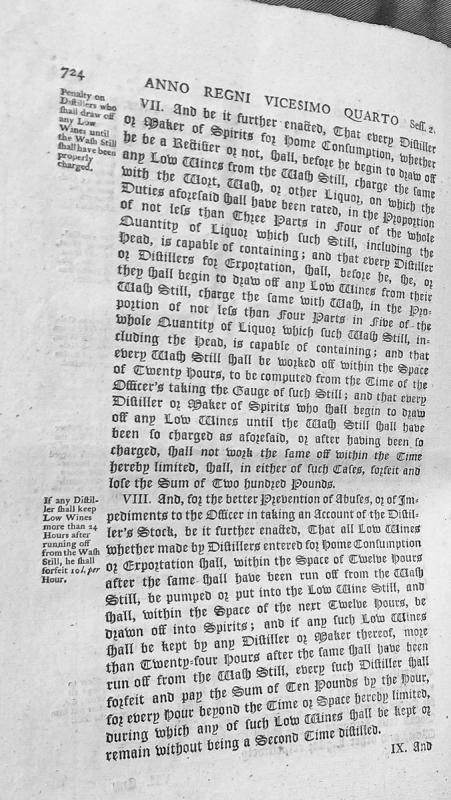
This is a legislative text (sections VII-IX) regulating the distillation of spirits in the Isle of Man, specifying minimum liquid charges for wash stills, time limits for working off stills, and penalties for non-compliance. It imposes strict requirements on how low wines must be handled after separation from the wash still, with substantial financial penalties for violations.
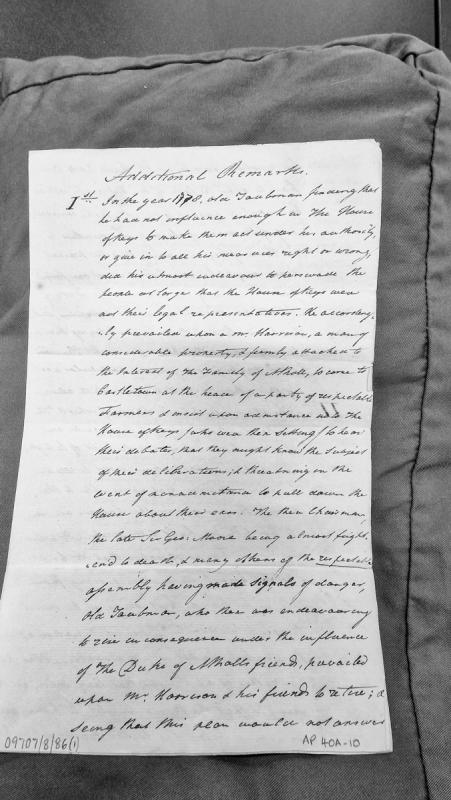
A historical account describing events in 1778 when Taubman allegedly persuaded Mr. Harrison and farmers to demand admission to House of Keys sessions to observe debates, threatening violence if denied. The incident involved Sir George Moore as Chairman and appears to document political tensions regarding representation and authority on the Isle of Man.