The site of an Early Medieval keeill or chapel and burial ground thought to date to the period AD 500-1000. Considerable remains of the keeill are visible although its present appearance dates largely from the clearing and partial reconstruction undertaken by the Inspector of Ancient Monuments, G.J.H. Neely, in 1935, when fallen stones and floor material were used to rebuild the 'robbed' walls. Externally, very few original stones are to be seen in the banking.
No trace of the burial-ground embankment (shown on the OS 1:2500 mapping of 1868) can now be seen, and the farmer asserted that he had never ploughed up graves there. Two stones outside of the keeill may be associated with it, and a third in the hedge-bank to the northwest may have been a tethering stone.
The above description is largely derived from J.R. Bruce's detailed record published in 1968. In recent years the current landowner has cleared vegetation from the site and now maintains it in this condition. The surrounding enclosure is now more obviously defined by a series of modern marker boulders, and part of the later field boundary has been removed to make the site more easily discernible. The grid reference is centred on the enclosure as now defined.
The site of an Early Medieval chapel or keeill and burial ground thought to date to the period AD 500-1000. Considerable remains of the keeill are visible although its present appearance dates largely from the clearing and partial reconstruction undertaken by the Inspector of Ancient Monuments, G.J.H. Neely, in 1935, when fallen stones and floor material were used to rebuild the 'robbed' walls. The walling of the keeill on its internal face is one course only except for a short length of east wall which is three courses high. The west end is ill-defined, apparently devoid of stones, but the opening may represent the position of the original doorway. The remains of the chapel are orientated northeast to southwest and consist of turf covered dry-stone walls with internal measurements of 5.1 metres x 2.4 metres. The walls have a maximum internal height of 1.5 metres, average external height of 0.6 metres and are 0.8 metres wide. A slight shelf in the east may indicate the remains of the altar. A broken down entrance 1.1 metres wide is in the west.
Externally, very few stones are to be seen in the banking. No trace of the burial-ground embankment (shown on OS 1:2500 mapping of 1868) can now be seen, and the farmer asserted that he had never ploughed up graves there. Two stones outside of the keeill may be associated with it, and a third in the hedge-bank to the NW may have been a tethering stone.
The above description is largely derived from J.R. Bruce's detailed record published in 1968. In recent years the current landowner has cleared vegetation from the site and now maintains it in this condition. The surrounding enclosure is now more obviously defined by a series of modern marker boulders, and part of the later field boundary has been removed to make the site more easily discernible.
Official response from Carlisle customs officers John Norman and William Wilson to a Parliamentary or ministerial inquiry about smuggling trade between the Isle of Man and Great Britain. The letter reports on armed smuggling gangs operating in the Borders, describes a specific incident in June 1764 near Hayton Castle involving 40 horse-loads of brandy and tea, and recommends military deployment to suppress the trade.
A letter from Carlisle customs officials John Norman and William Wilson responding to instructions to investigate the smuggling trade between the Isle of Man and Great Britain. The letter reports on smuggling activities in the Scottish Borders, violent encounters with armed smugglers, and recommends military intervention to suppress the trade.
Report from Dublin customs authorities (Ponsonby, Bourke, Trevor, Burton) to the Lord Lieutenant responding to an enquiry about smuggling between the Isle of Man and Ireland. Details the geography, personnel, vessels (wherries from Rush), contraband goods (tea, brandy, tobacco, East India goods), enforcement measures, and estimated revenue loss. A key document on the operational scale of the smuggling trade and official Irish response.
Official response from Lancaster Customhouse officers (Foxcroft and Smethurst) to enquiries about trade and smuggling from the Isle of Man. Reports minimal direct trade from Lancaster to Mann, notes vessels bound for Africa call at the island for India goods imported from Holland, and directs enquiries to Liverpool and Whitehaven ports as better sources of intelligence on Manx trade. Directly relevant to understanding smuggling networks and inter-port communication before the 1765 Revestment.
Official response from Lancaster Customhouse officers (Robert Foxcroft, Collector, and J. Smethurst, Deputy Comptroller) to enquiries about trade and goods imported into the Isle of Man. The officers report minimal direct trade from Lancaster to Man, note that India and other goods are imported via Holland, and suggest Liverpool and Whitehaven as better sources for information on Manx import duties and trade patterns.
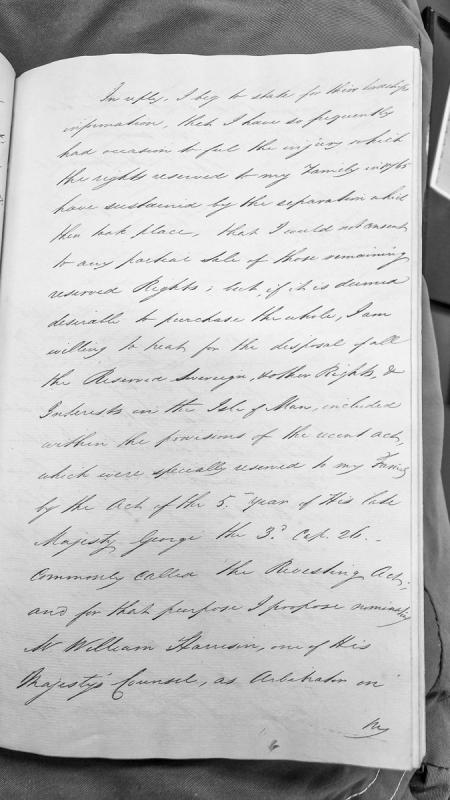
A formal reply to unidentified recipients (addressed as 'their Lordships') regarding the potential sale of reserved sovereign and other rights in the Isle of Man that were reserved to the author's family by Act of Parliament in 1765. The writer expresses unwillingness to sell partial rights but offers to negotiate the disposal of all reserved rights, proposing William Harrison as arbitrator.
Official response from the Treasury to the House of Commons regarding proceedings under the 1723 Act empowering the Lord High Treasurer to treat with the proprietor of the Isle of Man for purchase or sale. The Treasury confirms that the Commissioners have at several times invited the proprietor to make proposals, but no record of subsequent proceedings is available in the Treasury office books and papers.
An official response from the Treasury to a Parliamentary inquiry regarding proceedings undertaken under the 1720 Act for Improvement of His Majesty's Revenues, specifically concerning attempts to purchase sovereignty over the Isle of Man from its proprietor. The document confirms that multiple treatises with the proprietor were initiated but provides no details of outcomes.
A report from Governor George Lindsay to the Duke of Atholl covering financial transactions (bills of exchange), ecclesiastical discipline of a clergyman, and celebrations of the Duke of Cumberland's victory over the Scottish rebels. Demonstrates the Duke's administrative authority over the Isle of Man and provides insight into governance, loyalty expressions, and religious authority during the 1745 Jacobite Rebellion aftermath.
Governor Cochrane reports on revenue collection difficulties on the Isle of Man, citing interference from revenue cutters and poor weather preventing merchant trade. He discusses pending remittances, bills of exchange totaling £830, and personal matters including payments to Colonel Stuart. The letter illustrates the financial pressures on the Island's government and the relationship between the ducal administrator and the merchant community during the pre-Revestment period.
Governor Lindsey reports to the Duke of Atholl on maritime seizures of private property affecting the Duke's interests and revenue collection. The letter discusses the vulnerability of the Duke's property at sea, cash flow concerns pending harvest, and a scurrilous pamphlet circulating on the island. It provides insight into mid-18th century Manx governance, revenue collection, and tensions over enforcement activities.
Governor Lindsay reports to the Duke of Atholl on serious violations of ducal rights and privileges on the Isle of Man, including seizures by the naval vessel Wolfe and concerns about revenue loss from import duties. Lindsay suspects involvement of persons in power and warns that failure to respond will result in loss of all rights and revenues. The report documents a seizure of a sloop carrying brandy from Ramsey to Kirkcudbright.
Governor Basil Cochrane reports to the Duke of Atholl on financial remittances (£1353 to Liverpool via Captain Lace), clergy financial matters, and administrative recommendations regarding appeals. Cochrane proposes establishing a local appeals commission on the Isle of Man to reduce the burden and expense of appeals heard in London, referencing past practice under the Earls of Derby.
Official report from Governor Basil Cochrane to the Duke of Atholl concerning administrative and financial matters on the Isle of Man, including clergy affairs, tithes, naturalization of Roman Catholics, and remittances to Liverpool. Reflects governance structures and revenue issues in the pre-Revestment period.
Letter from Isle of Man Governor Basil Cochrane to the Duke of Atholl reporting on revenue collection, the conduct of collectors, and addressing concerns about Roman Catholic naturalization and religious tensions. Provides insight into island governance, commerce, and social conditions during the pre-Revestment period under Atholl's sovereignty.
A letter from Governor Basil Cochrane to the Duke of Atholl reporting on administrative matters in the Isle of Man, including remittance of £525, inquiry into escaped wherries from an Irish barge, tithe collection prospects, and ecclesiastical patronage arrangements. This document provides insight into day-to-day governance, revenue matters, and the Duke's direct control over Island affairs during the Atholl regime.
A letter from Governor Basil Cochrane to the Duke of Atholl reporting on Isle of Man administrative matters including financial transfers to Liverpool, passage of legislation regarding pedlars and dogs, clerical tithes, and property development in Douglas. Reveals the Duke's direct authority over Island affairs and financial management circa 1758.
Governor Basil Cochrane reports to the Duke of Atholl on financial matters (£1000 remittance to Liverpool, clergy payments), legislative acts (Pedlars Act, dog clause), tithe collection arrangements, property development in Douglas, and naturalization procedures. Provides insight into day-to-day manorial administration and revenue collection under the Atholl lordship.
Cochrane reports to the Duke of Atholl on naturalization petitions, customs revenue, merchant debts, and road maintenance on the Isle of Man. Discusses granting naturalization to several men including an Irish MP, and remits £300 in customs collections. Provides administrative updates on island commerce and governance.
Governor Basil Cochrane reports to the Duke of Atholl on various administrative and commercial matters in the Isle of Man, including disputes with merchant George Moore over harbour access and cargo handling, officer conduct, and infrastructure improvements. The letter illuminates governance tensions between commercial interests and customs enforcement in the pre-Revestment period.
A letter from Governor Basil Cochrane to the Duke of Atholl reporting on administrative matters in the Isle of Man, including naturalizations, road supervision, remittance of funds, customs revenue, and the Governor's health. Provides insight into local governance, merchant activity, and fiscal management under the Atholl proprietorship.
Governance report from Governor Wood to the Duke of Atholl regarding tithes, legal expenses, court reforms, revenue collection, and local disputes. Documents administrative oversight of the Isle of Man and financial management of ducal interests under the proprietary regime, two years before the Revestment.
Report from Governor Basil Cochrane to the Duke of Atholl covering audit completion, Fort and storehouse construction at Ramsey, clergy financial matters, herring fishery prospects, and administrative personnel changes. Provides insight into Isle of Man governance, revenue management, and infrastructure development under Atholl's lordship in the pre-Revestment period.