Governor Lindesay reports to the Duke of Atholl on legislative matters, including acts concerning Deemster fees, witness charges, and champarty law. The report discusses revenue implications and includes a detailed narrative of a disputed property case (Calcot v. purchasers of Ballalough) involving attorneys Smith and Gill, illustrating disputes over land title and legal practice in 1740s Isle of Man.
Governor Lindsey reports to the Duke of Atholl on sending £1,666:10 sterling to England via attorney and ship passage, discusses alternative remittance methods via merchant Fitzgerald, and reports loss of Swedish tea ship off Highland coast. Documents revenue collection, financial management, and smuggling-related losses on the Isle of Man during the Atholl lordship.
Governor Lindsey reports to the Duke of Atholl on arrangements to transmit money from the Isle of Man to England via attorney, discusses financial difficulties and potential merchant-based remittance systems, proposes improvements to the Calf of Man lease, and reports the loss of a Swedish tea smuggling ship on the Scottish coast. Provides insight into commercial networks, smuggling operations, and Atholl's financial management of the island.
Report from Governor Lindsey (Castle Rushen) to the Duke of Atholl regarding response to the 1745 Stuart uprising, island defences, revenue collection (£1663 12s in customs), financial proposals (raising £12,000 on customs security), and preparations for the Duke's proposed residence on the Isle of Man with his daughters. Provides valuable context on Atholl's sovereignty and revenue interests pre-Revestment.
Governor Lindsey reports to the Duke of Atholl on measures taken to defend the Isle of Man during the 1745 Stuart Rebellion, including militia mobilisation, fortification of Castle Rushen, and revenue collection efforts. The letter discusses customs revenue (£1,663 total collected), the Duke's proposal to raise £12,000 on security of customs, preparations for the Duke's proposed residence on the island with his daughters, and various economic activities including mining, herring fishing, and tobacco trade.
A letter from Governor Cochrane to the Duke of Atholl reporting on conditions on the Isle of Man following his arrival. Discusses shipping losses due to privateers, merchant activity, and a significant dispute with the Manx clergy over the Duke's proposal to sell the tithes. The clergy raise constitutional questions about Parliamentary authority and the Duke's settlement on Lady Charlotte.
Governor Cochrane reports to the Duke of Atholl on conditions in the Isle of Man following shipping losses and privateering activities. The letter discusses commercial recovery, ecclesiastical matters including the sale of tithes, the Bishop and Clergy's concerns about parliamentary authority, and the Duke's settlement provisions for Lady Charlotte. Relevant to understanding pre-Revestment governance and the Duke's relations with the Church.
Report of the House of Commons Select Committee appointed to examine the state of the tobacco trade, the effects of recent legal changes, smuggling, and adulteration. The committee examined manufacturers, merchants, and revenue officials, took extensive evidence, and recommended legislative measures. Directly relevant to understanding trade regulation, smuggling incentives, and revenue policy in the broader context of 1840s British commerce.
A comprehensive parliamentary committee report examining the tobacco trade, smuggling, and adulteration in Britain. The committee investigated the effects of recent legislative changes, heard testimony from manufacturers, traders, and revenue officers, and debated remedial measures. Though tangential to Isle of Man's specific revestment, this document provides essential context on smuggling networks, contraband routes, revenue challenges, and the broader trade environment of the 1840s.
Governor Wood's administrative report to the Duke of Atholl covering financial remittances, tithe sales, ore production, legal costs, and Governor's House repairs. Documents revenue collection and property management on the Isle of Man under Atholl's proprietary rule, three years before the 1765 Revestment.
Governor Wood's official report to the Duke of Atholl concerning the remittance of £2,000 in cash and bills, and five (subsequently six) tithe deed conveyances. The letter addresses complications arising from the sale of tithes subject to incumbrances versus the original promise of exemption from all incumbrances to those who purchased at 35 years' purchase. Reflects administrative and financial management of Atholl's Manx holdings pre-Revestment.
Routine administrative report from Governor Cochrane to the Duke of Atholl covering ecclesiastical appointments (death of Parson Quayle), personnel matters, naturalization papers, harbour planning for Douglas, brass coinage, clerical finances with Lord Derby, and audit preparations. Provides insight into mid-18th-century governance and fiscal administration of the Isle of Man under Atholl's proprietorship.
Governor Wood's official report to the Duke of Atholl covering financial remittances (£1200), castle repairs at Castle Rushen, industrial operations (paper mill, iron forge, snuff mill), and observations on the Isle of Man's trade conditions and cash scarcity. Provides insight into the Duke's revenue collection and estate management pre-Revestment.
Governor Wood reports to the Duke of Atholl on the distinction between tithes and revenue in recent remittances, Castle Rushen repair estimates, and the Boon Money accounts. The letter reflects administrative processes and financial management of the Isle of Man under Atholl's sovereignty in the period immediately before the Revestment negotiations.
A detailed administrative report from 1702 examining the tenancy rights and title to the estate of Knockaloe on the Isle of Man, following an order from the Lord (dated 24 September 1702). The report documents a complex land dispute spanning decades between Silvester Cross (claiming tenancy by right of heir) and Thomas Harrison (in possession under a lease from the Earl of Derby). The case illustrates Manx customary law regarding tenant right, widow's rights, succession, and the authority of the Lords of Man over land tenure.
A detailed administrative report from the Manx authorities (Governor, Officers, Deemsters, and Keys) examining the competing claims to tenancy of Knockaloe estate between Silvester Cross and Henry Harrison. The report traces the complex lineage and lease history from 1637 onwards, ultimately determining that Cross has the rightful claim as next of kin under Manx customary law. This document illustrates property rights, succession law, and the mechanics of Manx governance.
Official report of royal commissioners appointed to investigate allegations by the Duke of Atholl regarding losses and rights following the 1765 Revestment. The report covers three main allegations: unfair revenue collection pre-1765, the legislature's hypothetical willingness to increase duties, and rights unnecessarily vested in the Crown. Contains extensive testimony from Manx merchants, revenue officers, and delegates who attended Parliament in 1765.
Pages 131–137 of the 1792 Report of the Commissioners of Inquiry into the Isle of Man, focused on David Reid's dissenting postscript and observations. Reid disagreed with his fellow commissioners (Spranger, Grant, Osgoode, and Roe) on several key issues, particularly regarding carriage services, the Duke of Atholl's mutilated rights, and the impact of the 1765 Revestment Act. The document includes Reid's correspondence explaining his position, the original instructions from Henry Dundas (Secretary of State), and supporting letters to the Duke, Lieutenant-Governor, Attorney-General, and Revenue officials.
Official report by Commissioners of Inquiry examining the ancient and contemporary constitution of the Isle of Man, including legislative, executive, and judicial structures. Focuses on the composition and functions of the House of Keys, Governor's Council, and various courts prior to and following the 1765 Revestment Act. Provides detailed analysis of how the Act affected Manx institutions and governance.
A detailed report by David Reid, a commissioner of inquiry, proposing comprehensive reforms to Isle of Man's customs revenue administration, smuggling prevention, and taxation. Covers transfer of customs management to English or Scottish boards, preventive measures against smuggling of spirits, tea, tobacco and salt, licensing regulations, and proposals for warehousing. Critical for understanding post-Revestment governance and revenue challenges.
A formal committee report to the Bishop of Sodor and Man detailing the financial state of St George's Chapel in Douglas, Isle of Man, including debts (£363 2s 10.5d), outstanding contributions (£29 13s 6d), and estimated costs for completion and churchyard acquisition. The report provides revenue data from pew rents over the preceding decade and recommends elevation of the chapel to parish church status.
A formal report to the Bishop of Sodor and Man from a committee appointed to assess the financial condition of St George's Chapel in Douglas. The report details outstanding debts (£363.2s.10½d), uncollected contributions (£29.13s.6d), estimated costs to complete the chapel (£330), and churchyard acquisition costs (£170). It notes chapel revenues from pew rents average only £37.9s annually and recommends constituting the chapel as a parish church.
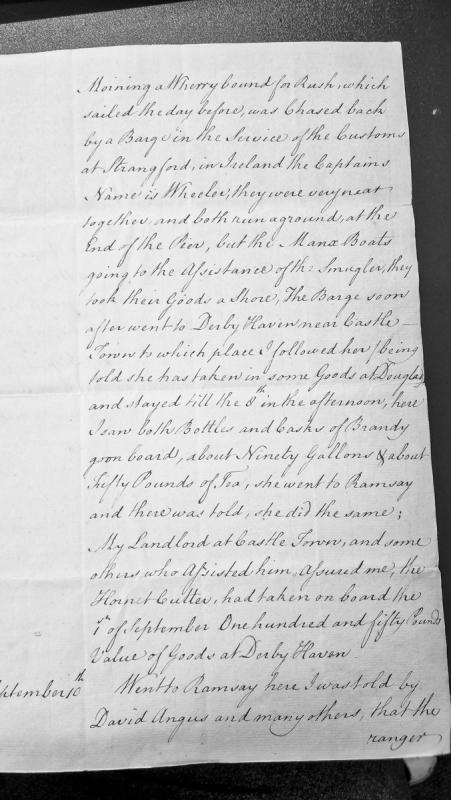
An administrative report detailing observations of smuggling operations involving vessels, customs enforcement, and contraband goods (brandy and tea) in Manx waters. The document references a wherry chased by a customs barge, goods brought ashore, and involvement of the Hornet Cutter in September, suggesting active monitoring of illicit trade.
A legal opinion from four senior English judges (including the Lord Chancellor and Chief Justices) on King James I's title to the Isle of Man, examining the validity of the grant to Sir John Stanley under Henry IV and the Derby family's subsequent ownership. The report addresses a potential defect in the original grant and discusses Crown claims versus Derby family rights.
A legal report to King James I from senior judges and nobles (Dorset, Shrewsbury, Worcester, Northampton) examining the Crown's title to the Isle of Man in relation to the Earls of Derby. The report identifies an imperfection in Henry IV's 1405 grant to Sir John Stanley and confirms the Derby family's continuous possession for approximately 200 years, ultimately deferring to the King's decision on how to proceed either by law or equity.