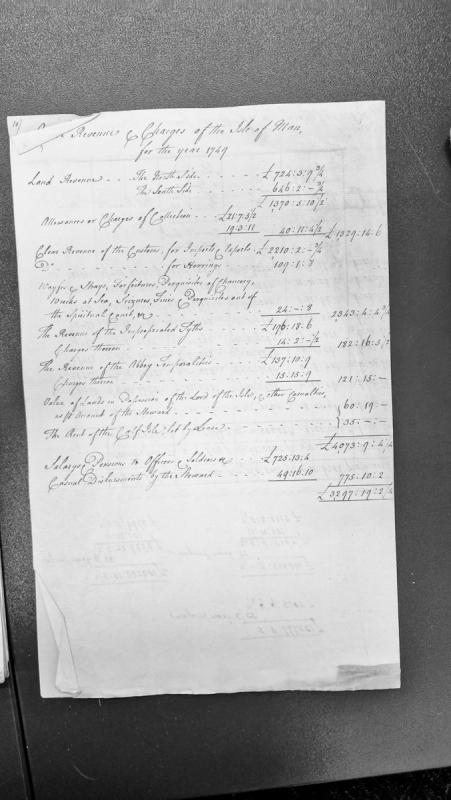
A financial abstract detailing the revenue sources and charges for the Isle of Man in 1749, including land revenue, customs duties, various fees and forfeitures, tithes, abbey temporalities, and salary disbursements. This document provides a comprehensive accounting of the island's fiscal position for that year.
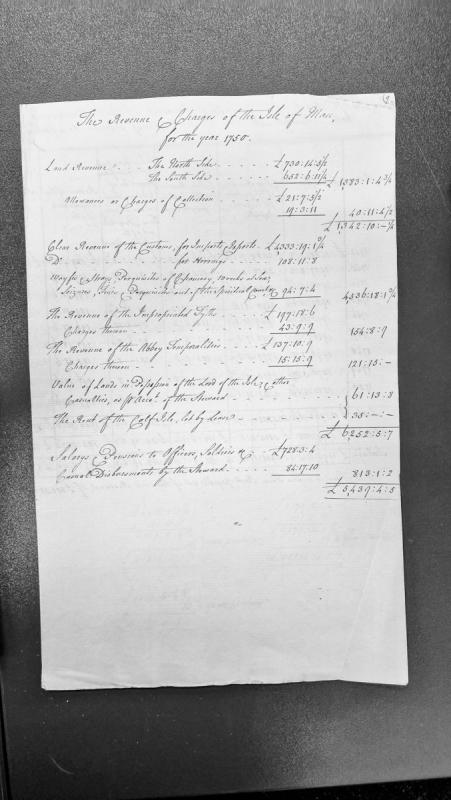
A detailed financial abstract documenting all revenue sources and charges for the Isle of Man in 1750, including land revenue, customs duties, spiritual court perquisites, tithes, abbey temporalities, and officer salaries. The document presents itemised income and expenditure, calculating a net revenue of £5,439:4:5.
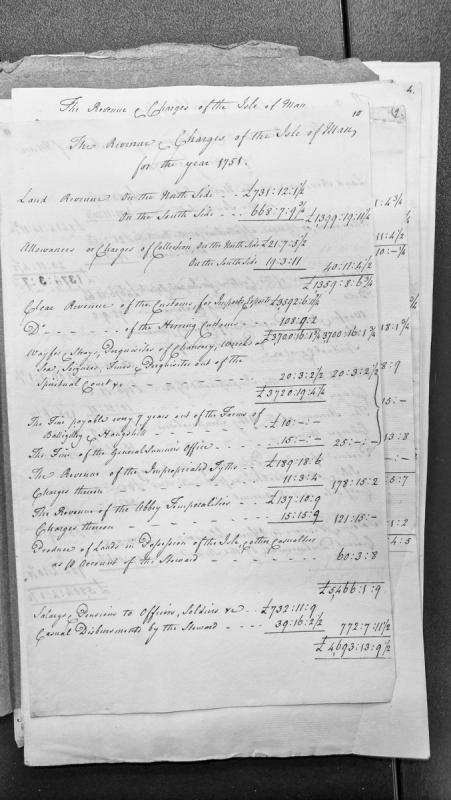
A detailed financial abstract presenting the revenue and charges of the Isle of Man for 1751. The document itemizes various revenue sources including land revenue (North and South sides), customs duties, herring customs, wayfes and strays, spiritual court fines, farm fines, impropriated tythes, and abbey temporalities, with corresponding collection charges. It concludes with total expenses for salaries, pensions, and casual disbursements.
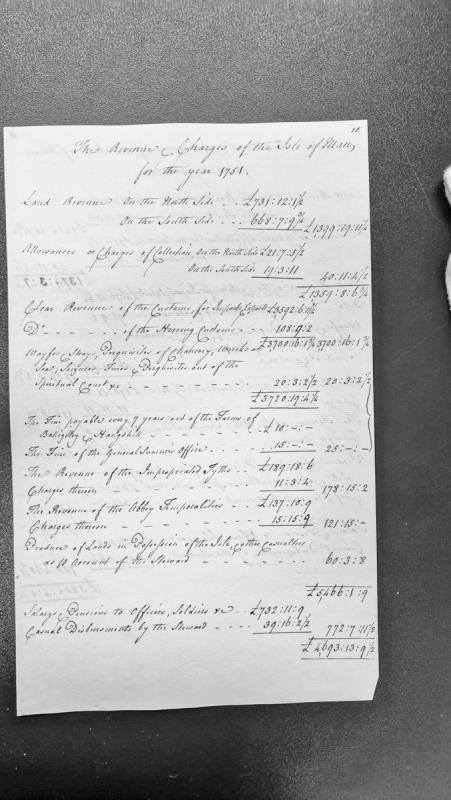
A detailed financial abstract documenting the revenues and charges of the Isle of Man for 1751, including land revenue (north and south sides), customs duties, herring customs, wayfes and strays, spiritual court fines, farm fines, tithes, abbey temporalities, and officer salaries. This represents a comprehensive accounting of the island's public finances for that year.
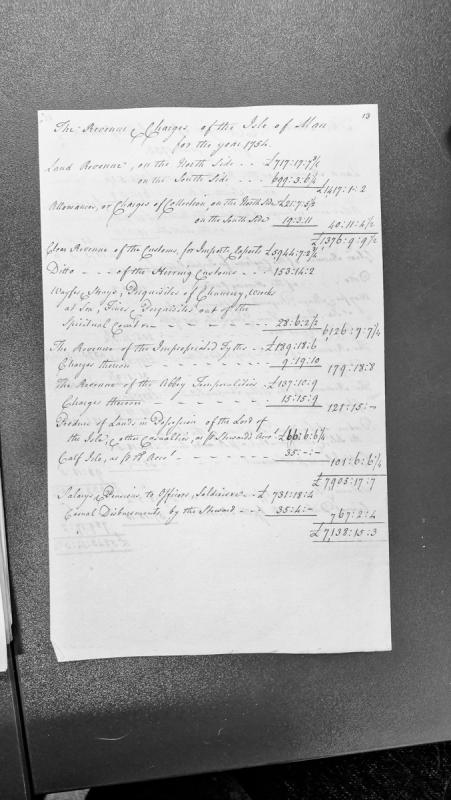
A detailed financial abstract presenting the Isle of Man's revenue sources and expenditures for 1754. It itemizes land revenue, customs duties, ecclesiastical revenues, and various other income sources, followed by disbursements for salaries and pensions, providing a comprehensive overview of the island's public finances.
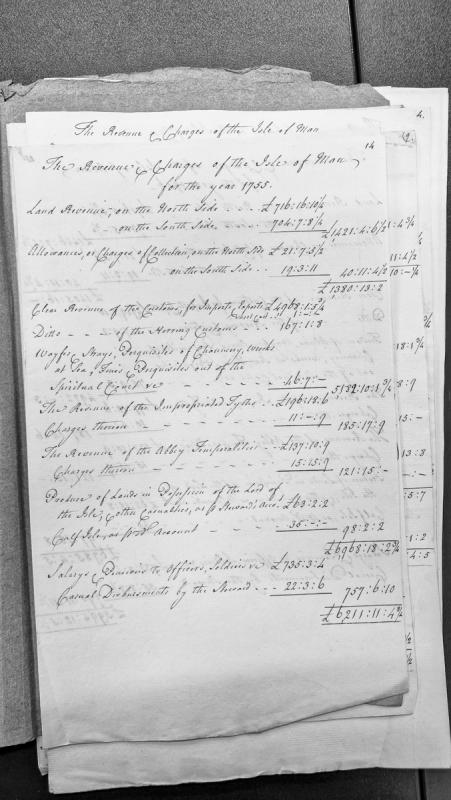
A detailed financial statement detailing the Isle of Man's revenue sources for 1755, including land revenue, customs duties, ecclesiastical revenues, and various other income streams. The document calculates total revenues and deducts salaries, pensions, and disbursements to arrive at net revenue figures.
A comprehensive monograph examining how British politicians responded to the East India Company's unexpected acquisition of territory and wealth in Bengal during the 1760s. The work explores the imperial crisis parallel to American colonial tensions, focusing on revenue collection, administrative reform, and the 1773 Regulating Act of Lord North. Essential contextual background for understanding the East India Company's role in Westminster politics during the Revestment period.
John Wetherall, a revenue officer, reports to the Chief of Commissioners and Governors of Irish Revenue on smuggled goods identified as originating from the Isle of Man. The report details classification methods for recognizing Manx contraband (tea in small casks, tobacco in trusses, spirits in ankers) and lists goods seized and sold, including tea, tobacco, brandy, geneva, rum, and foreign textiles. The letter reflects ongoing customs enforcement concerns during the period leading up to the 1765 Revestment.
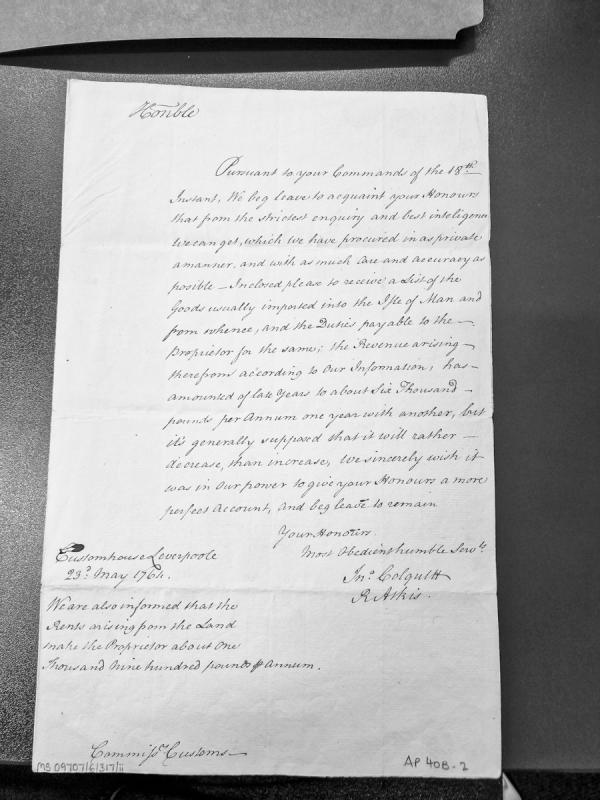
A letter from the Customhouse at Liverpool responding to commands dated 18th instant, providing information on goods imported to the Isle of Man, their origins, duties payable to the Proprietor, and revenue estimates. The report indicates annual revenue of approximately £6,000 and land rents of approximately £1,900 per annum.
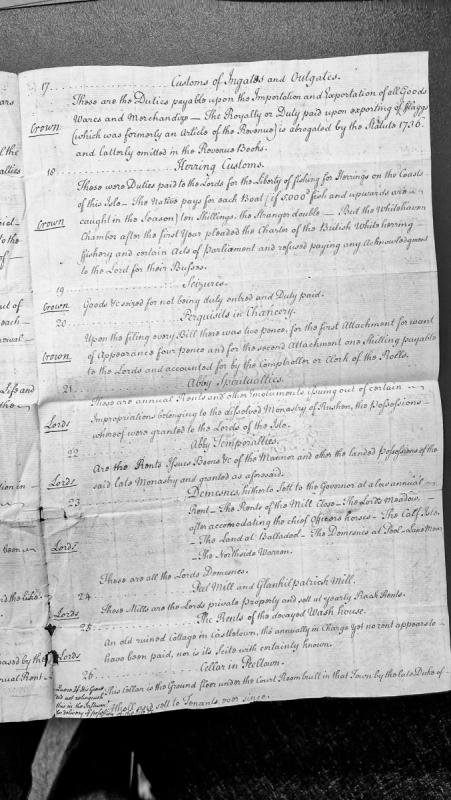
A detailed enumeration of revenue sources payable to the Lords of the Isle of Man, covering customs duties on imports/exports, herring fishing licenses, court fees, ecclesiastical rents from dissolved Rushen Monastery, and demesne lands. The document provides historical context on statutory changes and property management practices.
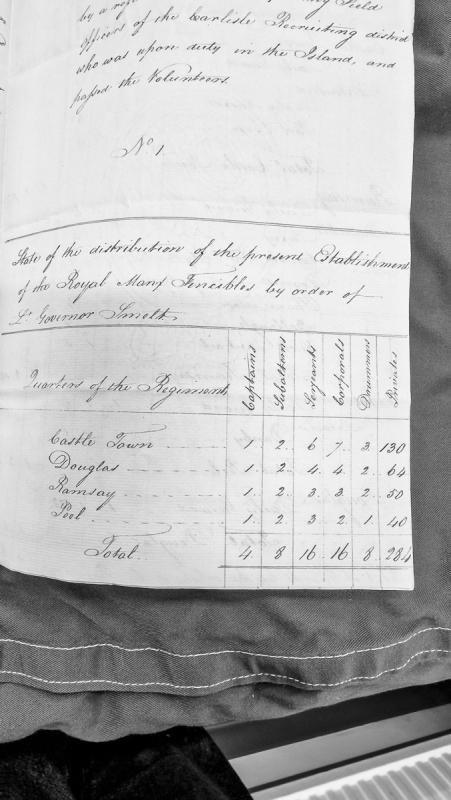
A tabulated revenue abstract showing financial data across four Manx towns (Castle Town, Douglas, Ramsay, and Peel) with columns of numerical values and totals. The document appears to be part of administrative or fiscal records tracking revenue distribution or assessments.
The Reverend James Wilks (1719-1777) was a Manx clergyman who served as Vicar of German, Vicar of Michael, Rector of Ballaugh, and vicar-general. He was closely connected with both Bishop Wilson and Bishop Hildesley, and played a significant part in the translation and revision of the Manx Bible, translating the Book of Joshua and the Epistles. He was also the father of Colonel Mark Wilks.
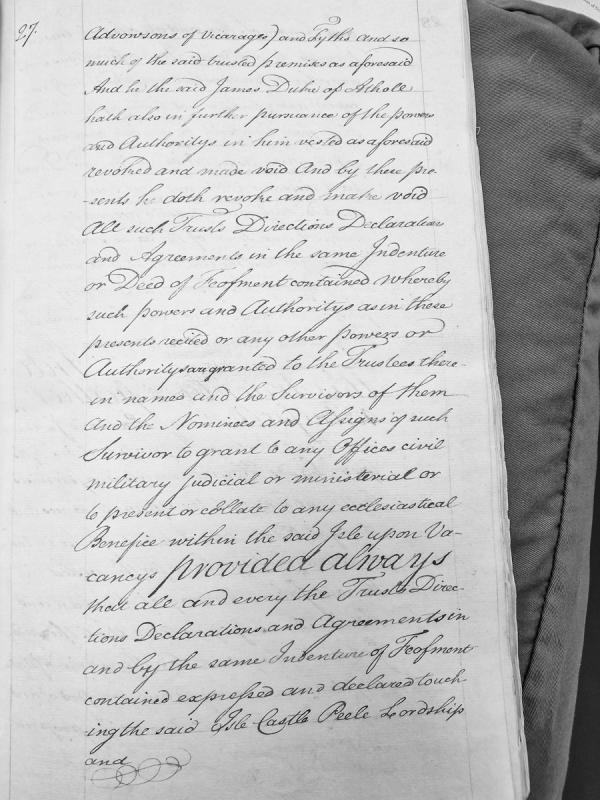
A legal document recording the Duke of Atholl's revocation of trusts, directions, declarations and agreements contained in a prior Indenture of Feofment. The revocation concerns powers to grant offices (civil, military, judicial, ministerial) and to present or collate to ecclesiastical benefices within the Isle of Man, with certain provisions preserved regarding Castle Peel lordship.
A mound of uncertain purpose which was excavated by Larch Garrad. Cowley gathered flints on 'Rheast Bwee' which included over 130 flints flakes and scrapers, as well as 5 Bronze Age pottery sherds from the area. Several quartz mounds or cairns were noted here during forestry operations in 1986-87.
The site of an early medieval keeill or chapel. The site has long since been ploughed out. It is situated on the Ard at a point 40 metres north of the road and 35 metres east of the field hedge, being a little to the south of Cashtal yn Ard. The field is still called 'Bwoaillee Caballagh' - Chapel Fold and is numbered as Plot 1912 on the 1870 1:2500 scale Ordnance Survey map.
A water-worn, broken slab with a possible 'Tau' cross incised upon it has been found at Rhendoo and is now kept at the Manx Museum. The stone has not since been included in the Manx Cross series. A six-figure grid reference was provided which places the discovery close to several others which are not of similar date if this is a Christian memorial or monument. No early medieval ecclesiastical or religious site is known in the vicinity.
The findspot of a Mesolithic flint scatter. The finds included pieces of Heavy-blade type worked flint, flakes, blades and an irregular, tanged 'missile head'.