An excavation undertaken by Dr Larch S. Garrad on 30 January 1985 revealed a shallow ditch, post holes, a hearth stone as well as iron slag scattered over a 20 metre area.
Flint and utilised stone were also recovered from the same field.
The findspot of a scatter of Mesolithic flint flakes and waste. They were collected when a hedge was removed which divided the fields numbered as Plots 767 and 785 on the 1870 1:2500 scale Ordnance Survey map. Some were found close to the site excavated by Dr Larch S. Garrad in 1985 (see PRN 1427.00). The site was visited by Mr Alan Skillan.
A quantity of prehistoric worked flint, coarse stone and midden material was found at Rhenwyllan in 1900. The material included later Mesolithic and Neolithic worked flints, together with coarse stone implements of quartz and slate, marine mollusc shells and bone.
The original finds were discovered by Mr F. Swinnerton and included flint arrowheads, flakes and scrapers. The precise location of Swinnerton's find is not known but is thought to be along the coastal perimeter of Ordnance Survey Field no. 1635, which is centred at the grid reference provided.
More recent investigation of the area in the 1970s produced a few microliths, eight tanged and butt-trimmed flakes, eight scrapers, a flake awl of Ronaldsway type and a plano-convex knife.
A quantity of prehistoric worked flint, coarse stone and midden material was found at Rhenwyllan in 1900. The material included later Mesolithic worked flints, together with coarse stone implements of quartz and slate, marine mollusc shells and bone.
The original finds were discovered by Mr F. Swinnerton and included flint arrowheads, flakes and scrapers. The precise location of Swinnerton's find is not known but is thought to be along the coastal perimeter of Ordnance Survey Field no. 1635, which is centred at the grid reference provided.
More recent investigation of the area in the 1970s produced a few microliths and eight tanged and butt-trimmed flakes.
A quantity of prehistoric worked flint, coarse stone and midden material was found at Rhenwyllan in 1900. The material included Neolithic worked flints, together with coarse stone implements of quartz and slate, marine mollusc shells and bone.
The original finds were discovered by Mr F. Swinnerton and included flint arrowheads, flakes and scrapers. The precise location of Swinnerton's find is not known but is thought to be along the coastal perimeter of Ordnance Survey Field no. 1635, which is centred at the grid reference provided.
More recent investigation of the area in the 1970s produced eight scrapers, a flake awl of Ronaldsway type and a plano-convex knife.
Modern watermill.
A substantial watermill, built of local limestone, now converted into flats over five floors.
Documentary evidence from the early 16th century clearly points to there having been a mill on the site prior to this date.
The present mill structure was originally built as a cornmill.
Waterpower was provided from a dam lying to the west, now filled in, and the wheel was located on the north wall of the building; the masonry still bears scars where the wheel rubbed against the stonework.
Modern watermill.
A substantial watermill, built of local limestone, now converted into flats over five floors.
Documentary evidence from the early 16th century clearly points to there having been a mill on the site prior to this date.
The present mill structure was originally built as a cornmill, but was later used for woollen weaving.
Waterpower was provided from a dam lying to the west, now filled in, and the wheel was located on the north wall of the building; the masonry still bears scars where the wheel rubbed against the stonework.
Modern watermill.
A substantial watermill, built of local limestone, now converted into flats over five floors.
Documentary evidence from the early 16th century clearly points to there having been a mill on the site prior to this date.
The present mill structure was latterly used for woollen weaving.
Waterpower was provided from a dam lying to the west, now filled in, and the wheel was located on the north wall of the building; the masonry still bears scars where the wheel rubbed against the stonework.
Modern mill dam.
A mill has existed at Rhenwyllan since at least the beginning of the 16th century. The modern watermill is a substantial structure built of local limestone, and now converted into flats over five floors.
Waterpower was provided from a dam lying to the west. This is now filled in, and the site is occupied by two modern dwellings.
The site of a medieval burial ground including lintel graves has been recorded at Rhullick y Doonee. Three lintel-graves, side by side, were discovered circa 1901 near Barrule Farm 'just above the cultivated land, and by the side of the old road leading to Castletown'. These were regarded as being part of the burial ground of a keeill. Kermode referred to the burial ground in 1930 and used the name 'Rullic y Doonee' which he stated proclaimed the site of a church of early date. No mention of the source of the name is given and it is not now locally remembered.
The exact location of the finds was marked on a working copy of the OS 6 inch by W. Cubbon (In Manx Museum) at SC 27687732. It was visited by J.R. Bruce in 1965-66 who observed that the area was covered with rough hummocky mountain pasture, intersected by numerous small drainage-channels, with a general slope down to the east. The land features were not those typically associated with a keeill-site, but the name 'Doonee' raised the presumption that a keeill was nearby. The lintel-graves were 'lost' and no other recognisable remains marked the site; the adjacent hedge bank was full of slabs which might well have served in lintel graves.
The site of a medieval burial ground including lintel graves has been recorded at Rhullick y Doonee. Three lintel-graves, side by side, were discovered circa 1901 near Barrule Farm 'just above the cultivated land, and by the side of the old road leading to Castletown'. These were regarded as being part of the burial ground of a keeill. Kermode referred to the burial ground in 1930 and used the name 'Rullic y Doonee' which he stated proclaimed the site of a church of early date. No mention of the source of the name is given and it is not now locally remembered.
The exact location of the finds was marked on a working copy of the OS 6 inch by W. Cubbon (In Manx Museum) at SC 27687732. It was visited by J.R. Bruce in 1965-66 who observed that the area was covered with rough hummocky mountain pasture, intersected by numerous small drainage-channels, with a general slope down to the east. The land features were not those typically associated with a keeill-site, but the name 'Doonee' raised the presumption that a keeill was nearby. The lintel-graves were 'lost' and no other recognisable remains marked the site; the adjacent hedge bank was full of slabs which might well have served in lintel graves.
The reported site of a burial cist of unknown date. It may be of prehistoric or early medieval date, perhaps a stray grave from an early Christian lintel-grave cemetery. The location is marked on the 1870 1:2500 scale Ordnance Survey map.
Richard Betham served as Collector of Customs at Douglas on the Isle of Man. His daughter Elizabeth, born in Glasgow, grew up among sailors and assembled a collection of shells brought by seafarers from their voyages. Elizabeth married William Bligh, the future captain of HMS Bounty, at the parish church at Onchan on 4 February 1781.
Richard Christian is recorded in Virginia colonial records with a headright in 1643, indicating his arrival in the colony. He was a member of the Christian family of Manx origin, forming part of the earliest wave of Manx emigration to colonial Virginia.
Richard Halsall served as a constable on the Isle of Man. In 1659, he was ordered by Governor James Chaloner to assist with the sequestration of William Christian's estates, seizing cattle, corn, grass, and tithes following Christian's departure from the Island.
Richard III (1452-1485) was the last Plantagenet King of England, reigning from 1483 until his death at the Battle of Bosworth in 1485. His defeat at Bosworth was partly due to the intervention of Thomas Stanley and his brother Sir William Stanley, who switched sides during the battle. The Stanley family's reward was the confirmation and enhancement of their position as Lords of Mann.
Richard Tyldesley was connected to the events of the English Civil War and its impact on the Isle of Man. The Tyldesley family were prominent Lancashire Royalists with links to the Stanley Earls of Derby.
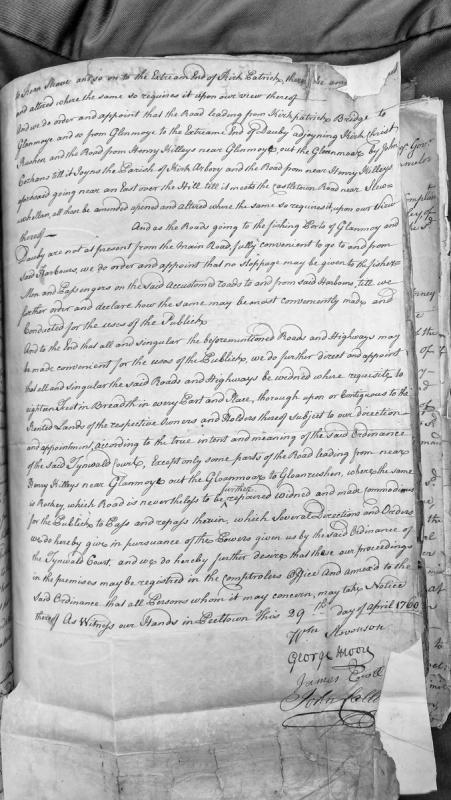
Official order from Tynwald Court officials directing the widening, opening, and repair of various roads in the Kirk Patrick and surrounding parishes to eighteen feet in breadth. The document specifies roads to fishing ports at Glanmoye and Dauby, and ensures no stoppage is given to fishermen and passengers until further notice.
Robert Christian of Cedar Grove was a member of the Christian family of Manx origin who settled in Virginia. The Cedar Grove plantation was established by the Christian family in the American colonies, representing the continued prominence of Manx emigrant families in colonial Virginia.