Letter from the Duke of Grafton (Secretary of State) to the Lords Commissioners of the Treasury reporting His Majesty's approval of barracks plans for the Isle of Man, drawn by Engineer Captain Dawson. The King approved the plans except for the removal of stables, as cavalry were being withdrawn from the island. The letter confirms post-Revestment military fortification of the island.
A royal letter patent from Queen Elizabeth I granting assent to the nomination of John Mericke (M.A.) as Bishop of the Isle of Man, following the death of Bishop John Salesbery. The document affirms the Earl of Derby's hereditary right of patronage over the Manx bishopric and directs the Archbishop of York to confirm, consecrate, and invest Mericke. It demonstrates the overlapping jurisdiction of the Crown, the Earl of Derby, and the Church over Man's ecclesiastical affairs.
A dual-language (English and Latin) royal warrant from King Charles I granting assent to the nomination of Richard Parre as Bishop of Man and Sodor. The document confirms the Earl of Derby's patronage rights over the bishopric (granted by Parliament in James I's reign) and directs the Archbishop of York to consecrate and invest Parre. Relevant to understanding Manx ecclesiastical governance and the Crown's relationship with the Island during the Stuart period.
A dual-language (English and Latin) royal writ granting Charles I's assent to the nomination of Richard Parre as Bishop of Man and Sodor. The document records the patronage chain from Parliament through William, Earl of Derby, and directs the Archbishop of York to consecrate and invest Parre. It illustrates the constitutional relationship between the Crown, the Derby family's lordship of Man, and ecclesiastical authority during the 1630s.
A royal letter patent issued by Queen Elizabeth I granting royal assent to the Earl of Derby's nomination of John Mericke as Bishop of the Isle of Man, following the death of the previous bishop John Salesbery. The document affirms the Earl of Derby's hereditary right of patronage over the Manx bishopric and directs ecclesiastical authorities to consecrate and invest the nominee. Presented in both English and Latin (Foedera) versions.
A royal writ issued by Queen Elizabeth I confirming the Earl of Derby's right of patronage over the bishopric of the Isle of Man and granting royal assent to the presentation of John Mericke (M.A.) as bishop. The document establishes that the Earl of Derby's right of nomination and presentation to the bishopric is confirmed by royal authority and reaffirms the Queen's supreme jurisdiction over the island in both ecclesiastical and secular matters.
A formal letter patent from Queen Elizabeth I granting royal assent to the Earl of Derby's presentation of John Mericke (Master of Arts) as Bishop of the Isle of Man. The document affirms the Earl of Derby's hereditary right of patronage and nomination to the bishopric, and commands the Archbishop of Canterbury to confirm, consecrate, and invest Mericke. This source illustrates the Crown's ecclesiastical supremacy over the Isle of Man and the Earl of Derby's feudal rights over the island during the Tudor period.
Modern watermill.
The Ordnance Survey 1:2500 First Edition mapping of 1867 depicts a water mill at this location, annotated as 'T. Mill'.
The mill has been demolished and the site redeveloped for residential purposes.
Modern mill leat.
The Ordnance Survey 1:2500 First Edition mapping of 1867 depicts a water mill at this location, annotated as 'T. Mill'.
A leat led water 370m from a millpond at the Chasa to the mill. The upper end of the leat is still visible for a stretch of about 80m north of Church Road, but to the south it is culverted below ground.
The grid reference marks the midpoint of the course of the leat, for indicative purposes.
Modern millpond.
The Ordnance Survey 1:2500 First Edition mapping of 1867 depicts a water mill at this location, annotated as 'T. Mill'.
The millpond for the Howstrake mill lay in an area of wetland to the north of the parish vicarage. It was originally quite extensive, covering almost 1 acre, but has now been landscaped as part of a residential development and is considerably reduced in size.
The grid reference marks the former centre of the pond, for indicative purposes.
Marble sculpture of a serviceman displayed within a wall-mounted glass cabinet. Dedicated in 1920 to all those who gave their lives in the First World War, in care of the Gurney family . Previously taken to garden parties and fetes to raise funds for full-size marble memorial for New Bradwell Cemetary in Buckinghamshire. Designed by W.A.W. Gurney. Donated by the family to Castletown branch of the Royal British Legion in 2003.
Roll of Honour in book form. First World War, names listed alphabetically. Second World War, names listed alphabetically. Book designed by Marjorie Knapton. Constructed from calf leather, with gold blocking worked by Cathy Roberts of Delta Design, London. Calligraphy on Fabriano cotton paper in red and black inks with gold leaf, written by Satwinder Sehmi of Alphabet Soup, London. Presented to the Royal British Legion and the people of Castletown by the Knapton family. Display cabinet made by Colin Craine of Castletown.
First and Second World War. This small area in St Columba's churchyard is a double grave size bounded by a kerb. The area is sown with grass and on days such as Remembrance Day the congregation can come out of church and plant their crosses into the lawn. There is a plaque set into the ground on stone tablet, erected by the Royal British Legion Colby Branch.
Roll of Honour compiled by the British Legion, Onchan Branch, and executed by J.N.H. Kelly (vice chairman) in 1939. It is believed that the Roll is of those who served in the armed forces.There are six columns, totaling 176 names, mostly alphabetical. The warden at St Peter Church advises that the memorial has been de-consecrated, as it was not a comprehensive memorial in terms of those killed during the wars and contained names of those who served but did not die during service. It has been returned to the Onchan RBL for long-term retention. First World War.
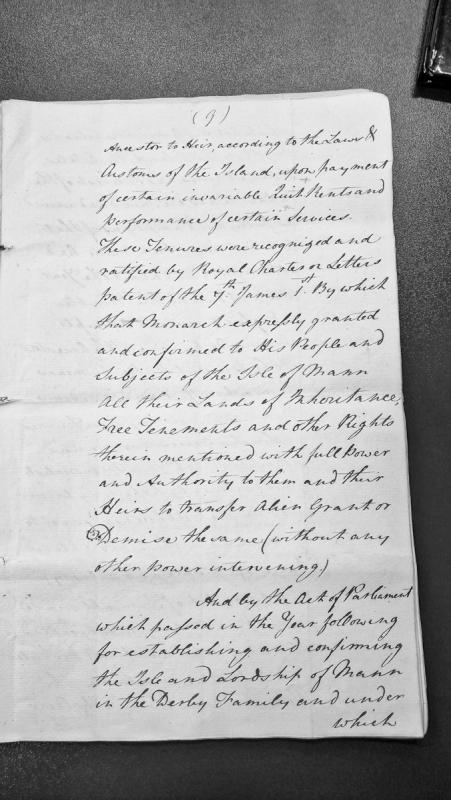
A legal document discussing the historical basis of land tenure in the Isle of Man, referencing a Royal Charter or Letters Patent from James I confirming ancestral inheritance rights, quit rents, and services. It also mentions a subsequent Act of Parliament establishing the Isle and Lordship of Mann in the Derby Family.
A 1610 royal charter (issued under James I) granting Manx subjects and residents the right to transfer, alienate, and demise lands, tenements, and chattels within the Isle of Man by sealed deed, without the ceremonies required in England. Notably permits married women to alienate property with their husband's consent and acknowledgment before the Court of Chancery. Preserves existing Manx property law customs alongside these new concessions.
A Latin charter (De Conciliis et Subditis de Insula Mann) issued by King James I granting property rights and alienation privileges to all subjects and persons residing in or possessing lands in the Isle of Mann. It permits free transfer of lands, tenements, and chattels by sealed deed without additional formalities, and extends these rights to married women with spousal consent and acknowledgment in English Chancery. This document establishes the constitutional and legal framework for property ownership on the Isle, predating the 1765 Revestment and illustrating the Crown's prerogative claims to regulate the island's laws.
A royal charter issued by Edward II protecting Manx men from injury or hindrance when travelling to England and returning home, valid until Christmas 1312. The document is bilingual (English and Latin) and demonstrates early royal recognition of the Isle of Man's distinct status and the Crown's commitment to protect Manx trading interests. Relevant to understanding constitutional protections and early cross-channel commerce.
A bilingual (Latin and English) royal charter issued by Edward II protecting the inhabitants of the Isle of Man from harassment and damage when travelling to or from the island. The document grants safe passage and royal favour to Manx people in recognition of their loyalty and adherence to the English Crown. This early 14th-century charter establishes royal protection of Manx interests and demonstrates the island's feudal relationship with the English monarchy.
A bilingual (Latin and English) royal charter from King Henry III granting King Olave of Mann an annual stipend of forty marks, one hundred crannocks of corn, and five doles of wine in return for guarding the coasts of Ireland and England adjacent to the Isle of Mann. This document demonstrates early medieval recognition of Mann's strategic maritime position and the Crown's reliance on the King of Mann for naval defence.
A charter from Henry III confirming King Olave of Mann and the Islands as guardian of the coasts between England, Ireland, and the Isle of Mann in exchange for annual payment of forty marks, one hundred crannocks of corn, and five doles of wine. The document establishes the King of Mann's early feudal relationship with the English Crown and his strategic role in coastal defence and maritime control.
A royal writ from King John of England commanding his seneschals, governors, and bailiffs in Ireland to assist Reginald, King of Mann, against the Wikini (Norwegian sea rovers) and other enemies. This document illustrates early medieval relations between the English Crown and the Kings of Mann, and the strategic importance of Mann in controlling Irish Sea trade and defence. It is relevant to understanding Mann's constitutional and feudal relationship with England prior to the 1765 Revestment.
A royal writ from King John of England commanding his Irish officials to assist Reginald, King of Mann, against Viking (Wikini) attackers in his territory. The document emphasises Reginald's feudal bond to the English Crown and reciprocal defensive obligations. Provides early 13th-century context for Mann's relationship with the English Crown and Viking threats to the island.