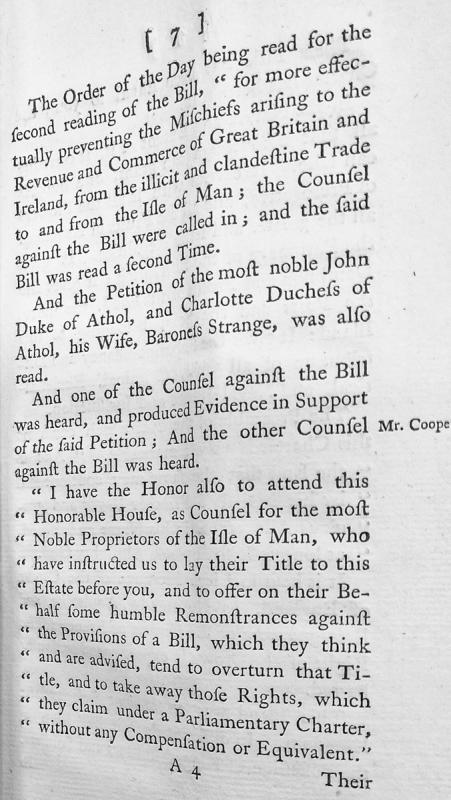
Parliamentary record of the second reading of a Bill concerning illicit trade affecting the Revenue and Commerce of Great Britain and Ireland in relation to the Isle of Man. A petition from John Duke of Athol and Charlotte Duchess of Athol is read, with counsel presenting arguments and evidence regarding the proprietors' title and rights under a Parliamentary Charter.
The Sefton Hotel is a five storey structure consisting of cement rendered masonry wall and a slate roof, and is part of a continuous terrace of buildings facing Douglas Bay. The rear of the premises, as is traditional in such sitings, can best be described as rudimentarily Spartan being a functional layout of light wells and fire escapes. The front facade however has a carefully articulated treatment with numerous large windows and a series of bays. The three entrances at the ground floor are subordinate to the main expression although the central axis of the building is marked by a triangular gable at roof level announcing the name 'Sefton the facade running through floors three to five respectively as opposed to the central four bays which extend from the ground to the third floor in all cases. The window heads at the second floor are all rectangular whereas all others are of a semi-circular design. The general character of the facade could perhaps be described as 'playful' in to Victorian sense. Decorative motifs abound and turrets and windows perforate the eaves in a 'lattice effect The building is a rather charming example of a larger hotel in the style of an iced birthday cake characteristic of the entire promenade development of that period.
Medieval coinhoard.
A hoard of medieval coins was found in 1846 at a site in Seneschal Lane, Douglas.
The hoard was described as containing 'many' coins, but only eight surviving today are known with a firm degree of certainty to have come from the same findspot.
M Dolley & AM Cubbon (1970) reconstructed the circumstances surrounding the discovery of the coins and the subsequent diffusion, loss and reassembly of a portion of the hoard in the Manx National Heritage collections.
The coins were found by workmen demolishing an old cottage, and a quantity were bought by the owner. A number were subsequently secured by Mr J Wallace for his museum in Distington, of which four survived a robbery to be acquired the Manx Museum. A further four coins were later donated by descendants of the family whose actions in clearing the site in 1846 had occasioned the original discovery. The replacement building was itself demolished in the 1930s as part of demolitions which completely cleared much of the surrounding area.
During the demolition process an additional coin was found 'near the market place' in 1934. Dolley and Cubbon rejected this as coming from the hoard; its findspot may, however, be no more than 30m from the main hoard site based on the description recorded, and given the disturbance associated with the demolition work, it is not impossible that it was originally part of the hoard.
All of the coins from the reconstructed hoard are gold: two nobles and six angels. The Market Place coin is also an angel.
Medieval coinhoard.
A hoard of medieval coins was found in 1846 at a site in Seneschal Lane, Douglas.
The hoard was described as containing 'many' coins, but only eight surviving today are known with a firm degree of certainty to have come from the some findspot.
M Dolley & AM Cubbon (1970) reconstructed the circumstances surrounding the discovery of the coins and the subsequent diffusion, loss and reassembly of a portion of the hoard in the Manx National Heritage collections.
The coins were found by workmen demolishing an old cottage, and a quantity were bought by the owner. A number were subsequently secured by Mr J Wallace for his museum in Distington, of which four survived a robbery to be acquired the Manx Museum. A further four coins were later donated by descendants of the family whose actions in clearing the site in 1846 had occasioned the original discovery. The replacement building was itself demolished in the 1930s as part of demolitions which completely cleared much of the surrounding area.
During the demolition process an additional coin was found 'near the market place' in 1934. Dolley and Cubbon rejected this as coming from the hoard; its findspot may, however, be no more than 30m from the main hoard site based on the description recorded, and given the disturbance associated with the demolition work, it is not impossible that it was originally part of the hoard.
All of the coins from the reconstructed hoard are gold: two nobles and six angels. The Market Place coin is also an angel.
From the Wallace collection: Gold noble of Edward IV, dated to 1465, accession no. 1954-1610 Gold angel Edward IV, dated to after 1471, accession no. 1954-1611 Gold angel Henry VII, dated to 1495-1498, accession no. 1954-1612 Gold angel Henry VII, dated to 1505-1509, accession no. 1954-1613
Medieval coinhoard.
A hoard of medieval coins was found in 1846 at a site in Seneschal Lane, Douglas.
The hoard was described as containing 'many' coins, but only eight surviving today are known with a firm degree of certainty to have come from the some findspot.
M Dolley & AM Cubbon (1970) reconstructed the circumstances surrounding the discovery of the coins and the subsequent diffusion, loss and reassembly of a portion of the hoard in the Manx National Heritage collections.
The coins were found by workmen demolishing an old cottage, and a quantity were bought by the owner. A number were subsequently secured by Mr J Wallace for his museum in Distington, of which four survived a robbery to be acquired the Manx Museum. A further four coins were later donated by descendants of the family whose actions in clearing the site in 1846 had occasioned the original discovery. The replacement building was itself demolished in the 1930s as part of demolitions which completely cleared much of the surrounding area.
During the demolition process an additional coin was found 'near the market place' in 1934. Dolley and Cubbon rejected this as coming from the hoard; its findspot may, however, be no more than 30m from the main hoard site based on the description recorded, and given the disturbance associated with the demolition work, it is not impossible that it was originally part of the hoard.
All of the coins from the reconstructed hoard are gold: two nobles and six angels. The Market Place coin is also an angel.
From the Kaye collection: Gold angel of Henry VII dated to 1505-1509, accession no. 1954-6647 Gold angel of Henry VII dated to 1504-1505, accession no. 1954-6648 Gold noble of Edward IV dated to 1465, accession no.1954-6649
Medieval coinhoard.
A hoard of medieval coins was found in 1846 at a site in Seneschal Lane, Douglas. The hoard was described as containing 'many' coins, but only eight surviving today are known with a firm degree of certainty to have come from the some findspot.
M Dolley & AM Cubbon (1970) reconstructed the circumstances surrounding the discovery of the coins and the subsequent diffusion, loss and reassembly of a portion of the hoard in the Manx National Heritage collections.
The coins were found by workmen demolishing an old cottage, and a quantity were bought by the owner. A number were subsequently secured by Mr J Wallace for his museum in Distington, of which four survived a robbery to be acquired the Manx Museum. A further four coins were later donated by descendants of the family whose actions in clearing the site in 1846 had occasioned the original discovery. The replacement building was itself demolished in the 1930s as part of demolitions which completely cleared much of the surrounding area.
During the demolition process an additional coin was found 'near the market place' in 1934. Dolley and Cubbon rejected this as coming from the hoard; its findspot may, however, be no more than 30m from the main hoard site based on the description recorded, and given the disturbance associated with the demolition work, it is not impossible that it was originally part of the hoard.
All of the coins from the reconstructed hoard are gold: two nobles and six angels. The Market Place coin is also an angel.
From the McWilliam collection: Gold angel of Henry VII, dated to 1505-1509, accession no. 1970-0089.
Medieval coinhoard.
A hoard of medieval coins was found in 1846 at a site in Seneschal Lane, Douglas.
The hoard was described as containing 'many' coins, but only eight surviving today are known with a firm degree of certainty to have come from the some findspot.
M Dolley & AM Cubbon (1970) reconstructed the circumstances surrounding the discovery of the coins and the subsequent diffusion, loss and reassembly of a portion of the hoard in the Manx National Heritage collections.
The coins were found by workmen demolishing an old cottage, and a quantity were bought by the owner. A number were subsequently secured by Mr J Wallace for his museum in Distington, of which four survived a robbery to be acquired the Manx Museum. A further four coins were later donated by descendants of the family whose actions in clearing the site in 1846 had occasioned the original discovery. The replacement building was itself demolished in the 1930s as part of demolitions which completely cleared much of the surrounding area.
During the demolition process an additional coin was found 'near the market place' in 1934. Dolley and Cubbon rejected this as coming from the hoard; its findspot may, however, be no more than 30m from the main hoard site based on the description recorded, and given the disturbance associated with the demolition work, it is not impossible that it was originally part of the hoard.
All of the coins from the reconstructed hoard are gold: two nobles and six angels. The Market Place coin is also an angel.
Gold angel of Richard III, dated to 1483-5, found near Market Place, Douglas, when house was being demolished, July 1934, accession no. 1954-3407
Extract from Rotuli Parliamentorum recording the conditional pardon and banishment of the Earl of Warwick to the Isle of Man for life by King Richard II in 1398. The document details the terms of imprisonment, guardianship arrangements with Sir William le Scrop and his brother, and conditions for revocation of the pardon. Provided in both English and Anglo-Norman French.
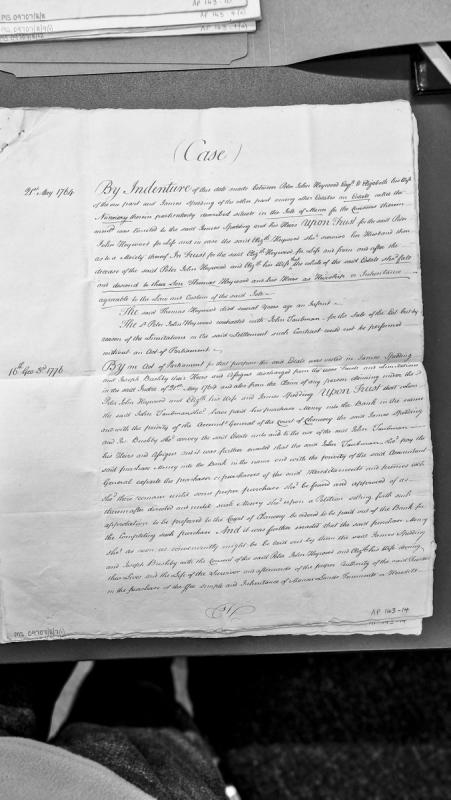
This document describes a complex property settlement involving the Nunnery estate in the Isle of Man. It outlines an original indenture of 1764 between Peter John Heywood and James Spedding, followed by Parliamentary legislation in 1776 (16 Geo 3) that vested the estate in trustees to facilitate its sale to John Taubman, with provisions for reinvestment of the purchase money in other properties.
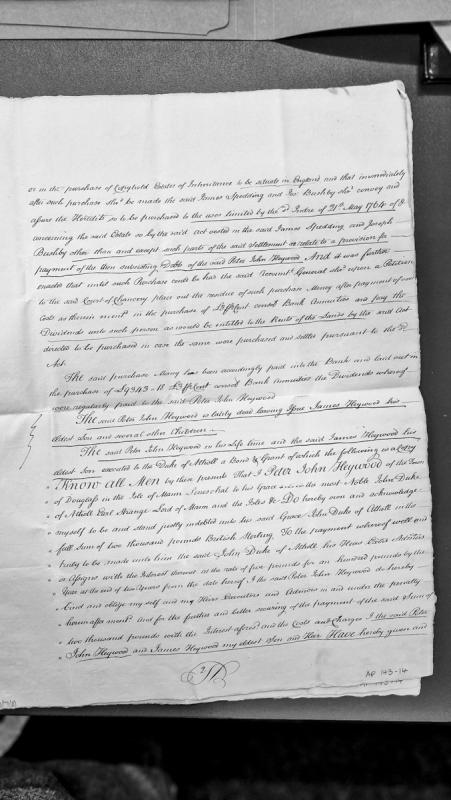
A legal document concerning the settlement of Peter John Heywood's estate, referencing an Indenture of 21 May 1764 and describing the purchase of £9343.18 in consolidated Bank Annuities. The document includes a copy of a bond executed by Peter John Heywood and his eldest son James Heywood to the Duke of Atholl for £2000 with 5% annual interest.
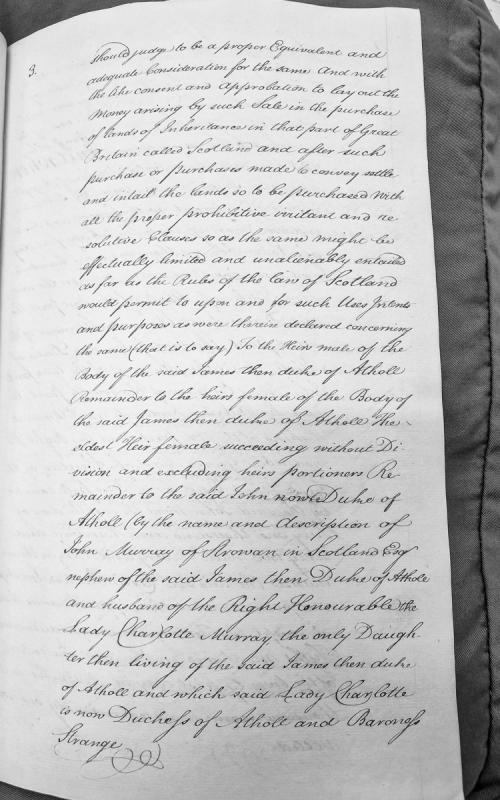
A legal document concerning the settlement and entailment of lands in Scotland purchased from the sale of other property. The document outlines the terms of entailment to the heirs male and female of James, Duke of Atholl, with remainder to John Murray of Strowan (later Duke of Atholl) and his wife Lady Charlotte Murray (now Duchess of Atholl).
The site of a Bronze Age cairn, which survives as a heather-covered mound measuring 5.0 metres in diameter and 0.8 metres high, with a few small stones exposed on the surface.
The site of a post-medieval lead mine. It is shown on the valley floor of a tributary stream of the Sulby River on the 1870 1:2500 scale Ordnance Survey map.
Letter from Alexander Shaw, Lieutenant Governor of the Isle of Man, to Evan Nepean (Under Secretary of State) requesting copies of gubernatorial instructions and correspondence records. Shaw reports that previous Governor Smith's letter book, Royal Instructions accompanying the governorship, and instructions given to Governor Wood in 1765 (upon vesting the Isle in the Crown) cannot be located. He also notes that his predecessor Lieut Governor Dawson left only statute books and largely worthless papers. This letter is crucial for understanding post-Revestment administrative continuity and the state of governance records in the 1790s.
The findspot of an artefact scatter which included a water-worn hammer-shaped stone (possibly natural), a large flint blade 53 millimetres long, and a further 6 flint blades, all collected along the shore and from eroding cliffs.
Stone-built rectilinear sheepfold, 10 by 5.5m. The fold is formed where an old curvilinear 'sod hedge' is crossed by a more recent stone wall which runs east-west and separates improved grassland within Shenvalley Farm (now known as Sound Farm) from what may in the past have been seasonal grazing or outfield: the fold lies within the latter. It may have been used for sorting stock, or alternatively provided shelter from the prevailing wind.