Modern watermill.
The Ordnance Survey 1:2500 First Edition mapping of 1868 shows an ochre works at this location.
The site was however originally developed in 1767 as a fulling mill for processing flax by John Quayle, and later owned by George Quayle of Bridge House in Castletown.
The building was converted first for grinding ochre, and later into a dwelling in 1901, and has subsequently been the subject of further extension and redevelopment.
Modern watermill and associated water management.
The Ordnance Survey 1:2500 First Edition mapping of 1868 shows an ochre works at this location.
The site was originally developed in 1767 as a fulling mill but later converted to grind 'rottenstone' to make ochre. It was subsequently redeveloped as a dwelling in 1901, and has since been the subject of further extension and alteration.
The mill was fed by a 170m leat and millpond taken off the Silver Burn. The millpond appears to have been extended upstream at some point, reducing the length of the leat by 70m. The upper part of the leat and the extended millpond are now largely silted up, but still traceable. The lower end of the leat and tailrace are now infilled, and the grounds of the dwelling are landscaped, removing most visible signs of the former industrial use.
Modern watermill.
The Ordnance Survey 1:2500 First Edition mapping of 1868 shows an ochre works at this location.
The site was originally developed in 1767 as a flax mill by John Quayle, and later owned by George Quayle of Bridge House in Castletown. Under different ownership, the mill was subsequently used for grinding 'rottenstone' to make ochre.
Sir Charles Frederick (c. 1709-1785) was Surveyor-General of the Ordnance and a member of Parliament. His connection to the Isle of Man relates to military and administrative affairs concerning the Island during the Revestment era.
Sir Fletcher Norton, 1st Baron Grantley (1716-1789), served as Attorney General and Speaker of the House of Commons. He was involved in the legal proceedings and parliamentary debates surrounding the Revestment of the Isle of Man in 1765 and the subsequent governance of the Island.
Sir James Gell was Attorney General of the Isle of Man and a leading figure in Manx legal and public life. He was connected to the prominent Gell family of the Island and played a significant role in Manx legal practice during the nineteenth century.
Sir John Cust, 3rd Baronet (1718-1770), served as Speaker of the House of Commons from 1761 to 1770. His time as Speaker coincided with the passage of the Isle of Man Purchase Act 1765 (the Revestment Act), which transferred the sovereignty of the Island from the Duke of Atholl to the British Crown.
Sir John Stanley (c. 1350-1414) was the first Stanley Lord of Mann, receiving the grant of the lordship from Henry IV in 1405. This grant established the Stanley family's rule over the Isle of Man, a dynasty of lords that would govern the Island for over 250 years and shape its political, legal and social development.
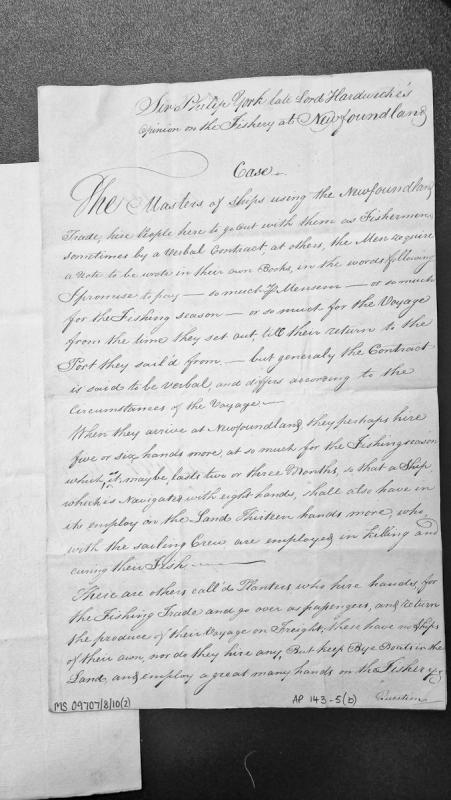
A legal opinion by Sir Philip York (late Lord Hardwicke) examining the nature of employment contracts between ship masters and fishermen engaged in the Newfoundland trade. The opinion describes various contractual arrangements, payment methods, and the distinction between crew and hired hands, as well as the role of independent planters in the fishery.
Sir Stephen le Scrope served as a deputy or agent in the administration of the Isle of Man during the le Scrope lordship. His connection relates to the period when Sir William le Scrope held the lordship of Mann before his execution in 1399.
Sir William le Scrope (c. 1351-1399) purchased the lordship of Mann from William Montacute, Earl of Salisbury, in 1392. He governed the Island through deputies until his execution in 1399, following his support for Richard II against the future Henry IV. His death led to the transfer of the lordship to the Stanley family.
Sir William Stanley (c. 1435-1495) was the brother of Thomas Stanley, 1st Earl of Derby, and played a decisive role at the Battle of Bosworth in 1485 by switching sides to support Henry Tudor. His intervention helped secure the Tudor victory and the Stanley family's continued lordship of Mann. He was later executed for treason in 1495.
A grass covered and ditchless mound with some loose small stones on top, thought to be a possible bowl barrow or burial mound. It is 16.0 metres in diameter and up to 0.4 metres high. 20.0 metres to the northeast is a large, apparently natural, mound which bears some resemblance to a barrow.
A flint scatter found at 'Goldie's Sherrisdale', the exact findspot is unknown. It includes flints of Neolithic Ronaldsway type as well as flints 'of curiously indeterminate character' which are kept together at the museum to demonstrate a localised find.
In 1884 Savage found a Bronze Age cinerary urn a little to the southwest of the now lost site of St Bartholomew's Chapel and Burial Ground, which has been lost to coastal erosion. It was found about half-way down the side of the broogh. The findspot of the urn has also been lost to erosion. The urn is now kept at the Manx Museum.
Prehistoric flint scatter.
A single worked prehistoric flint was recovered from Skerrisdale by CH Cowley.
No further details concerning the circumstances of the discovery were recorded and the grid reference relates to the farmstead for indicative purposes only.
The antiquary Charles Harry Cowley was an avid collector of worked flint and coarse stone artefacts revealed by agricultural activity, mainly on farms located around Peel, and occasionally from further afield. He was active from 1900 until 1943. His entire collection of artefacts, together with a daybook cataloguing his discoveries, was later donated to Manx National Heritage.
Prehistoric flint scatter.
A small quantity of worked prehistoric flint was recovered from Skerrisdale by CH Cowley, from 'Cain's'.
No further details concerning the discovery were recorded and the grid reference relates to the farmstead for indicative purposes only.
The antiquary Charles Harry Cowley was an avid collector of worked flint and coarse stone artefacts revealed by agricultural activity, mainly on farms located around Peel, and occasionally from further afield. He was active from 1900 until 1943. His entire collection of artefacts, together with a daybook cataloguing his discoveries, was later donated to Manx National Heritage.
Prehistoric flint scatter.
A small quantity of worked prehistoric flint was recovered from Skerrisdale by CH Cowley, from the 'Field Far Side of Glen With Railway'.
The description is confusing and the grid reference relates to the farmstead for indicative purposes only.
The antiquary Charles Harry Cowley was an avid collector of worked flint and coarse stone artefacts revealed by agricultural activity, mainly on farms located around Peel, and occasionally from further afield. He was active from 1900 until 1943. His entire collection of artefacts, together with a daybook cataloguing his discoveries, was later donated to Manx National Heritage.
Prehistoric flint scatter.
A small quantity of worked prehistoric flint was recovered from Skerrisdale by CH Cowley, from the 'Field North of Best Field'.
The description is difficult to interpret and the grid reference relates to the farmstead for indicative purposes only.
The antiquary Charles Harry Cowley was an avid collector of worked flint and coarse stone artefacts revealed by agricultural activity, mainly on farms located around Peel, and occasionally from further afield. He was active from 1900 until 1943. His entire collection of artefacts, together with a daybook cataloguing his discoveries, was later donated to Manx National Heritage.
Prehistoric flint scatter.
A small quantity of worked prehistoric flint was recovered from Skerrisdale by CH Cowley, from the 'Field nearer Sea from Goldie's Field'.
The description is difficult to interpret and the grid reference relates to the farmstead for indicative purposes only.
The antiquary Charles Harry Cowley was an avid collector of worked flint and coarse stone artefacts revealed by agricultural activity, mainly on farms located around Peel, and occasionally from further afield. He was active from 1900 until 1943. His entire collection of artefacts, together with a daybook cataloguing his discoveries, was later donated to Manx National Heritage.
Prehistoric flint scatter.
A small quantity of worked prehistoric flint was recovered from Skerrisdale by CH Cowley, from 'Goldie's fourth Field from Road Up Glencam'.
The description is difficult to interpret and the grid reference relates to the farmstead for indicative purposes only.
The antiquary Charles Harry Cowley was an avid collector of worked flint and coarse stone artefacts revealed by agricultural activity, mainly on farms located around Peel, and occasionally from further afield. He was active from 1900 until 1943. His entire collection of artefacts, together with a daybook cataloguing his discoveries, was later donated to Manx National Heritage.
Prehistoric flint scatter.
A small quantity of worked prehistoric flint was recovered from Skerrisdale by CH Cowley, from 'Goldie's Field'.
The description is difficult to interpret and the grid reference relates to the farmstead for indicative purposes only.
The antiquary Charles Harry Cowley was an avid collector of worked flint and coarse stone artefacts revealed by agricultural activity, mainly on farms located around Peel, and occasionally from further afield. He was active from 1900 until 1943. His entire collection of artefacts, together with a daybook cataloguing his discoveries, was later donated to Manx National Heritage.