This broken and worn slab was found during excavation in the chancel of the chapel (IOMHER 0732.00) in 1908. It bears an almost complete cross set within an oval frame. The arms are of unequal lengths, and two have short cross-bars. Two of the spaces between the bars contain small crosses.
A worn grave covering stone with cross within a circle incised on one face. The slab measures 76 centimetres x 40.5 centimetres x 10 centimetres and is now kept at St Trinians Church.
St. Peter's Church. The church is one of the more recent buildings in the village, and was only completed in 1878.
It served a double purpose as a schoolroom for infants, but already by the early 1890s was reportedly out of use for this function.
Prehistoric stone axehead.
A prehistoric stone axehead was recovered from Staarvey by CH Cowley, from the 'Second Field Behind House'.
The description appears to relate to OS Field no. 1389, which is centred at the grid reference provided.
The antiquary Charles Harry Cowley was an avid collector of worked flint and coarse stone artefacts revealed by agricultural activity, mainly on farms located around Peel, and occasionally from further afield. He was active from 1900 until 1943. His entire collection of artefacts, together with a daybook cataloguing his discoveries, was later donated to Manx National Heritage.
Prehistoric stone axehead.
A Neolithic stone axehead was recovered from Staarvey and given to CH Cowley.
The axehead was found in the 'Mollagh Field', which has been identified as OS Field no. 1117. This is centred at the grid reference provided.
The antiquary Charles Harry Cowley was an avid collector of worked flint and coarse stone artefacts revealed by agricultural activity, mainly on farms located around Peel, and occasionally from further afield. He was active from 1900 until 1943. His entire collection of artefacts, together with a daybook cataloguing his discoveries, was later donated to Manx National Heritage.
Prehistoric flint scatter.
A single worked prehistoric flint was recovered from a field at Staarvey by CH Cowley, who described the findspot as the 'Third Field behind House'.
This description would appear to relate to OS Field No. 1387, which is centred at the grid reference provided.
The antiquary Charles Harry Cowley was an avid collector of worked flint and coarse stone artefacts revealed by agricultural activity, mainly on farms located around Peel, and occasionally from further afield. He was active from 1900 until 1943. His entire collection of artefacts, together with a daybook cataloguing his discoveries, was later donated to Manx National Heritage.
A Bronze Age burial cist with two compartments was found in OS Field no.1385 (see the 1869 1:2500 scale OS map). The cist was excavated by Megaw in 1947.
A Bronze Age collared urn with a decorated collar, of Longworth Secondary Series, NW Style, Form I/II, and standing 44cm high, was found inverted over a cremation in one of the two compartments of the cist.
The second compartment held the remains of a second urn, mainly the lower portions and a few sherds with incised lattice pattern. The collared urn is held at the Manx Museum (Accession No 7247).
A Bronze Age burial cist with two compartments was found in OS Field no.1385 (see 1869 1:2500 scale map). The site lies at the north end of a slight summit on a ridge extending north from Staarvey through Lhergydhoo to Knocksharry, between the Switchback and Staarvey roads.
The cist was excavated by Megaw in 1947: a Bronze Age collared urn of Longworth Secondary Series, NW Style, Form I/II, standing 44cm high and with a decorated collar, was found inverted over a cremation in one of the two compartments of the cist.
The second compartment held the remains of a second urn, mainly the lower portions and a few sherds with incised lattice pattern. The collared urn is held at the Manx Museum (Accession No 7247).
Stained glass window. First World War.
The Reverend Disney Charles Woodhouse was in the Army Chaplain's Department attd. 12th Battalion Royal Sussex. He is buried in Bolougne Eastern Cemetery, Pas de Calais, France. Grave ref. VII A.5. Son of The Rev A.C. & Mrs Woodhouse of Pampisford Vicarage, Cambridge, England. Source: Commonwealth War Graves Commission.
Information courtesy of the Isle of Man Government Committee for the Preservation of War Memorials.
The Stamp Act 1765 was a British parliamentary measure imposing direct taxation on the American colonies, enacted in the same parliamentary session as the Isle of Man Purchase Act and Mischief Act. The colonial resistance it provoked drew on similar arguments about parliamentary overreach and the rights of self-governing communities, and the parallels between the Manx and American situations were noted by contemporaries.
Henry IV granted the lordship of Mann to Sir John Stanley in 1405 (lifetime grant), re-granted as inheritable on 6 April 1406. The Stanley dynasty would hold the Island for over two and a half centuries. The grant came after Percy's rebellion — the Island as political reward. The family that bet on Henry at Bosworth would later collect the earldom of Derby.
Treasury document reporting on Crown lands in the Isle of Man derived from the former Bangor and Sabal Abbey (Ireland), including messuages and a water mill at Dalby. Also documents the 1666 grant of all Mines Royal (gold and silver) to the Earl of Derby and its expiration in 1735. Includes historical leasing records from 1666 onwards and notes arrears and abandonment of the property.
Treasury document surveying Crown lands in the Isle of Man formerly belonging to Bangor and Sabal Abbey, with lease history from 1666–1770, and status of Royal Mines grant to the Earl of Derby (1666–1735). Demonstrates Crown revenue administration and property management in the post-Revestment period, relevant to understanding the financial structure and assets acquired in 1765.
Report from Lieutenant Governor Cornelius Smelt to the Home Office describing the inadequate state of the sole prison on the Isle of Man (Castle Rushen), with a supporting Memorial from the House of Keys requesting funds for prison infrastructure. Documents overcrowding, lack of segregation by sex or offence, and poor conditions. Reflects post-Revestment (1765) administrative issues and governance challenges.
Official correspondence from Lieutenant Governor Cornelius Smelt to the Home Office (referenced as Ryder) enclosing a Memorial from the House of Keys regarding conditions at Castle Rushen Prison. Documents overcrowding, lack of separation facilities, and the need for gaol facilities at Douglas, Peel, and Ramsey. Reflects post-Revestment governance challenges and the transition of state responsibilities to British authority following the 1765 purchase of sovereignty.
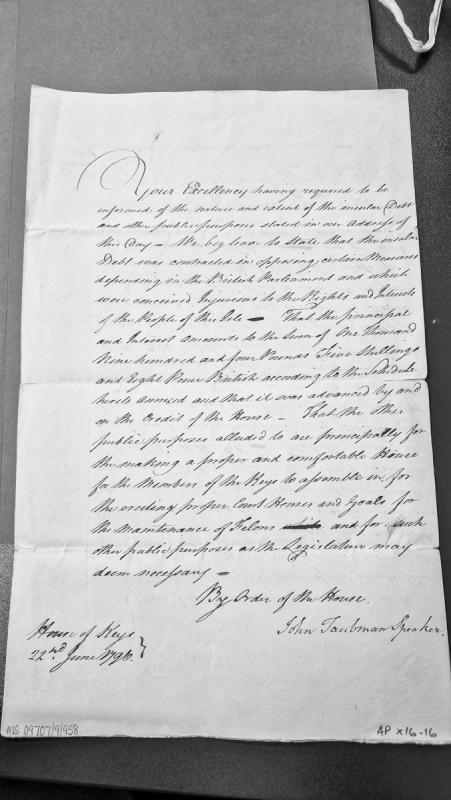
An official statement from the House of Keys to His Excellency detailing the nature and extent of the insular debt, which amounted to £1,904 5s 8d and was contracted in opposing certain measures in Parliament. The document also outlines other public purposes for which funds are needed, including a meeting house for the Keys, court houses, goals, and maintenance of felons.
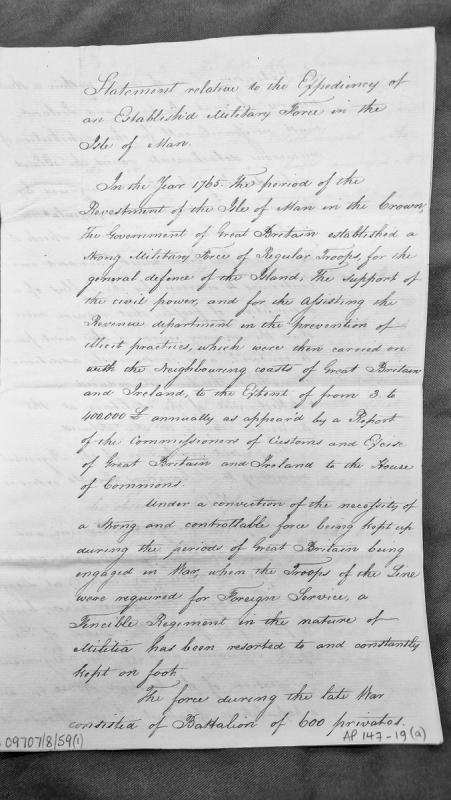
A statement justifying the establishment of a military force in the Isle of Man following the revestment of the island to the Crown in 1765. The document explains the necessity of maintaining troops for island defence, supporting civil authority, and preventing illicit trade, citing customs revenue losses of £300,000-400,000 annually.
Parliamentary statute enacted under Henry VIII annexing the Bishopric and Diocese of Man to the ecclesiastical jurisdiction of York. This is a foundational constitutional document establishing Man's religious governance within the English church hierarchy, relevant to understanding pre-Revestment institutional structures and English Crown authority over the island.
An excerpt from the Statutes of the Realm (5 Elizabeth I, 1562) permitting foreign-born merchants to import French wines into Manx ports via foreign-owned vessels, limited to 100 tonnes annually. This primary legal source demonstrates early statutory provision for trade privileges in the Isle of Man and the regulatory framework governing wine importation.
Parliamentary statute from 1542 enacting the annexation of the Bishopric and Diocese of Man to the ecclesiastical jurisdiction of York. This foundational constitutional document establishes the religious governance structure of the Isle of Man under English law and is essential context for understanding Manx institutional development prior to the 1765 Revestment.
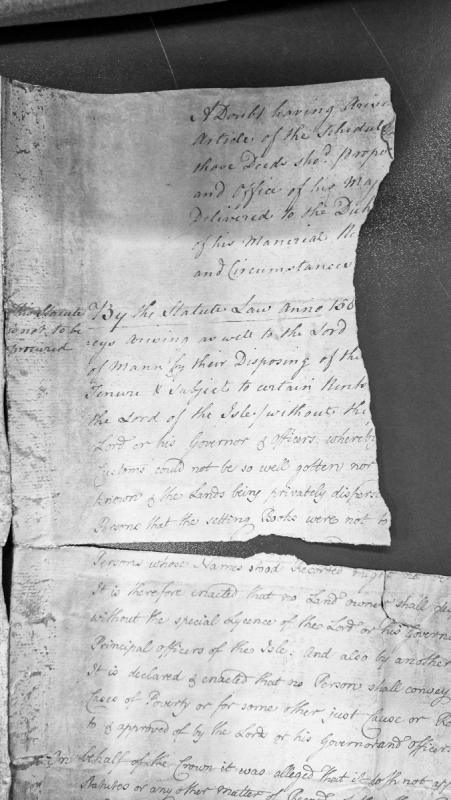
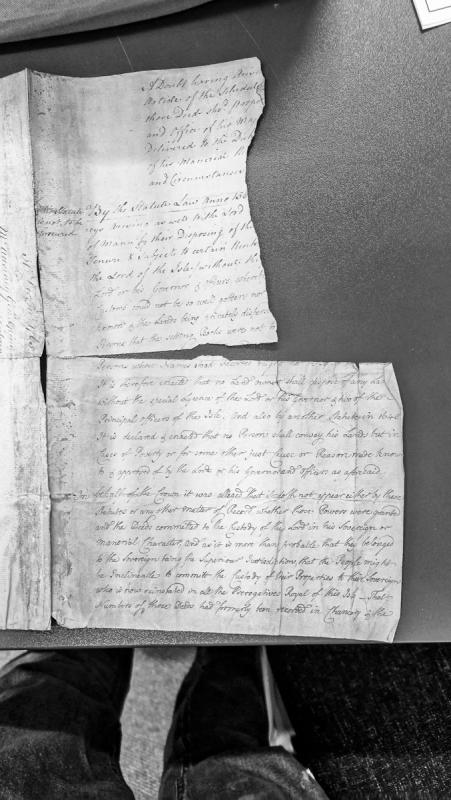
A legal document discussing Manx statutes relating to land ownership and tenure, specifically addressing the disposal of lands and the authority of the Lord of Mann and his officers. The document references statutes from anno 1580 and discusses restrictions on land conveyance without proper license from the Lord or Governor.
A legal document discussing statutes regulating land ownership and conveyance on the Isle of Man, with provisions requiring license from the Lord or Governor and principal officers. The fragment includes an argument on behalf of the Crown regarding custody of property deeds and sovereign prerogatives.