Thie ny Boandyr, Douglas Street, Castletown, is a house which was used for the Taubman Endowed School between 1799 and 1872. The building is marked on the Ordnance Survey 1:2500 large scale mapping of 1867 together with the annotation, 'School'.
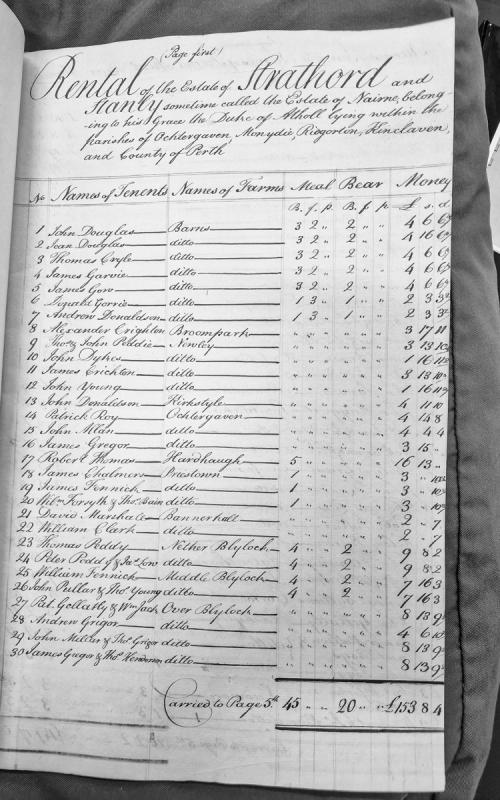
A financial ledger or revenue abstract listing 30 entries of individuals and partnerships with associated land parcels, monetary values in pounds/shillings/pence, and two columns of numerical measurements (possibly acreage or assessment values marked 'B. f. p.'). The document appears to be part of a larger tax or rent assessment roll, with a total carried forward to page 5.
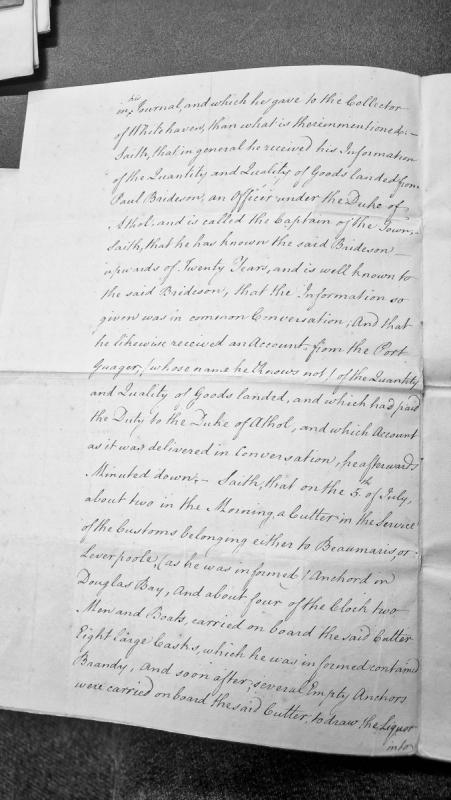
An excerpt from sworn testimony concerning the receipt of information about goods landed, their quantity and quality, and duties paid to the Duke of Athol. The witness describes conversations with Paul Brideson (Captain of the Town) and a Port Guager, and reports on customs cutter activity in Douglas Bay on 5th July involving the transfer of brandy casks.
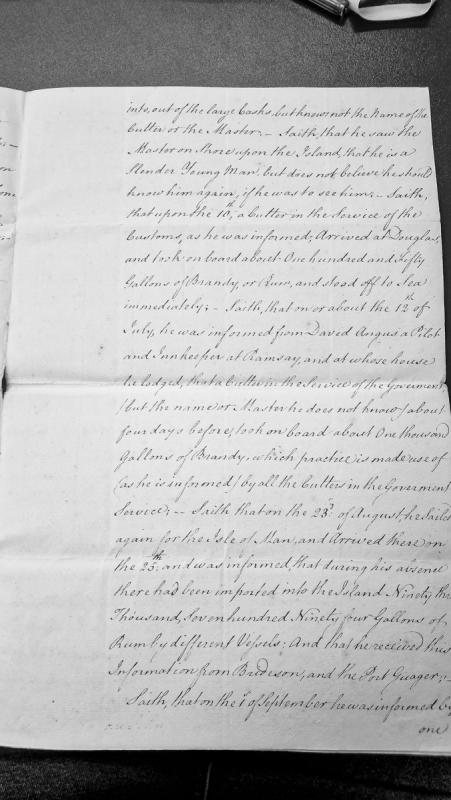
A deposition or court testimony detailing observations of illegal spirits trading involving government customs cutters. The witness describes encounters with vessels carrying brandy and rum, conversations with pilots and innkeepers, and reports of large quantities of spirits imported to the Isle of Man during summer months.
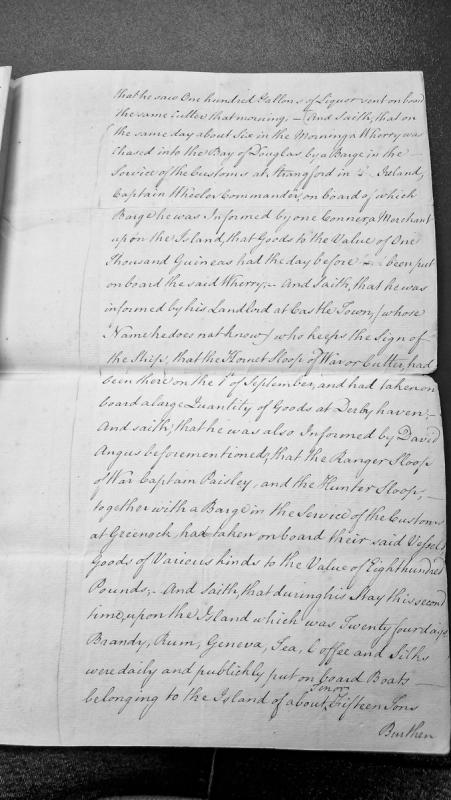
A deposition or court testimony describing observations of smuggling operations on the Isle of Man, including reports of liquor and goods being loaded onto vessels, and interactions with customs cutters and sloops of war from Ireland and Scotland. The witness provides detailed accounts of quantities and values of contraband goods.
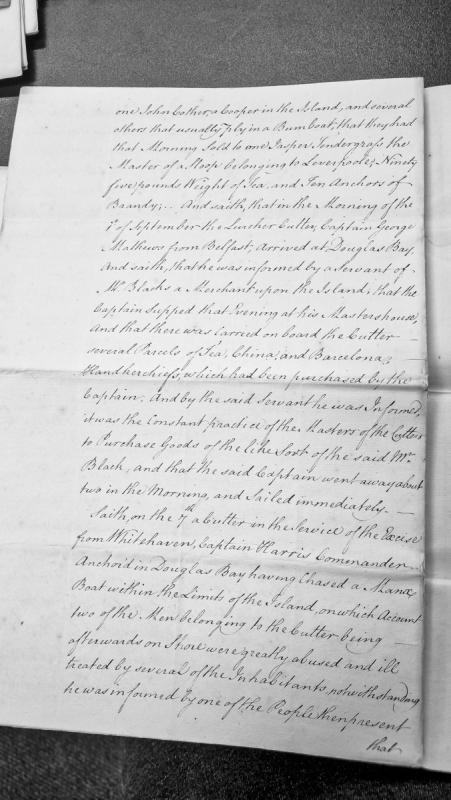
A deposition or court testimony documenting smuggling operations involving tea and brandy sales to ship captains at Douglas Bay. The account describes the arrival of the Lurcher Cutter from Belfast and an Excise cutter from Whitehaven, with details of illicit goods purchases and tensions between Excise officers and local inhabitants.
Extensive remains of 19th century quarrying activity represented by offices at SC32708783, powder magazine at SC32858793, and quarry workings at SC32648770, SC32948802, SC33008792, and SC33838768. The features are presumed to be associated with the Tetleys Mine.
Extensive remains of 19th century quarrying activity represented by offices at SC32708783, powder magazine at SC32858793, and quarry workings at SC32648770, SC32948802, SC33008792, and SC33838768. The features are presumed to be associated with the Tetleys Lead Mine.
Prehistoric flint scatter.
A small quantity of worked prehistoric flint was recovered from Thalloo Quayle by CH Cowley. No further details concerning the discovery were recorded and the grid reference relates to the cottage for indicative purposes only.
The antiquary Charles Harry Cowley was an avid collector of worked flint and coarse stone artefacts revealed by agricultural activity, mainly on farms located around Peel, and occasionally from further afield. He was active from 1900 until 1943. His entire collection of artefacts, together with a daybook cataloguing his discoveries, was later donated to Manx National Heritage.
Prehistoric flint scatter.
A small quantity of worked prehistoric flint was recovered from Thalloo Quayle by CH Cowley, from the 'Field next to Stream'.
This description could relate to one of several fields on the east side of the landholding, all of which are bounded by a stream. The grid reference relates to the cottage for indicative purposes only.
The antiquary Charles Harry Cowley was an avid collector of worked flint and coarse stone artefacts revealed by agricultural activity, mainly on farms located around Peel, and occasionally from further afield. He was active from 1900 until 1943. His entire collection of artefacts, together with a daybook cataloguing his discoveries, was later donated to Manx National Heritage.
The findspot of a scatter of Mesolithic 'Heavy Blade' type and Neolithic Ronaldsway type flint artefacts as well as a polishing stone. They are held in the Clementson Collection at the Manx Museum.
The findspot of a scatter of Mesolithic 'Heavy Blade' type and Neolithic Ronaldsway type flint artefacts as well as a polishing stone. They are held in the Clementson Collection at the Manx Museum.
Single storey, double-fronted thatched cottage, originally constructed before 1868 (present on Ordnance Survey 1:2500 1st edition map of that date).
This dwelling was replaced by the current structure shortly after 1900.
A comprehensive historical monograph examining the 1765 Act of Revestment through comparative economic analysis, focusing on the smuggling trade, Parliamentary protectionism, and the Island's unique constitutional position. Covers causes, smuggling operations, immediate aftermath, and draws parallels with the American Revolution and Edmund Burke's critique.
A comprehensive secondary source examining the 1765 Act of Revestment from economic, political, and social perspectives. Covers the commercial systems in England and Man, the growth of the smuggling trade, the constitutional position of the Isle of Man, and the consequences of revestment including trade restrictions, merchant hardship, and population decline. Includes extensive primary source quotations (Gentleman's Magazine 1751, parliamentary petitions, customs memorials) and comparative analysis with American colonial taxation.
The Prayer Book printed in Manx in 1765, the same year as the Revestment Act. Both a monument and a marker: it preserved the language in print and marked the moment after which no institution on the Island would fight for the language the way Wilson had fought for it. The coincidence of date makes it a symbol of everything the Revestment interrupted. The literary infrastructure that Wilson and Hildesley created before and during the Revestment would eventually provide the foundation for the language revival two centuries later.
In 1779, fourteen years after the Revestment, William Clucas, vicar of Malew, translated the Bishop of Sodor and Man's SPG appeal into Manx (Manx Museum MS 224a). The translation proves that Manx was still the operational language of religion and community in the parishes as late as 1779. It provides a data point between the 1765 Prayer Book and the 1874 census: the language that the administration was ceasing to support was still necessary for reaching the people in their parishes.
In 1798, when fears of French-supported Irish rebellion swept the Irish Sea, the island's volunteer companies turned out. The Keys — the same Keys who had petitioned London for decades about the impoverished state of the island — refused to criminalise their own people for sheltering Irish refugees who washed up on Manx shores. It was a moment of quiet defiance: the island would defend itself and serve the Crown, but it would not abandon its own traditions of sanctuary. Manx people had given shelter to strangers for as long as anyone could remember. The Crown's wars did not change that.
In 1827, three ships carried Manx emigrants to Ohio: the Chile, the Curler, and the Ocean. The Cleveland Herald of 3 August 1827 reported about 200 immigrants from the Isle of Man. The northern parishes of Ballaugh, Jurby, Kirk Michael, and Lezayre bled the most — parishes where the herring economy had mattered most, where the collapse of the harbours had been felt most acutely, and where the agricultural land was thinnest. Moore fixed 1824 as the date at which the Manx labourer reached his lowest depth of misery. The 1827 ships sailed three years later. The people who left were not adventurers. They were families — the Corletts and the Cannells and the Sayles and the Kellys — doing what the Keys' petition had described: removing themselves and their families to seek a livelihood, because the island that had sustained their ancestors could no longer sustain them.
Chapter 13 from a published history examining the transition of Isle of Man sovereignty from the Stanley family to the Duke of Athol in 1736. It traces the development of smuggling trade from the 16th century, analyzes the impact of customs tariffs, and details the constitutional reforms enacted by the first Duke of Athol, including trial by jury rights and parliamentary control of taxation.
The genius of the Manx church: each arriving culture adapted to what was already there rather than replacing it. Christianity settled beside the holy wells. The Norse built their parliament on sacred ground. The ritual year wove both traditions together so tightly that by the eighteenth century nobody could have said where Christianity ended and the older religion began.
The early missionaries did not suppress the older world. Moore explained the mechanism: the early teachers of Christianity encouraged belief in charms against fairies and witches as a means of diverting their converts from the worship of nature. The clergy knew that to preach against the existence of fairies would make the people refractory. So they did not try.
The accommodation runs through everything. The wells sat in church grounds: pre-Christian practice operating inside Christian space, with the knowledge and consent of the clergy. The rushes still went up South Barrule at Midsummer while the Christian calendar governed the Tynwald ceremony below. The fishermen of Peel and Port St Mary prayed to Saint Patrick at the harbour — Dy bannee Noo Parick shinyn as nyn maatey, "St Patrick bless us and our boat" — and sang of Manannán on the water, the song collected in Kiaull yn Theay. The formal prayer went to the saint. The song remembered the god. Both lived in the same boat.
Teare’s daughter was still practising the charming of fishing nets in the late nineteenth century. Moore records it: "she is resorted to by the fishermen for the sake of having their nets charmed, and so cause them to be lucky in their fishing." The power passed man to woman to man, alternating through generations. At Kirk Andreas, Thorwald’s Cross carries Odin devoured by Fenrir on one face and Christ triumphant on the other — two religions on the same slab of stone. Around 950 AD, the Pagan Lady of Peel was buried with the full apparatus of Norse ritual inside a Christian cemetery.
Gill’s well-visiting on the hills was denounced by the Church at Snaefell but continued anyway. The scenes at Maughold were described as "essentially non-Christian." Moore noted that when Christianity was introduced, its ministers, "unable to do away with these feasts, wisely adopted their periods as Christian festivals, and so they have continued semi-pagan in form till the present day." The word wisely is Moore’s own. This was not defeat. It was wisdom.
The accommodation was not a compromise. It was a way of being in the landscape.
The ancient militia was one of the Lord of Mann's prerogatives — Manx men, armed and trained, defending their own island under the Lord's authority. The garrison tradesmen whose names fill the disbursement accounts — the Brews and Killeys and Quayleys — had combined military service with their ordinary occupations for generations. A man might be a carpenter six days a week and a soldier on the seventh, and his father and grandfather had done the same. The Lord took responsibility for defence, but the community contributed. The garrison was raised from the people, not imposed upon them. That distinction — between a force that belongs to a community and a force that occupies it — is the distinction the Revestment destroyed.