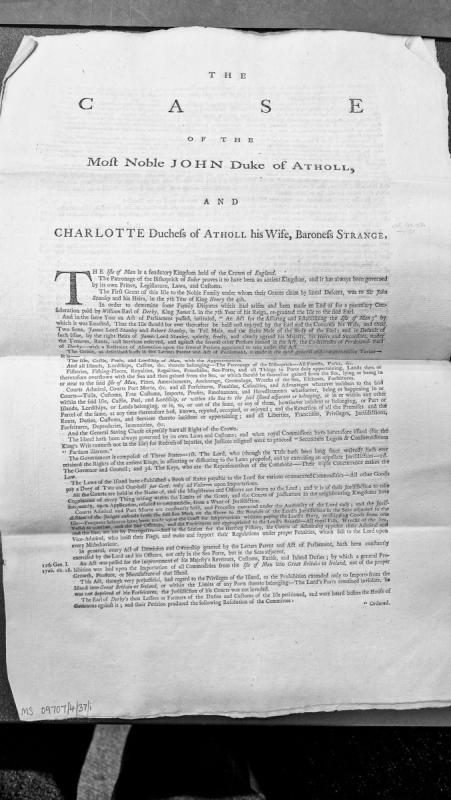
A legal document presenting the case of the Duke and Duchess of Atholl regarding their feudal rights over the Isle of Man. It traces the historical grants from Henry IV through James I, details the comprehensive privileges granted including judicial, maritime, and revenue rights, and argues for the Lords' sovereignty and jurisdiction over the island and adjacent seas.
A detailed petition submitted by the inhabitants of the Isle of Man to Parliament in response to the 1765 Revestment Act and subsequent trade restrictions. The document traces the constitutional history of Man's self-governance, details the series of British Parliamentary acts restricting trade (1710–1765), and argues that the inhabitants' ancient rights and commercial privileges were violated without consultation or compensation when sovereignty transferred to the Crown.
A detailed petition by the inhabitants of the Isle of Man arguing for restoration of ancient constitutional and commercial rights following the 1765 Revestment. The document traces Manx legal history, parliamentary acts affecting the island's trade (1710–1765), and the severe economic consequences of the 1765 Act restricting commerce. It challenges the legitimacy of Parliament's authority to strip commercial privileges without consent or compensation.
A formal petition/memorial presented by the Inhabitants of the Isle of Man to Parliament in February 1765, arguing against the loss of their ancient constitutional rights and trading privileges following the Crown's purchase of sovereignty from the Duke of Atholl. The document traces Manx constitutional history, details the progression of restrictive Parliamentary acts (1710-1765), and pleads for relief from the devastating 1765 Act that effectively closed the island's profitable smuggling-based trade.
A formal petition presented by the inhabitants of the Isle of Man to Parliament in February 1765, following the passage of the Revestment Act. The document outlines the historical constitutional status of Man, its independent legislative power (Tynwald), and the ancient commercial privileges of its people. It protests the purchase of the island by the Crown from the Duke of Atholl and the subsequent restrictive trade legislation (5 Geo 3 Cap 25 and the Act for preventing illicit trade), arguing these measures violated immemorial rights and caused severe economic hardship. The petition requests parliamentary redress and trade concessions.
This small inland promontory overlooking the Glen Gawne or Garwick stream is crowned by a ruinous rectilinear structure which was visible at the time of the Ordnance Survey in the late 1860s, and orientated SW-NE.
The site was investigated by Gerhard Bersu in 1941. Excavation revealed the remains of two superimposed rectilinear structures: the first measured 11 by 5.6m, and was defined by a small number of surviving postholes, which suggested a wholly wooden structure to the excavator. This building appeared to have burnt down.
The second structure was built over the first and extended slightly further to the NE, so that it measured approximately 13m in length, and required the building up of the ground level at this end of the promontory in order to accommodate it. The structure was defined by well-built walls faced in stone with an earth core. The interior was marked by four parallel but discontinuous rows of postholes aligned along the long axis of the building. It would appear that they were meant to support a roof structure. No datable artefacts were recovered.
Having initially postulated that the building might have represented a secure or even defensible granary, Bersu later changed his mind and thought that it represented a dwelling; following Bersu's death, Marshall Cubbon excused the lack of an obvious hearth by suggesting that it might have been set on bedrock already reddened by the destruction of the original building.
The cathedral at Peel Castle, seat of the Bishop of Sodor and Man. By the time of Crown administration it was described as totally useless. The cathedral that had been the spiritual centre of the Island, that Wilson's predecessors had maintained, that the Lords had supported as part of the constitutional fabric of Mann, was allowed to decay because no institution under Crown control saw any reason to maintain it.
Neolithic stone axehead.
A polished Neolithic stone axehead was found on the Chasa, an area of wetland north of Onchan parish church, by a Mr Lewin, the village postmaster. A drawing of the axehead was made by the finder for PMC Kermode (director of the Manx Museum 1922-32) in the latter's notebook, under the date of 1st December 1892, implying that it was found prior to this. Kermode subsequently (1901) appears to refer to the same object having been found in the 'Field below Vicarage Garden, Howstrake.'
The Ordnance Survey 1:2500 First Edition mapping of 1867 shows a 1-acre millpond just to the north-east of the Chasa, which is centred at the grid reference provided. The post office is marked at the road junction about 80m west of the Chasa.
The axehead was subsequently sent off the Island, and its whereabouts are unknown.
The longest-serving governing family in Manx history, producing Deemsters from 1408 and members of the Keys across every generation. John McCristen served as Deemster in 1408 and at Tynwald in 1422 — 'the first to put the Manx Laws in writing.' Ewan Christian served as Deemster for fifty-one years, the longest tenure on record. Edward Christian proposed elected Keys and accountable Deemsters under the Great Stanley and was imprisoned for eighteen years. William Christian — Illiam Dhone — negotiated the Parliamentary surrender of 1651 and was shot at Hango Hill in 1663. Ewan Christian of Lewaigue negotiated the Act of Settlement at Lathom in 1703. Captain Matthias Christian commanded at Ramsey and was held at gunpoint by revenue cutters. Fletcher Christian, of the Milntown branch, mutinied on the Bounty. Three Christians signed the Keys' Resolution of March 1765. A tradition recorded by A.W. Moore connects the family to Virginia, where Christians settled from the 1650s. Thomas Christian patented land in Charles City County in 1657 and founded a dynasty that produced judges, legislators, and a connection by marriage to the White House. In 1888, four Christians served simultaneously as judges in Virginia. Whether the Virginia Christians descended from the Manx Deemster line, as Moore believed, is a question the primary sources have not yet answered. The family's farms at Ronaldsway became the Island's airport. Edward Christian of Bemahague was forced to sell in 1789; the property became Government House — maintained at Manx expense for a Lord who has never slept in it.
The Christians settled in New Kent County, Virginia. Robert Christian of Cedar Grove became Chief Magistrate of New Kent County, described as “Washington’s devoted friend.” His granddaughter Letitia married John Tyler, who became the tenth President of the United States. Whether the family originated on the Isle of Man is a question the primary sources have not yet answered. A separate line of research connects the Augusta County Christians — Israel Christian, Colonel William Christian of the Fincastle Resolutions, and their kin — to the Jurby parish Christians through Dollin Christian, son of the Reverend John Christian, vicar of Jurby, who died “on the coast of Virginia” around 1745. The Cedar Grove line and the Augusta County line have not been connected to each other in primary sources. The full research is documented on the companion page.
The chronicle of the kings of Mann and the Isles, compiled by the monks of Rushen Abbey from the twelfth century onward. A Manx document, produced on Manx soil, preserving a Manx understanding of the past. The manuscript now sits in the British Library in London. There have been campaigns to bring it home. It has not come home yet.
This is Chapter 1 of a comprehensive historical work analysing constitutional and administrative changes in the Isle of Man following the 1765 Revestment (transfer of sovereignty from the Duke of Atholl to the British Crown). It traces the evolution of the governor's role, the Tynwald Court's powers, judicial reforms, and the gradual expansion of Manx political autonomy from 1765 to approximately 1890. The chapter provides detailed examination of the 1866 constitutional reforms and financial negotiations between Westminster and the Manx Legislature.
A detailed scholarly analysis of constitutional and administrative changes in the Isle of Man following the 1765 Revestment (transfer of sovereignty from the Duke of Atholl to the Crown). Covers the evolution of the governorship, judiciary, legislature (Tynwald Court and House of Keys), revenue control, and the gradual expansion of insular self-governance from 1765 to 1900. Examines key moments including the 1866 financial settlement with the Treasury, the Keys' evolution toward electoral representation, and the modernization of courts and administration.
In 1776, eleven years after the Revestment, the clergy were expelled from Tynwald. No Act of Parliament. No crime. No principle. Merely the will and pleasure of the Governor. The Bishop's Memorial protesting the expulsion was filed. The determination was never made. The clergy were restored in 1791, but the precedent had been set: constitutional rights that had existed since at least 1422 could be removed without legislation, without debate, without explanation.
In Cleveland and the surrounding townships — Newburgh, Warrensville, and the small settlements along the lake — Manx emigrants formed what later accounts described as a community bound by their own Gaelic language, which they used almost exclusively with each other. City censuses counted ninety-five Manx-born residents of Cleveland in 1846, a hundred and forty-eight by 1848, though most of the Manx settled outside the city proper. Eventually, the Encyclopedia of Cleveland History recorded, there were over three thousand Manx and their descendants. Kinvig, writing in 1954, noted that the Manx use of their own language had given them a reputation for clannishness.
Initiated in 1922 when Joe Kelly and Edward Callister of the Cleveland Manx community met with Willie Craine during a visit to the Isle of Man. The medal is awarded annually at the Manx Music Festival (Yn Chruinnaght or the Guild) in Douglas. It represents the enduring connection between the Cleveland Manx community and the cultural life of the homeland, the diaspora reaching back across the Atlantic to support the traditions it had carried with it.
The cloak of mist is the most enduring motif in the Manannán tradition. When enemies approached the Island, Manannán mac Lir would wrap it in fog, hiding it from sight. The Traditionary Ballad, composed between 1504 and 1522, records it plainly: “when he would see ships sailing, he would cover it round with a fog.” The Supposed True Chronicle elaborates that Manannán “was a paynim” who “kept, by necromancy, the Land of Man under mists,” and that if he feared an enemy, “he would of one man cause to seem an hundred, and that by art magic.”
The Manx Gaelic word for the cloak is cloagey druiaght — the invisible cloak. Charles Roeder recorded it in 1904. It is a Manx word, not borrowed from the Irish, for a specifically Manx tradition. The Irish equivalent, feth fíada, appears in several of the major Irish mythological texts. In the Wasting Sickness of Cúchulainn, Manannán arrives “in a magic mist,” takes back his wife Fand, and shakes his cloak between her and Cúchulainn so they can never meet again. Cúchulainn takes a draught of forgetfulness. The cloak does not just hide islands. It separates lovers and erases memory.
Morrison places Manannán at Peel Castle, where he once caused a single man standing guard on the battlements to appear as a thousand, sending the enemy fleet away in terror. In another version, he made boats from sedges, creating the illusion of a great fleet in Peel Bay. A god who fought with fog and grass — easy to dismiss, but hard to forget. The cloak survives in everyday Manx speech. When the sea mist settles along the coastline, someone will say it: Manannán’s cloak. A piece of mythology so embedded in daily life that people repeat it without thinking about what they are saying, or who they are remembering.
The site of a Neolithic chambered cairn. The site has never been excavated, but is thought to be a passage grave aligned on a north-northeast to south-southwest axis, with a chamber 2.4 metres wide and 4.2 metres long, based on the partially exposed structure.
The stones are situated in the front garden of a bungalow, and are closely constricted between the building and the road, both of which have contributed to the destruction of the rest of the structure.
A true sense of ground level is difficult to establish as both the road and the bungalow are sunken below the level of the monument. The appearance therefore is of a raised mound from which the tops of seven stones of the chamber and the septal stone protrude together with two portal stones. The latter are of a monumental scale and stand to a height of 1.8 metres and 1.7 metres respectively. On the northwest side the chamber is obscured by the garden wall, but to the southeast the entire length of the side slabs remain in situ as revetting between the raised garden and the wall of the dwelling.
Neolithic chambered cairn. The site has never been excavated, but is thought to be a passage grave aligned on a NNE-SSW axis, with a chamber 2.4m wide and 4.2m long, based on the partially exposed structure. The stones are situated in the front garden of a bungalow, and are closely constricted between the building and the road, both of which have contributed to the destruction of the rest of the structure. A true sense of ground level is difficult to establish as both the road and the bungalow are sunken below the level of the monument. The appearance therefore, is of a raised mound from which the tops of seven stones of the chamber and the septal stone protrude together with two portal stones. The latter are of a monumental scale and stand to a height of 1.8 m and 1.7 m respectively. On the north-west side the chamber is obscured by the garden wall, but to the south-east the entire length of the side slabs remain in situ as revetting between the raised garden and the wall of the dwelling.
A hundred miles of coastline for an island thirty miles long and ten miles wide. The shoreline twists in and out of coves and bays, rises into cliffs, drops to beaches of sand or shingle or bare rock. The cliffs at Spanish Head still drop three hundred feet to the sea, as they did before the Vikings. The western coast takes the weather, prevailing winds from the southwest carrying moisture accumulated over hundreds of miles of open Atlantic. The geography made the running trade possible: close enough to all four coasts that a fast boat could make the crossing in a night, far enough that the revenue cruisers could not easily extend their reach.
The Consolidated Fund is the general fund of the British government into which tax revenues are paid and from which public expenditure is drawn. Following the Revestment of 1765, customs revenues collected on the Isle of Man were paid into the Consolidated Fund, with the proceeds used to offset the seventy thousand pounds paid to the Duke of Atholl and to finance the Island's administration under Crown control.
A comprehensive historical and constitutional overview of the Isle of Man's legislative and administrative structures, tracing the evolution of the House of Keys, the Council, and the Governor's role from medieval times through the 1860s. Discusses the 1765 Revestment as it relates to Parliamentary sovereignty, the development of representative government, and the balance of power between Crown and Manx institutions. Directly relevant to understanding post-Revestment constitutional arrangements and the framework governing the Island after purchase of its royalties.