Benjamin Franklin's major pamphlet on British imperial policy following the Seven Years' War, arguing for retention of Canada over Guadeloupe based on mercantilist economic theory and the value of North American colonies as markets for British manufactures. Includes comparative trade data, population statistics, and discussion of colonial governance and the risk of independence. Part of broader 1759–1763 pamphlet debate over peace settlement terms.
Benjamin Franklin's influential pamphlet arguing for British retention of Canada rather than Guadeloupe in the forthcoming Treaty of Paris, addressing mercantile theory, colonial markets, and imperial economic interests. Originally published April 1760, this is a transcription from Founders Online (National Archives). The document engages with contemporary debates on colonial value and prefigures later tensions between mother country and colonies.
Benjamin Franklin's major 1760 pamphlet arguing for British retention of Canada over Guadeloupe in peace negotiations following the Seven Years' War. Engages mercantilist economics, colonial growth potential, and the role of North American colonies as markets for British manufactures. Includes comparative trade statistics and reprints Franklin's 1751 'Observations concerning the Increase of Mankind.'
Benjamin Franklin's influential pamphlet arguing for British retention of Canada over Guadeloupe in peace negotiations following the Seven Years' War. Addresses mercantilist economic theory, colonial population growth, trade expansion with North America, and the strategic importance of continental colonies as markets for British manufactures. Includes statistical evidence on exports and population growth in the colonies.
Benjamin Franklin's 1760 pamphlet engaging in public debate over post-war colonial policy, particularly the retention of Canada versus Guadeloupe. Franklin argues for Canadian possession on grounds of American security, frontier stability, and prevention of future costly conflicts. The work addresses imperial strategy, colonial defense, Indigenous relations, and the economics of empire during the Seven Years' War aftermath.
The sea is the thing. It always was. An islander might go a lifetime without climbing Snaefell, but nobody could ignore the water. It was visible from almost anywhere on the island, audible from everywhere on a windy night, and it shaped every aspect of Manx life. The Irish Sea can be millpond-smooth in the morning and dangerous by afternoon, and the fishermen who made their living from it learned its moods through generations of accumulated experience. Every coastal parish had its stories of boats that did not come back. Somewhere out in that water, if the old stories can be believed, lies the Kingdom of Manannan mac Lir.
Chapter 10 from an 1893 history of the Isle of Man, drawing on primary accounts by William Blundell, Thomas Chaloner, William Sacheverell, and Bishop Wilson to describe Manx life during the Civil War period and Restoration. Covers agriculture, herring fishery, social structure, laws, and governance under the Derby dynasty, providing context for pre-Revestment island conditions.
Chapter 10 from "Land of Home Rule" (1893) provides a detailed portrait of Isle of Man society in the 17th century following the English Civil War, drawing on primary sources by William Blundell, Chaloner, Sacheverell, and Bishop Wilson. It covers agriculture, herring fishery, social structure, laws, mineral resources, and governance under the Derby dynasty, offering crucial context for understanding pre-Revestment Manx conditions.
Modern commercial building.
The property is currently in use as a bank (the Isle of Man Bank).
The structure is protected under the terms of the Town and Country Planning Act 1999. It was placed on the protected buildings register on the 3rd February 1984, and is Registered Building No 39.
A bilingual (English/Latin) historical record from the Manx Society vol. 7 documenting the 1393 purchase of the Isle of Man by William Scrope from Montague, Earl of Salisbury. The entry also notes the transfer of the King's Bench and Chancery from London to York in the same year. This provides crucial context for understanding pre-1765 sovereignty claims over Man and the history of feudal ownership prior to the Revestment.
A bilingual (English/Latin) chronicle entry from Monumenta de Insula Manniae recording the 1393 purchase of the Isle of Man by William Scrope, Lord Chamberlain, from Montague, Earl of Salisbury. The entry also notes the temporary transfer of the King's Bench and Chancery from London to York. This is an early medieval precedent document relevant to understanding Manx sovereignty transfers.
The Isle of Man Times was a newspaper published in Douglas by Brown and Sons, Limited, from their premises in Athol Street. It was associated with James Brown, and served as an important forum for Manx public discourse, publishing historical and political articles including Thomas Grindley's influential study of the Revestment.
The Jubilee Clock is a typical 'Victorian' monument comprising of a single stone column on a conically elevated tiered base supporting a cubical housing for a four-faced clock which is 'crowned' by a metalic decoration. The clock faces are relatively small for public use and the scale of the monument is appropriate to this limitation.
174 keeill sites have been identified by archaeological survey. Many are on private land or hard to find, but dozens are accessible — marked on Ordnance Survey maps, visible as low stone foundations in fields and on hillsides.
This summer project challenges you to find and photograph as many keeills as you can. Each keeill entry in your field notebook should include: location (grid reference), condition, whether there’s water nearby (there almost always is), what you can see of the walls, and a sketch.
How many can you find in a summer? Nobody’s counted yet. You could be the first.
The communities remembered what happened to anyone who interfered with the keeills. A windmill built from keeill stones went with tremendous fury and had to be taken down. A farmhouse roofed with stone from a keeill produced such unearthly noises that the stone was returned to the site. Bishop Wilson knew the formula for the worst curse a Manx person could utter: Clogh ny killagh ayns corneil dty hie mooar, may a stone of the church be found in the corner of thy dwelling-house. The stories protected what the buildings could not. The holiness was understood to be permanent, deposited in the ground, infused into the stones. A ruined keeill was not a dead church. It was a sleeping one.
Over two hundred tiny chapels once scattered across the Island, roughly one for every treen. Built by the culdees, servants of God, who chose to live among the people and serve the families nearest to them. Typical dimensions: five metres by three, walls of stone described as unnecessarily massive for such small enclosures. One window. One door. Altar against the eastern wall. Almost invariably a spring or stream nearby. One keeill per treen was the general pattern. By the eighteenth century most were ruins, but the memory of holiness clung to them. A windmill built from keeill stones went with tremendous fury and had to be taken down. Wilson knew the curse: may a stone of the church be found in the corner of thy dwelling-house. The 2007 archaeological survey identified 174 sites. They survived because they were beneath notice.
The spirits that haunted churchyard stiles in Manx tradition. The boundary between consecrated and unconsecrated ground was a charged threshold in Manx belief. The keimagh inhabited that boundary, occupying the liminal space where the sacred met the everyday. Part of Moore's comprehensive taxonomy of the Manx supernatural world.
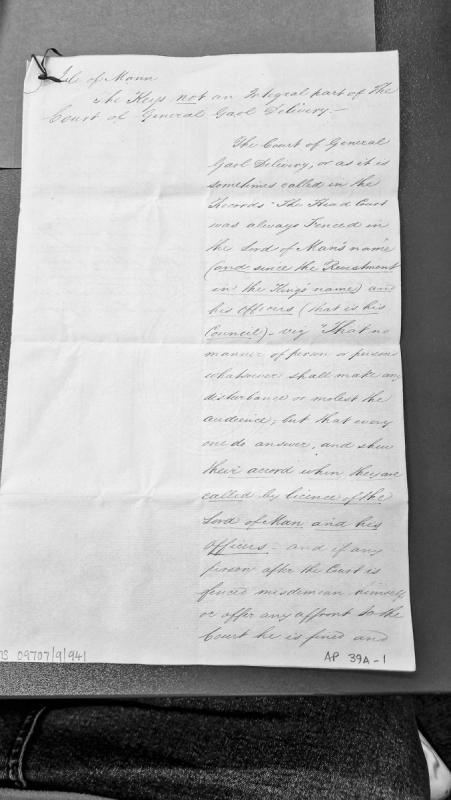
A legal document discussing the constitutional status of the Court of General Gaol Delivery (also called the Head Court) in the Isle of Man, describing its procedures for fencing the court in the Lord of Man's (later the King's) name and regulations for conduct during proceedings.
The approximate area of the findspot of an early prehistoric flint scatter which included 17 flakes, 12 chips and an asymmetrical slate whorl with hole drilled from one side only (PRN 1234.10).
Prehistoric flint scatter.
A single worked prehistoric flint was recovered from The Lhag, Dalby by CH Cowley, from 'Creggan Mooar'.
No further details concerning the discovery were recorded and the grid reference relates to the farmsteads gathered in the base of the valley for indicative purposes only.
The antiquary Charles Harry Cowley was an avid collector of worked flint and coarse stone artefacts revealed by agricultural activity, mainly on farms located around Peel, and occasionally from further afield. He was active from 1900 until 1943. His entire collection of artefacts, together with a daybook cataloguing his discoveries, was later donated to Manx National Heritage.