Letter from Philadelphia merchant Thomas Wharton to Benjamin Franklin discussing multiple versions of Patrick Henry's Virginia House of Burgesses resolves against the Stamp Act (May 1765), with detailed editorial analysis of textual variants and manuscript copies in Franklin Papers. Also reports on Cumberland County's violent opposition to supplying Fort Pitt, including the seizure and burning of Joseph Spear's goods.
Thomas Wilson (1663-1755) served as Bishop of Sodor and Man from 1697 until his death, an episcopacy of fifty-eight years. He is regarded as one of the greatest bishops of the diocese, remembered for his strict moral discipline, his promotion of education and the Manx language, and his charitable works. He was also notable for his resistance to civil authority when it encroached upon ecclesiastical matters, at one point being imprisoned in Castle Rushen by the governor.
A double sided wheel-headed carved cross with interlace and scenes from Norse mythology. It was found in 1869 and measures 56 inches x 21 inches x 3 inches. It is recorded as Manx Cross No. 124.
Kermode supposed that all the figures on the cross were characters from Norse myth and legend, including 'Thor and the ox-head'. Margerson stated that none of these had validity when examined closely and the iconography probably represented a combination of pagan and Christian elements of Celtic and Viking influences. The cross was considered too clumsy to be Grutr's work but was of that period, circa 950.
An information notice called it Thor Cross and stated that it has more scenes of Norse mythology depicted on it 'than any other slab'. The notice refers to five cross slabs found in the parish and dates them collectively from the 7th-12th centuries though Manc Cross Nos.124 and 118 are clearly Scandanavian.
This cross was apparently found during the demolition of the old church in 1869. Each face has an equal-limbed cross within a ring; the spaces between the limbs within the ring are pierced. Square panels above and below the ring suggest an extension of the vertical limbs. The rest of the slab depicts various beasts and figures interpreted as gods, giants and men on panels separated by crushed key-fret, spirals and interlaces. It has been interpreted as carrying several scenes from Norse mythology, but not all experts agree.
On one face above the circle is a pair of cockerels: these may be a Christian symbol of the Resurrection, but are also reminiscent of 'Gold-comb', who proclaimed the dawn of Ragnarok, the last battle between the gods and monsters of the world. In the panels beneath the cross are two groups of figures centred around stags, which at first sight might be interpreted as hunting scenes. On the left, a deer is surrounded by two hounds and two human figures, one of whom holds a spear. To the right, two hounds and a third creature again surround a deer and a single male figure is depicted nearby carrying what appears to be a bag. Separated from these scenes by panels of interlace, two further dog-like animals are shown near the bottom of the face. The face is edged with a twisted, cable-like border which terminates below the right arm of the cross in a serpent's head.
The scene on the right has been interpreted as showing Thor carrying an ox-head which he intends as bait for the great sea-serpent Jormungand, shown next to him. The other figures are more problematic; hunting scenes appear on several of the Manx crosses, so it is open to question whether there is a precise mythological allusion in the presence of the stags and dog-like creatures.
On the other face above the circle a bordered panel of crushed key-fret is carved, either side of which is a small dog-headed figure. Below the circle to the left is a male figure wearing two criss-crossed belts. He looks away from a coiled serpent, against which his right arm is raised; a tiny human figure reaches up to touch his foot. Below him a second figure stands with legs spread on a domed object and arms akimbo. The remainder of the panel below is filled with interlace.
One interpretation, as with the other side of the slab, draws on Ragnarok, the fabled final conflict between gods and monsters. The figure wrestling with the serpent can be seen as Thor fighting Jormungand, his head turned away to avoid the serpent's foul breath. The little figure has been identified as Thor's young son, Magni, who on one occasion saves his father by lifting the fallen body of a giant off his throat. The figure below has been interpreted as the giant Rungni, who in yet another fight with Thor stands on his shield having heard that the god is about to attack him from below. The various scenes are from disparate myths, however, and it is difficult to sustain a narrative that would link them together. The supposed depiction of Thor without his trusty hammer is another reason for doubt.
The panel to the right shows a very worn male figure apparently resting on a spear. Another scene further down the cross shows three male figures seemingly trampled by a four-legged animal. It has been suggested that the badly worn figure is Odin, and that the other scene shows the death of Swanhild, trampled by deer; again, these interpretations have been criticised.
This fragment of a broken slab was found in the 1870s at Rhynne farm. Only part of the inscription survives, which runs up the centre of the face, and translates as, 'Thorbjorn raised this cross...'
The findspot of a cross-slab which bore a Runic inscription. It was found at Rhyne Farm before 1878. The slab measures 53 centimetres x 25.5 centimetres x 7.5 centimetres and is now kept at St Trinians Church.
The site of an early medieval keeill or chapel, thought to have been in use during the period circa AD500 to circa AD1000.
No traces remain of the keeill as the site has long been ploughed over. A broken slab bearing the beginning of an inscription in runes - 'Thorbjorn raised this cross...' was found in the stackyard wall of Rhyne farm and is now in the Manx Museum (Cross Slab. No 139). There is nothing to indicate the date of this keeill but the finding of this monument shows it was still in use for burial as late as the 12th century.
This damaged slab was found in a garden in Onchan village in 1841 and moved to the church in 1892. It bears on each face a plain incised cross with a plain ring connecting the limbs.
On one face, an inscription runs up and then down the panel to the left of the cross shaft, then up the panel to the right. A few runes are broken off at the beginning, but the inscription has been translated as '...son erected to the memory of his wife Muirgheal...'
A second runic inscription runs up the face to the right of the cross shaft, and has been translated, with some difficulty, as 'I examine (the runes) and interpret (them) correctly'. Additional runes next to this may signify agreement.
The other face also bears runes. Above the head of the cross is the word for 'cross', and, in the opposite direction, 'of Jesus Christ'. At the foot of the face another inscription reads, 'Thorid carved (these) runes.'
This stone was discovered in Old Kirk Braddan churchyard, since when it has been broken in two and restored. The stone takes the form of a pillar, its main faces being only slightly wider than its edges. It is wheel-headed in outline, bearing an equal-limbed cross, the arms of which extend slightly beyond a surrounding ring. The spaces between the limbs and ring are pierced. The crosses on both faces are decorated with interlaced ornament, and the rings with a simple twist.
The shaft, the edges of which are bordered with a plain cable-mould, is decorated on both of the major faces with four dragons, head downwards save for the lowest, which faces the others. They have lizard-like heads and scaly bodies represented by pelleted infill, their tails are elaborately entwined by double bands branching into small spirals and tendrils. One edge is occupied by a single dragon, carved head down, of similar form but without limbs, twisting back and forth and trapped within a band which throws out tendrils at each point of crossing. The ornament is typical of the Scandinavian Mammen art style, dating to the end of the 10th century.
The other edge bears a runic inscription, which has been translated as, 'Thorlief Hnakki erected this cross to the memory of Fiacc his son, brother's son to Haf.' On the lower quarter of the ring the characters 'Ihsus' appear, partly in runes, partly in Roman capitals.
The striking similarities between this and Odd's Cross (Manx Cross 136) suggest that they were carved by the same sculptor.
A wheel-headed cross with carved cross with interlace on both faces, and a Runic inscription on one side. It measures 213 centimetres x 24 centimetres x 10 centimetres. It is kept in Braddan Church. It is of Scandinavian date and is recorded as Manx Cross No 135 (108).
A neo-classical style residence originally set in its own grounds. The grounds have now been subdivided into a housing estate which borders on the property on all sides and shares a common access. The house has been extensively restored to its former condition. It is a rectangular, two storey, cement rendered, slate roofed building of pleasing proportions. The main facade has the major treatment in that it has two double storey pilasters, one at each end of the facade, to an unbroken cornice. The ground floor between the pilasters is expressed as 'heavy' cut stone with an accented key stone above each of the four rectangular windows deployed on either side of the central flat curved headed entrance doorway. The windows of the first floor have molded frames and elevated head reliefs detached from the main frames. The central of these head moldings is triangular accenting the position over the main entrance. The chimneys are grouped into two stacks, one at each gable end of the roof. There is a small shed-like addition to the west wall. Although the remaining elevations of the building do not have the same treatment as the front facade, the house is a good example of a Victorian town house (albeit in the country) in a well maintained condition. It is suggested that it should be listed to ensure that the property continues in the same circumstances, although there is no evidence to suggest that the owners have any other plans. No interior inspection has been made.
The upper part of this rectangular slab is broken off, but it is still possible to see that it bears a cross set in a ring on both faces. One face is almost worn away, though traces of a well-formed key pattern can still be made out on the panel to the right of the cross shaft.
The other face shows a ring-chain interlace on the shaft which extends to form loops threaded through a ring in each limb. The edges of the shaft are picked out with a bead-moulding which expands at the base to form a curved pedestal. The space to the left of the shaft has a twist-and-ring pattern, while that to the right contains a runic inscription which has beentranslated as, 'Thorstein erected this cross to the memory of Ufeig son of Crina'.
A cross-slab, one face of which bears traces of key-fret, the other, ring-chain and twist-and-ring, with a Runic inscription. It measures 115.5 centimetres high x 40.5 centimetres maximum width and 5 centimetres thick. It is kept in Braddan church. It is of Scandinavian date and is recorded as Manx Cross No 138 (110).
Thorwald is a Norse figure commemorated on the Isle of Man through runic cross-slabs, most notably the Thorwald's Cross at Kirk Andreas, which depicts scenes from Norse mythology, including the figure of Odin being consumed by the wolf Fenrir. The cross is one of the finest examples of Norse-influenced art on the Island and dates from the tenth century.
This cross was found in the rectory garden north of the churchyard. Only a fragment survives, showing on each face the broken head of a shafted cross without circle. The shaft is decorated with ring-chain terminating in a cross.
On one face the space to the right shows a scene from the conflict of Ragnarok. Odin, one of his ravens on his shoulder, stabs at the wolf Fenrir with his spear, as the beast grips him in its jaws. Odin is devoured by the wolf and though the gods eventually prevail at great cost, a new mythological world order is created.
On the other side, a second figure of similar size is shown to the left of the cross shaft, holding a cross and what appears to be a book. Nearby are a fish and two knotted serpents, one of them trampled underfoot. The figure is interpreted as a priest, the fish as a potent symbol of Christianity, and the trampled serpent as signifying the triumph of Christ over evil.
While several Manx crosses portray pagan and Christian motifs side by side, this monument is particularly unusual in juxtaposing images on opposite faces apparently depicting two pivotal moments in pagan mythology and Christian belief.
The edge of the slab bears a fragment of a runic inscription, translated as, 'Thorwald raised this cross...'
Thorwalds Cross is a fragment of a cross slab which had a cross carved on both faces. Odin and the Fenris Wolf are carved on one face and a missionary on the other. It also has a runic inscription and measures 35.5 centimetres by 19 centimetres by 5.7 centimetres thick.
The Three Anchors Tavern on Milk Street in London was a public house in the City of London. Its connection to the Isle of Man relates to the Island's administrative and commercial ties with the capital, where Manx deputations and agents conducted business with the English government.
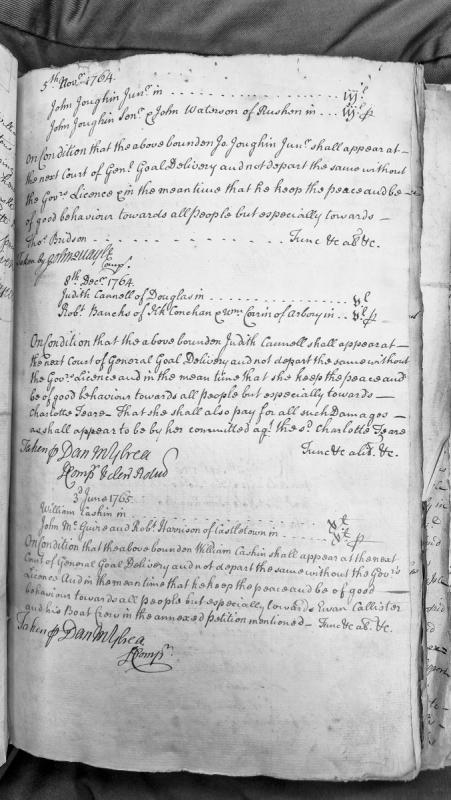
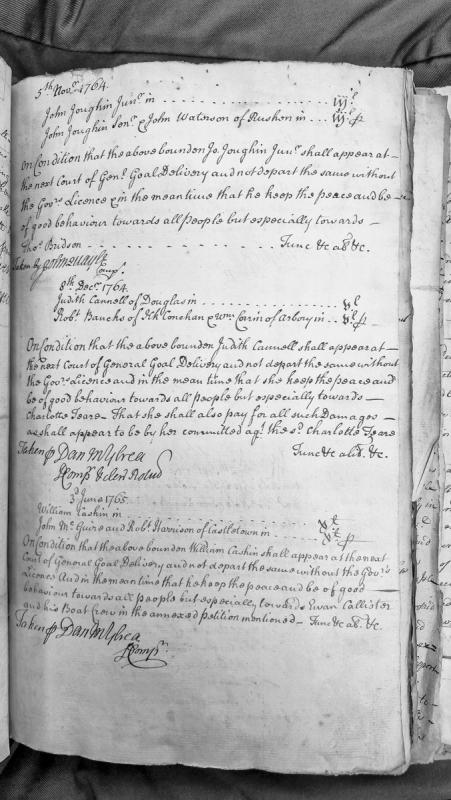
A record of three recognisance bonds requiring individuals to appear before the Court of General Gaol Delivery and maintain good behaviour. The bonds cover John Joughin Jr. (November 1764), Judith Cannell of Douglas (December 1764), and William Cashin (June 1765), each with named sureties and specific conditions regarding peace-keeping and reparations.
A record of three separate recognisance bonds taken before the Manx courts between November 1764 and June 1765. Each bond requires the named party to appear at the next Court of General Goal Delivery, keep the peace, and maintain good behaviour, with named sureties. The bonds relate to disputes involving Thomas Bridson, Charlotte Tears, and Ewan Callister and his boat crew.
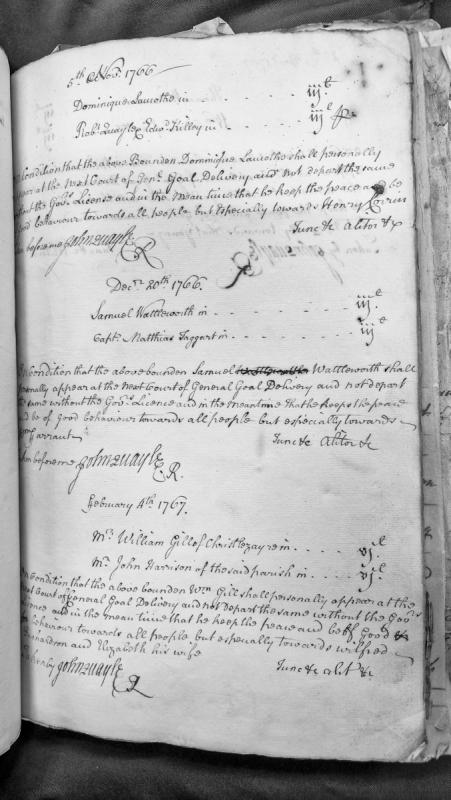
A series of three recognisances (bonds) taken before John Quayle, Coroner and Jurat, requiring individuals to appear at the next Court of General Gaol Delivery and keep the peace. Each recognisance names two sureties bound in £3 or £6 amounts and specifies particular individuals toward whom peaceful behaviour must be maintained.