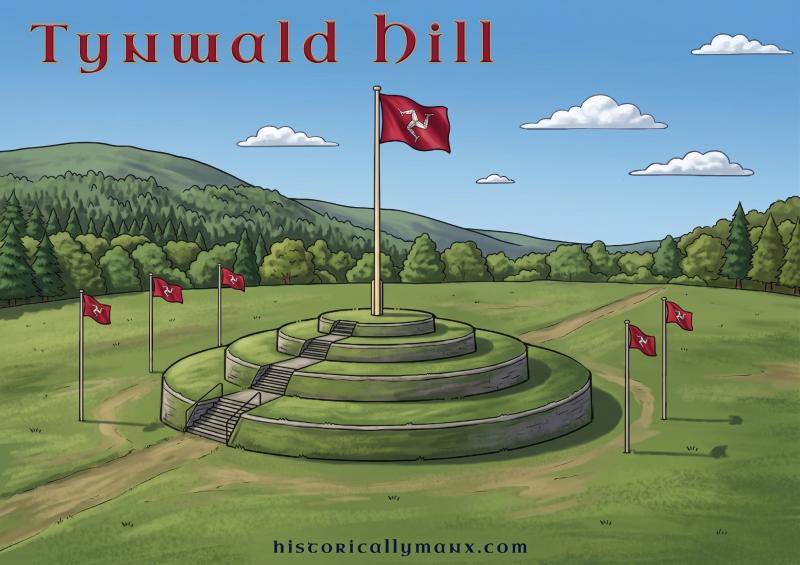
Tynwald is the parliament of the Isle of Man and one of the oldest continuously functioning legislative assemblies in the world. It comprises two branches, the Legislative Council and the House of Keys, and meets annually on Tynwald Day (5 July) at St John's, where new laws are promulgated in both English and Manx from the ancient Tynwald Hill.
The Tynwald Codification of 1417 was an early compilation of Manx customary law, undertaken during the lordship of Sir John Stanley. It recorded the "constitutions of old time" as declared by the Deemsters, preserving the ancient laws and customs of the Isle of Man in written form and establishing a foundation for the Island's distinctive legal tradition.
The codification of Manx law at Tynwald in 1417 preserved the Island's legal tradition in written form. The breast law — customary law carried in the memory of the Deemsters — was recorded. This was not an imposition of new law but the writing down of what the Deemsters already knew and applied.
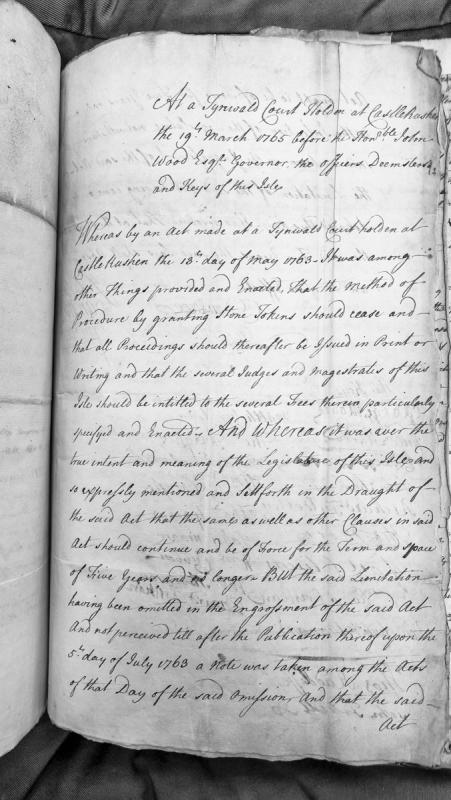
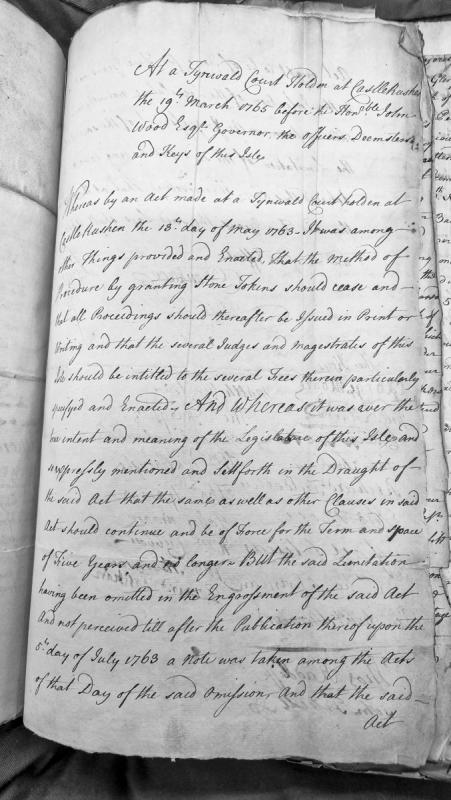
A Tynwald Court proceeding from Castle Rushen addressing an omission in an Act passed on 13 May 1763 concerning the cessation of Stone Tokens as a legal procedure and the establishment of fees for judges and magistrates. The court clarifies that the Act was intended to have a five-year limitation period, which was omitted from the engrossment and discovered after publication on 5 July 1763.
A Tynwald Court judgment from 1765 addressing an Act passed in 1763 concerning the cessation of stone token procedures and the establishment of fees for judges and magistrates. The judgment discusses an omission in the original Act regarding its five-year limitation period, which was discovered after publication.
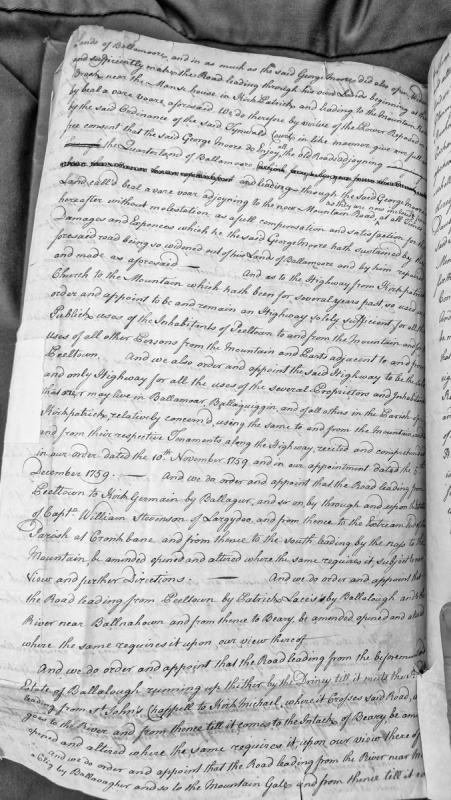
A Tynwald Court directive addressing road maintenance and usage rights in the Kirkpatrick parish area of the Isle of Man. The document grants George Moore of Ballamoore compensation and road rights in exchange for road improvements made on his lands, and specifies multiple public highways for use by inhabitants of Peeltown and surrounding parishes.
The open-air parliamentary ceremony held at Tynwald Hill on 5 July (originally 24 June, Midsummer Day, shifted when the Gregorian Calendar was adopted in 1753). Laws are proclaimed from the hill in Manx and English. The Deemsters fence the court and declare that no one shall quarrel or make disturbance. Rushes are laid along the procession way from the chapel to the hill. The ceremony is not a museum piece. It is a working constitutional act, the formal proclamation of legislation on a hill where legislation has been proclaimed since before the Norman Conquest. The forms survived because the forms are the substance. There is no Tynwald ceremony separate from Tynwald itself.
Tynwald Hill is an artificial tiered mound at St John's in the centre of the Isle of Man, where the annual Tynwald ceremony has been held since at least the Norse period. New laws are proclaimed from its summit in both English and Manx, and it remains the symbolic heart of the Island's parliamentary tradition, representing the continuity of self-governance that dates back over a thousand years.
Not a hill in the geographic sense, no chance feature of the earth's creation. A constructed mound, built deliberately at the centre of the Island, at a site where Manannan's roads converge, where a keeill dedicated to St John stood before the Norse arrived, and where the midsummer gathering had taken place since before written record. The Norse established their thing-vollr at an already-sacred site. The Manx name Cronk-y-Keeillown preserves the pre-Norse chapel. The name Tynwald preserves the Norse assembly. The roads preserve Manannan. Three layers of meaning in one constructed mound.
It has been suggested in the past that the Tynwald Hill may have origins as a pre-Vikign place of assembly, possibly even a Bronze Age burial site, but this is speculative and no evidence has been discovered to date to support such a theory. The Bronze Age megalithic cist of King Orry's Grave is located less than 50 metres to the north.
Assembly place. Early written statutes record a parliamentary assembly, or 'thing' at "Killabane" in 1428. The actual site is believed to have been at SC 36158252, now the site of a quarry from which stone was extracted for the construction of the nearby St Luke's Church, which was consecrated in 1836. The site had until then appeared as a rocky eminence.
A fair was held there until circa 1770 and 'seats' or tiers are said to have survived until at least the same time. The site was commemorated by an annual procession around it until about 1871, when it was described as 'levelled and enclosed in the adjoining field', though a fragment of the 'seats' was reportedly still to be seen in 1910.
The circular stone enclosure to the south at SC 36178245 serves as a memorial to the assembly site, and is marked by a bronze plaque, set up by the Trustees of the Manx Museum in 1928 on the fifth centenary of the earliest recorded assembly here.
This the site of a new woollen mill complex which was built by the grandson of John Moore, grandson of the founder of the earlier Tynwald mill founded in 1846. Unlike the earlier mill the new mill was powered by electricity, not water. It continues to work today.
Tynwald formally ratified Stanley rule — not as automatic acceptance of an English king's grant, but as the Manx constitutional body exercising its own authority to confirm a new lord. The distinction is important: the grant came from Henry IV, but the legitimacy came from Tynwald.
For over a decade after the Revestment, Tynwald was effectively silenced. No petitions heard in the old way. No laws promulgated as the constitution required. The ancient ceremony continued in form but the substance — the living governance the Prologue describes — was hollowed out. The silence is the book's recurring structural motif: told, acknowledged, ignored.
Complete text of the Declaration of Independence (July 4, 1776) and U.S. Constitution with amendments, published by U.S. Citizenship and Immigration Services as educational material. Includes index and scholarly quotations on constitutional principles. Relevant to the Revestment project as a comparative document illustrating colonial grievances against Parliamentary sovereignty and principles of constitutional reform that provide context for understanding contemporary 1765 debates on Manx governance.
Official USCIS publication containing the full text of the Declaration of Independence (4 July 1776) and U.S. Constitution with amendments, plus editorial quotes from Hamilton, Washington, Jefferson, Mason, Marshall, and Madison. Includes index and reference to National Constitution Center. Relevant to Revestment project as comparative constitutional/parliamentary context for understanding 1765 Isle of Man debates on sovereignty, representation, and taxation.