A scholarly essay (Retiring President's Address) by David Craine examining the life and business activities of George Moore (1709–1787), a prominent Peel merchant, smuggler, and Speaker of the Keys. Drawing on Moore's Letter Books held in the Manx Museum, the essay covers his trading ventures, contraband operations, relationship with Bishop Wilson, family life, and public service during the critical period surrounding the 1765 Revestment. Essential primary source material on Manx merchant enterprise, smuggling networks, and constitutional politics.
A scholarly essay by David Craine (Retiring President's Address) on George Moore (1709–1787), a major Peel merchant and Keys Speaker during the 1765 Revestment period. Based on Moore's letter books (1750–1780) held in the Manx Museum, it details his trading ventures, smuggling operations, family life, and political role—particularly his involvement in the Keys during the post-Revestment crisis and his relationship with Bishop Wilson over the contraband trade.
A comprehensive historical account of smuggling on the Isle of Man from the Mischief Act of 1765 to 1853, detailing the immediate post-Revestment chaos, subsequent legislative efforts (1767 Act, 1798 reforms), patterns of illicit trade in spirits, tea, tobacco, salt, and grain, and the eventual suppression of smuggling activity. Draws heavily on eyewitness accounts and the 1791 Commissioners' Report.
Scholarly historical monograph covering revenue, expenditure, taxation, and economic policy of the Isle of Man from the 1765 Revestment through 1866. Extensively documents the negotiations over customs revenue, the establishment of the Post Office, harbour development, and the Manx people's struggle to control surplus revenue. Directly addresses the constitutional and fiscal aftermath of the Revestment.
A scholarly history of the Isle of Man covering the post-Revestment period (1765–1866), with detailed focus on smuggling activities before and after the Mischief Act of 1765 and subsequent reform legislation. Includes eyewitness accounts of post-1765 chaos, the role of surveyor Lutwidge, the 1791 Commissioners' Report, and anti-smuggling reforms up to 1853.
Comprehensive secondary historical account covering social and economic conditions on the Isle of Man in the century following the 1765 Revestment. Details wages, prices, housing, town development (Douglas, Ramsey, Castletown, Peel), poor relief systems, police inadequacy, public health, and the impact of smuggling suppression, agricultural depression, emigration, and tourism on Manx society.
A comprehensive secondary historical work covering the revenue, expenditure, taxation, and customs reforms in the Isle of Man between 1765 and 1866, with particular emphasis on the Revestment Act of 1767 and subsequent governance of insular finances. Moore examines the negotiation of surplus revenues, smuggling, harbour development, and the relationship between the Manx Legislature and Westminster Parliament, providing detailed financial tables and legislative history.
A comprehensive scholarly history of Manx social and economic conditions following the 1765 Revestment, covering trade restrictions, the licence system, industrial development, shipbuilding, and commercial evolution. This chapter examines how the change in sovereignty affected Manx commerce, the oppressive regulatory framework imposed by Westminster, and the gradual modernization of the island's economy through factories, steam communication, and financial institutions.
Chapter II of Moore's comprehensive history focuses on trade, industry, and economic development on the Isle of Man following the 1765 Revestment. It details the restrictive commercial policies imposed by Westminster, the licence system and its effects on smuggling, the establishment of factories and mills, shipbuilding, and the gradual liberalisation of trade through the mid-19th century. The chapter provides detailed analysis of exports, imports, and the island's industrial ventures.
Speaker of the House of Keys and the most productive Manx scholar of his generation.
He was of Cronkbourne, and took his degree at Trinity College, Cambridge. His title pages give both, and by 1900 they give the Speakership as well.
The books came steadily. Manx Surnames and Place-Names was followed by The Folk-Lore of the Isle of Man, which he dated from Cronkbourne in June 1891 and offered as a contribution, though an insignificant one, to the science of folklore. Sodor and Man appeared in 1893 in the Diocesan Histories series for the Society for Promoting Christian Knowledge. A History of the Isle of Man came out in two volumes in 1900. The Story of the Isle of Man, a school book, followed in 1901, sent out in the hope that its little readers would find it useful and interesting and that it might increase their love for their native land. He also compiled Manx Worthies.
He worked in the smaller forms too. He contributed a paper on water and well worship in the Isle of Man to volume five of Folk-lore, describing the ritual at half a dozen named wells, where the patient walked round sunwise, drank, and wetted a fragment of clothing. He catalogued a document of 1379 preserved at Knowsley Hall for the Transactions of the Isle of Man Natural History and Antiquarian Society in 1898. He kept the rainfall gauge at Cronkbourne and signed off the Island's annual rainfall returns in the 1880s.
Later collectors treat him as the baseline. W. W. Gill sets his own place-name notes against Moore's, marks where Moore could not locate a name, and records where Moore's enquiries had failed.
Detailed historical chapter on Manx social and economic conditions in the century following the 1765 Revestment, covering wages, labour conditions, prices, housing, urban development, poor relief, and public services. Provides extensive primary source evidence (wages tables, price data, contemporary descriptions) and discusses the impact of trade liberalisation, emigration, visiting populations, and legislative reforms on island society.
The Abbey Clay Works was founded in the 19th century on the site of an earlier corn mill. The Clay Works is shown on the 1869 1:2500 scale Ordnance Survey map, which shows a tramway connecting to works to a clay pit to the north. The main part of the complex lies in German parish but it appears that the brick kiln and the eastern part of the main building lie in Patrick parish.
The Abbey Clay Works was founded in the 19th century on the site of an earlier corn mill. The Clay Works is shown on the 1869 1:2500 scale Ordnance Survey map, with a truncated mill leat shown to its southwest, which may have served the corn mill. The Peel to Douglas railway was built through the area in the later 19th century and destroyed the mill site. The water wheel was moved to Kella for reuse however.
Medieval watermill and associated water management.
A watermill is assumed to have been associated with the nearby Rushen Abbey from medieval times onwards. Even after the Reformation, it was recorded in 1660 that all tenants of what was formerly abbey demesne land had to have their corn ground at the abbey mill.
The Ordnance Survey 1:2500 First Edition mapping of 1868 shows a corn mill at this location, on the east bank of the Silver Burn, just a few metres upstream of the site of Rushen Abbey.
The existing building incorporated the wheel within the structure, fed by water drawn from a leat which lead up to the rear of the building from the north. The tail race was culverted under the road and reappears just to the south for 50m before rejoining the river.
The mill was fed from two sources: the Crossag stream flowing from the north-east, and the Silver Burn itself, from the north. A leat was drawn off the latter from above a weir 40m upstream of the Monks' Bridge, which led 290m to the rear of the mill. The Crossag water could be diverted into this. The weir above the Monks' Bridge was destroyed in a flood in the early 20th century.
The mill, its associated storage space and living accommodation were all gathered under one roof. Additional storage was historically added to the westerly gable.
The building is now converted as a private residence.
Medieval watermill.
A watermill is assumed to have been associated with the nearby Rushen Abbey from medieval times onwards. Even after the Reformation, it was recorded in 1660 that all tenants of what was formerly abbey demesne land had to have their corn ground at the abbey mill.
The Ordnance Survey 1:2500 First Edition mapping of 1868 shows a corn mill at this location, on the east bank of the Silver Burn, just a few metres upstream of the site of Rushen Abbey.
The existing building incorporated the wheel within the structure, fed by water drawn from a leat which lead up to the rear of the building from the north. The tail race was culverted under the road and reappears just to the south for 50m before rejoining the river.
The mill, its associated storage space and living accommodation were all gathered under one roof. Additional storage was historically added to the westerly gable.
The building is now converted as a private residence.
Medieval watermill and associated water management.
A watermill is assumed to have been associated with the nearby Rushen Abbey from medieval times onwards. Even after the Reformation, it was recorded in 1660 that all tenants of what was formerly abbey demesne land had to have their corn ground at the abbey mill.
The Ordnance Survey 1:2500 First Edition mapping of 1868 shows a corn mill at this location, on the east bank of the Silver Burn, just a few metres upstream of the site of Rushen Abbey.
The mill was fed from two sources: the Crossag stream flowing from the north-east, and the Silver Burn itself, from the north. A leat was drawn off the latter from above a weir 40m upstream of the Monks' Bridge, which led 290m to the rear of the mill. The Crossag water could be diverted into this. The weir above the Monks' Bridge was destroyed in a flood in the early 20th century. The leat is still traceable for part of its length.
The tail race was culverted under the road and reappears just to the south for 50m before rejoining the river.
A corn mill is shown on the 1869 1:2500 Ordnance Survey map along with the annotation "Dam" which may refer to a dam on the leat which supplied it with water from the north-northeast.
The site of a small 19th century lead mine working. It was located in the now thickly wooded stream valley and is shown on the 1870 1:2500 scale Ordnance Survey map as having a water wheel and two other structures. A weir on the stream to the northeast marked the start of a leat to the south of the stream which brought water to the mine site to power the water wheel.
The site of a small 19th century lead mine working. It was located in the now thickly wooded stream valley and is shown on the 1870 1:2500 scale Ordnance Survey map as having a water wheel to the north of the stream and two other structures to the south. A weir on the stream to the northeast marked the start of a leat to the south of the stream which brought water to the mine site to power the water wheel.
Manufacturer who set up the first cotton mill in the Isle of Man.
About the year 1781 he built at Ballasalla, two miles north of Castletown and close to the ruins of Rushen Abbey, the first and only mill in the Island for spinning and weaving cotton. It was given up in 1791, and Manx economic historians cite him by name when they come to the Island's short-lived cotton trade, alongside the Act of 5 George III and the privilege of exporting cotton yarn which Ireland obtained in 1778.
The end of the venture and his appearance in the public record coincide. He petitioned the Commissioners of Inquiry on 21 October 1791, asking that his case be taken into consideration and reported to government so that he might obtain such relief as it merited. The Lieutenant-Governor certified the petition the following day, stating that the petitioner was a worthy and industrious man, much respected in the Island, and that to the best of his knowledge and belief the petition contained a just statement of facts.
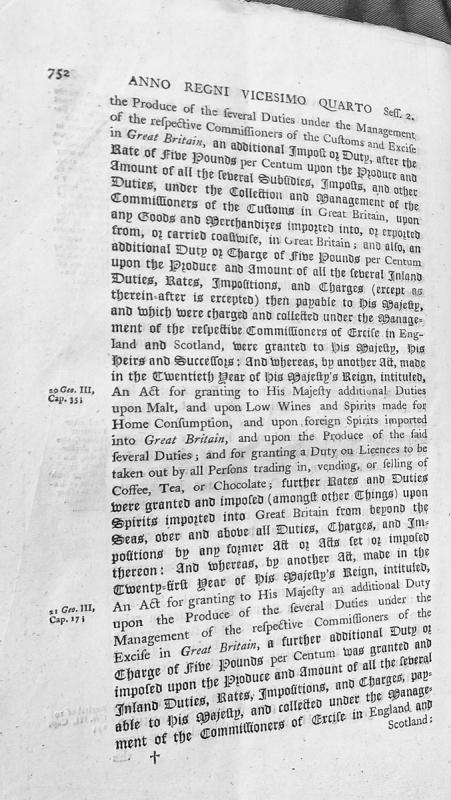
This document is an excerpt from legislative records detailing various acts of Parliament granting additional duties and imposts. It references acts from the 24th, 20th, and 21st years of the reigning monarch's reign, imposing duties on customs, excise, malt, spirits, and other goods, as well as licences for trading in coffee, tea, and chocolate.
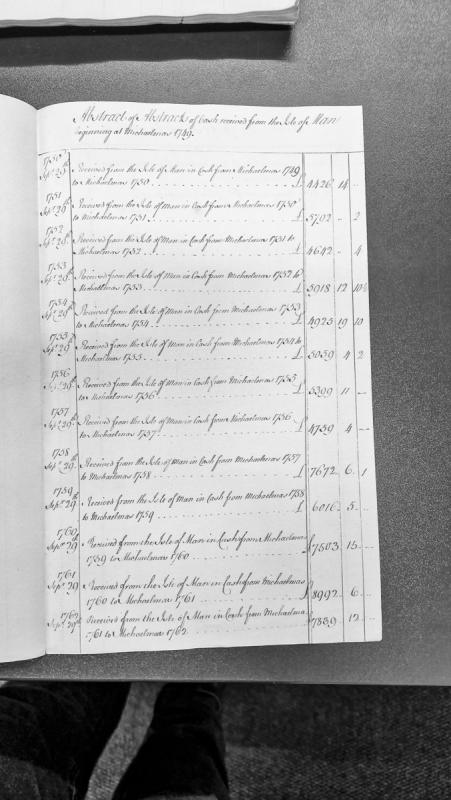
A revenue abstract recording annual cash receipts from the Isle of Man from Michaelmas 1749 to Michaelmas 1762. The document lists thirteen annual entries, each dated September 29th, showing amounts received in pounds, shillings, and pence for the fiscal year ending at Michaelmas.
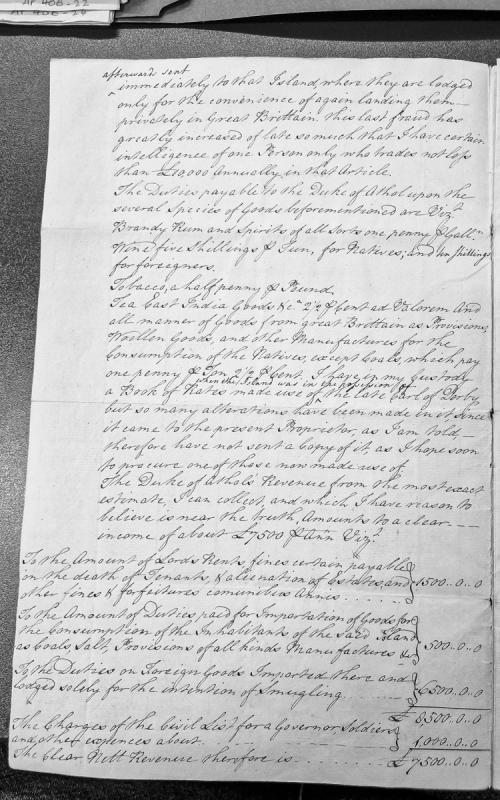
A detailed administrative document detailing the duties payable to the Duke of Athol on various imported goods (spirits, wine, tobacco, tea, manufactures), the scale of smuggling fraud, and a financial breakdown estimating the Duke's annual net revenue at approximately £7,500. The document includes specific duty rates and revenue sources.
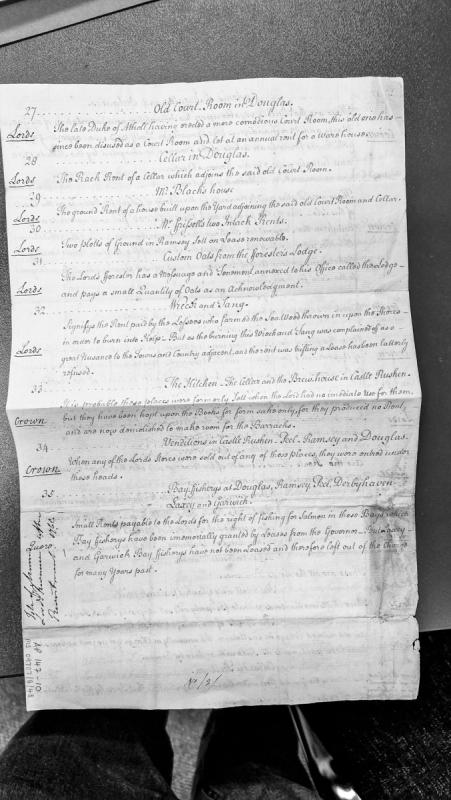
Part of a revenue abstract detailing various rents and revenue sources belonging to the Lord of Mann, including properties in Douglas, Ramsey, Peel, and Castle Rushen. The document explains the nature of each rent (ground rents, rack rents, fishing rights, etc.) and provides historical context for items no longer generating income.