Items

Bemahague
Historic house and estate in Onchan. The evidence pack for Bemahague is comparatively thin. Most of the nineteenth-century references relate to Joseph Jefferson, who was living there while serving as Treasurer of the Manx Society. The Society's membership lists repeatedly give his address as Bemahague, Conchan. In the first volume of the Manx Society publications he appears both in the list of members and as one of the officers responsible for receiving subscriptions. Later volumes continue to identify him with the house. The surviving references therefore establish Bemahague as the residence of Joseph Jefferson during the early years of the Manx Society, but the present evidence pack does not provide enough reliable material for a fuller architectural or estate history.
Bemaken Friary
Medieval Franciscan friary. The single-storey building at the centre of the farmyard with its gable facing the road was the church of the Franciscan friary of Bemaken, founded in the 1300s following permission granted by the Pope in 1367. The grant provided for "a church or oratory, together with a bell-tower, bell, cemetery, houses and other necessary offices" to accommodate a community of twelve friars. The most obvious feature of the church is the now-blocked east window, only part of which survives above a later doorway. The dressed stonework defines a Gothic window. The original roof profile can just be seen in the stonework below the gable verges. Inside, the creation of the doorway in the east gable has removed any evidence for an altar, though a recess where the south wall meets the gable almost certainly marks the position of a piscina. Door and window openings in the north and south walls have the shouldered lintel known as a 'Caenarvon arch', other examples of which may also be seen at Castle Rushen and the Monks' Bridge. The west end of the building has been rebuilt, so the dressed stone surrounding a door and window in the west gable may not be original. The entire structure is now about 19 by 7m, but due to the reconstruction of the west end it is not known whether this reflects the proportions of the original building. It has been suggested that elements of other medieval buildings may be preserved within the masonry of the farmhouse, though this has yet to be proved. Other structures may have been lost when the farmyard was improved during the early 1900s. A number of lintel graves were discovered around the same time in the area to the west of the church though whether these were contemporary with the friary or are evidence of an earlier burial ground is not clear. Two stones bearing ogham inscriptions were found on the farm during the 1800s.
Bemaken Friary
The church stands at the centre of the farmyard with its east gable facing the road. Its most obvious feature is the now-blocked east window, only part of which survives above a later doorway; the surviving original dressed stonework defines a Gothic window. The original roof profile is also visible in the gable, and can just be seen in the stonework below the verges. Inside, the creation of the doorway in the east gable has removed any evidence for an altar, though a recess where the south wall meets the gable almost certainly marks the position of a piscina. Door and window openings in the north and south walls have the shouldered lintel known as a 'Caenarvon arch', other examples of which may also be seen at Castle Rushen and the Monks' Bridge. The west end of the building has been rebuilt, so the dressed stone surrounding a door and window in the west gable may not be original. The entire structure now measures about 19 by 7m, but due to the reconstruction of the west end it is not known whether this reflects the proportions of the original building. The Friary Church is the only surviving building of the former religious house of Bemaken, and the other farm buildings are of various later periods. The church has a modern slate roof and is now used as a store. A plaque on the outside wall states that it is a protected monument.
Bemaken Friary Burial Ground
Graves were reportedly discovered in the 1920s by a farmer at the Friary though their location was never formally recorded. From the description, '40 to 50 yards west of the church', they would appear to have been located where an area of trees stood until cleared in the 1970s. the area is now occupied by an agricultural building and farmland.
Bemaken Friary Enclosure
Medieval enclosure. According to accounts prepared less than twenty years before the dissolution came into force on the Isle of Man, Bemaken Friary was recorded as holding a 'quarter of land comprising 40 acres enclosed by a ditch'. J.K. Barratt in 1964 suggested that the course of the stream just to the north of the friary was likely to have been little changed since medieval times, and also noted that a substantial ditch, nearly a metre wide and lined with flagstones, had once lain approximately parallel, to the SE: the distance between the two watercourses is about 450 - 460m. He proposed that, assuming the main road was on the line of a medieval boundary, that the friary's 40-acre holding could have been accommodated within the space formed by these three features, with the fourth side of an irregular rectangle lying about 360 - 370m SW of the road. The stone-lined ditch to which he referred is now piped under ground for much of its length. It should be noted that the antiquity of the main road past the friary is unknown. It may also be of interest to note that the Friary farm quarterland in 1865 amounted to 140 acres. The grid reference provided lies at the centre of Barratt's notional landholding.
Bemaken Friary Ogham Stone (Manx Cross 3)
This pillar-shaped stone was found at Bemaken Friary (IOMHER 0011.00) where it was noted at least as early as 1885 built into the south wall of the friary church, where it had probably been re-used as a lintel. Once recovered it was found to be incomplete, the upper end being broken off. It bears an incomplete ogham inscription running up one edge, which reads, 'Cunamagli maq?', translated as '(the stone) of Cunamaglus, son of?'. It is now displayed in the Manx Museum.
Bemaken Friary Ogham Stone (Manx Cross 4)
This rounded granite boulder was found at Bemaken Friary (IOMHER 0011.00). Its precise findspot is unknown, but a local tradition reports that it was found in a field bank on the boundary between the Friary and the neighbouring farm of Ballaclague lying to the north-west. The stone bears a simple ogham inscription which spells the name, 'Macleog', from which the modern Manx surname 'Clague' is derived. The stone is now displayed at the Manx Museum.
Benjamin Franklin
Benjamin Franklin (1706-1790) was an American polymath, diplomat and Founding Father. His connection to the Isle of Man relates to the broader political context of the Revestment era and the American colonial dispute, with correspondence in the Island's archives touching on transatlantic trade and the rights of self-governing territories.
Benjamin Franklin to Isaac Norris, 9 June 1759 — Pennsylvania affairs, Indian trade, Board of Trade proceedings
Letter from Benjamin Franklin in London to Isaac Norris in Philadelphia reporting on Parliamentary and Board of Trade proceedings relating to Pennsylvania colonial affairs, including the Indian Trade Act, proprietary disputes, and publication of the Historical Review. Discusses smuggling-adjacent trade regulation issues and constitutional tensions between Assembly and Proprietors.
Benjamin Franklin to Joseph Galloway on Pennsylvania affairs and stock investment
Letter from Benjamin Franklin in London to Joseph Galloway regarding Pennsylvania Assembly business before the Privy Council, including presentation of colonial laws and financial advice on British stocks. Discusses the Proprietor's opposition to Pennsylvania legislation and investment strategy during wartime.
Benjamin Franklin to Thomas Leech on Pennsylvania Assembly proceedings and Board of Trade hearings
Letter from Benjamin Franklin, Pennsylvania's agent in London, to Speaker Thomas Leech and the Assembly Committee of Correspondence, detailing legal proceedings before the Attorney and Solicitor General regarding William Smith's petition against the Pennsylvania Assembly, and Board of Trade hearings on Assembly acts. Discusses constitutional issues of parliamentary privilege, the scope of colonial assembly powers, and proprietary interference with provincial governance.
Benjamin Franklin to Thomas Leech on Smith's Petition hearing and Pennsylvania constitutional privileges
Benjamin Franklin reports to the Pennsylvania Assembly Committee of Correspondence on legal proceedings regarding William Smith's imprisonment by the Assembly, the status of an Attorney General's report, and strategic advice on constitutional issues arising from potential direct Crown governance. Includes discussion of legal opinions on Assembly privileges and a planned propaganda work to improve the colonies' reputation in Britain.
Benjamin Franklin to Thomas Walpole on Walpole Company affairs and land claims
Letter from Benjamin Franklin in Paris to Thomas Walpole in London discussing Franklin's financial interest in the Walpole (Grand Ohio) Company, his request for reimbursement of £200 for two shares, and prospects for the Company's land claims in Virginia. Includes extensive editorial commentary examining the tension between Franklin's role as American diplomat and his private interest in western land speculation.
Benjamin Franklin to Thomas Walpole on Walpole/Grand Ohio Company affairs
Letter from Benjamin Franklin in Paris to Thomas Walpole in London concerning Franklin's financial claims and shares in the Walpole (Grand Ohio) Company, written during the American Revolution. Includes extensive editorial commentary on Franklin's involvement with western land speculation, his role as diplomat, and potential conflicts of interest regarding territorial claims. Contextualizes Franklin's business interests against his diplomatic negotiations and Congressional peace commission work.
Benjamin Franklin to William Franklin on Land Acquisition, Indian Sovereignty, and Colonial Rights
A substantial letter from Benjamin Franklin to his son William Franklin, written in London on 14 July 1773, discussing the Pratt-Yorke legal opinion on Indian land grants, Franklin's evolving theory of settlers' rights to acquire territory independently of Crown sovereignty, land speculation schemes (particularly the Walpole Company and Retribution Grant), political intrigue with Lord Hillsborough, and personal and family matters. The letter provides critical evidence of Franklin's radical constitutional thinking regarding colonial independence and his involvement in western land speculation.
Bergen
Norwegian royal and ecclesiastical centre with direct connections to the medieval Kingdom of Mann and the Isles. The Chronicle of Mann and related Norwegian material repeatedly place Bergen within the political world to which the Manx kings belonged. In 1230 King Håkon IV gathered forces for an expedition to the western seas after conflict among the rulers of the Hebrides. Olave, King of Mann, was described as remaining loyal to Håkon while other western rulers opposed him. The connection became especially clear in 1263. After reports of Scottish pressure in the Hebrides, Håkon ordered troops and provisions to assemble at Bergen. He arrived there in the spring, held a general council near the city at Baeka and prepared the fleet which sailed west against Scotland. Prince Magnus asked to command the expedition in Håkon's place, but the king replied that he was older and had greater knowledge of the western lands; Magnus was left with authority to govern Norway during his absence. Mann was still part of the Norwegian sphere during that expedition. Håkon died in Orkney after the campaign, and his remains were subsequently carried back to Norway. Bergen also appears in the ecclesiastical history of the Manx diocese. A note to the Chronicle records that the marriage of King Harald of Mann to Cecilia, the widow of Gregor Anderson, was celebrated at Bergen in 1248. Following the death of Bishop Simon, Laurence, Archdeacon of Mann, travelled to Norway after being elected bishop by the Manx chapter. A later agreement concerning the Hebrides and Mann was negotiated at Bergen in 1423 and recorded in a document dated 1426, long after direct Norwegian rule over Mann had ended.
Berk Corn Mill
A record for a post-medieval corn mill.
Berrag Burial
The findspot of three sherds of a Bronze Age, cordoned, cord-impressed urn and six fragments of human bone which were associated with a burial site.
Berrey Dhone
The name is first found in print as the title of an air in the Mona Melodies of 1820, according to A. W. Moore, who thought little of the English verses that Barrow wrote for it. The Manx words were printed by Moore in his Manx Ballads and Music of 1896, from the manuscript of the late Robert Gawne, under the heading Berrey Dhone, with an English rendering, Berrey Brown. T. E. Brown, in his prefatory note to the book, called it a witch-song of the ruggedest and most fantastic type. In his own introduction Moore explained the name as that of an ox. Berrey Dhone, Brown Berrey, seemed to him to commemorate the wild pranks of a notorious witch called Margayd-y-Stomachey, Margaret the Stomacher, from her costume, who lived at Cornaa in the parish of Maughold at the end of the eighteenth century. She was said to have been a tall powerful woman, as strong as two men, with a very bad reputation. A pool in the Cornaa river called Poyll Berrey Dhone was where she was supposed to have drowned the ox before flaying it. Moore's informant told him that his own father had seen this woman when he was a boy. The song itself is a search and a theft. The singer asks whether Berrey is in, and where Berrey walks, if not on the green strip beside Barrule. The company go to the mountain to lift the turf and to see whether Berrey will come home at night. The singer walks over Carraghan and over Snaefell, over Slieau Beg, over Pen-y-Phot and over Slieau Ouyr, and each time Berrey was behind the door, once with the slate on his head, once as sure as a rock, once between the hoops of the store. Then the poor man was walking in the wet and the dry, but the old thief with the sack had flayed the ox and eaten it with the fat. The second part names Margad-y-stomachee, who lived at Cornaa and had breeches and a jacket for the journey, and brave yellow and green skirts for walking at night. While the people were at their dinner there was a yellow glimpse in the glen running with the hide, and while they were at supper Margaret was skimming the dish. A quarter of Berrey Dhone went to Ramsey, half the liver and half the heart to the Lord and Lady of Ballayoughey. She was sent to the gallows, but she got favour, came home by Mullagh Ouyr, and picked up a goat. W. Walter Gill, in A Manx Scrapbook of 1929, read the name the other way about. For him Berrey Dhone was the witch, the Queen of the Maughold Witches, at some uncertain date in the past, and the ox was one of the shapes she took, so that she had become confused with the cattle-stealing legend of a more human person, Margad y Staminey, who dwelt in Glion y Spreeagh in the Cornaa valley. He thought the words in Moore's book were a conflation of at least two separate songs. He recorded Lhing Berrey Dhone, Berrey Dhone's pool, in the Cornaa river above the Corrany bridge, where girls from a farm nearby went on the first moon of harvest, walking barefoot over a row of small stones set across a trench, and repeated a rhyme asking Berrey to show them their true lover's form. He was told that two of her pupils could lever up North Barrule from its base so that she and her coven could enter, and that she visited the haunt of the Buggane of Gob ny Scuit on the mountain in her bovine shape. He added a record, without saying where he found it. In 1700, he wrote, the churchwardens of Kirk Marown presented Ann Gelling for cursing the minister as the kindred of thieves and the seed of Bery Doane. Gill wondered whether she was the Caillagh Bhera of Irish tradition, who kept a famous bull. The ballad itself supports Moore. Berrey is found behind the door with the slate on his head and between the hoops of the store, which is where a carcass in a cask would be, not a woman. The thief who flayed the ox is a separate figure, the old woman with the sack, and the closing Manx lines name her as Margad-y-stomachee who lived at Cornaa. Gill's Queen of the Maughold Witches is a later reading laid over the song, and his suggestion that the words conflate two songs is what allows it. The one thing that could alter the picture is the Kirk Marown presentment of 1700. If someone was cursed in that year as the seed of Bery Doane, the name was a byword long before the woman Moore's informant's father remembered at the end of the eighteenth century, and Moore's story would be a late attachment to an older name. Gill reports the presentment and does not say where he saw it. It has not been seen for this site. What is not in doubt is the ground, the Braaids of Cornaa, the green thorn trees, the pool in the river and the hills the singer walks over, all in the north-east of the Island, and the song, which was still sung to a tune that Gill thought called up a vision of Vikings carousing in camp and hall.

Bibliotheca Monensis: A Bibliographical Account of Works Relating to the Isle of Man
A comprehensive bibliography of works relating to the Isle of Man, compiled by William Harrison and published by the Manx Society in 1876 as a revised and enlarged edition (first published 1861). It catalogues historical works from Ranulph Higden (1482) through 1870, covering chronicles, constitutional documents, ecclesiastical histories, and island descriptions. Highly relevant to research on the 1765 Revestment as it indexes contemporary and earlier sources on Manx governance, trade, and constitutional status.
Bibliotheca Monensis: A Bibliographical Account of Works Relating to the Isle of Man
A comprehensive bibliography of works relating to the Isle of Man, compiled by William Harrison and published by the Manx Society in 1876 (revised and enlarged from the 1861 first edition). The work catalogues historical, religious, geographical, legal, and administrative sources from the 15th century onwards, including primary documents, chronicles, maps, parliamentary records, and scholarly works. It serves as an essential research guide for all aspects of Manx history, including governance, ecclesiastical matters, trade, and social history relevant to the 1765 Revestment study.
Big Lawn Flint Scatter
The findspot of an early prehistoric flint scatter including a narrow flint blade measuring 45mm in length.
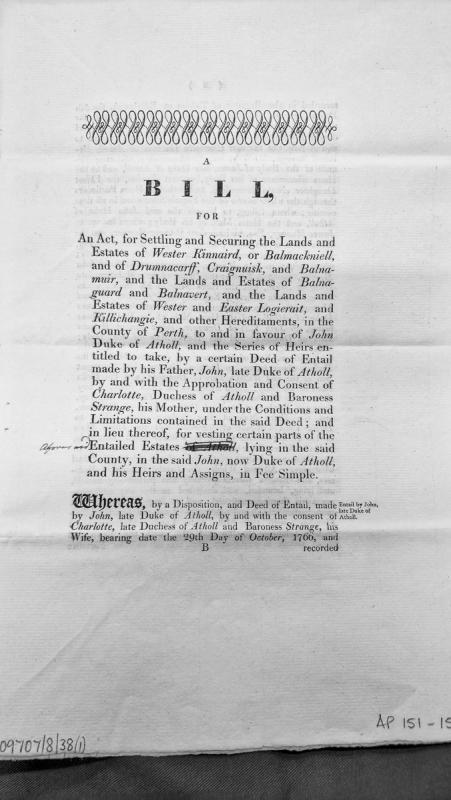
Bill for settling and securing estates in Perth County to Duke of Atholl
A legislative bill proposing an Act to settle and secure various entailed estates in Perth County, Scotland in favour of John, Duke of Atholl, and his heirs. The bill references a Deed of Entail made by his father (also John, late Duke of Atholl) with the consent of Charlotte, Duchess of Atholl and Baroness Strange, dated 29 October 1766. The bill proposes vesting certain parts of these entailed estates in fee simple.
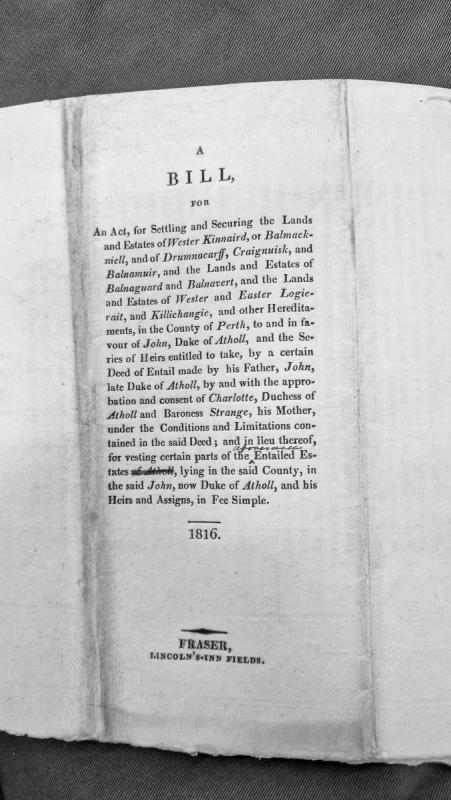
Bill for settling entailed estates in Perth County to Duke of Atholl
A printed legislative bill from 1816 concerning the settlement and security of multiple entailed estates in Perth County, Scotland, in favour of John, Duke of Atholl, and his heirs. The bill seeks to vest portions of these estates in fee simple under conditions specified in an earlier deed of entail made by the previous Duke.
Billown
Worked prehistoric flint of later Mesolithic (heavy-bladed) character has been found at Billown. The material included scrapers and flakes, and was localised to Ordnance Survey Field no. 2441, which is centred at the grid reference provided.