British military department responsible for artillery, stores and fortification works which became involved in the Isle of Man after Crown rule was established.
The Board of Ordnance managed guns, ammunition, military stores and engineering works throughout the British state. Its connection with Mann is clearest after Revestment, when responsibility for the Island’s military stores and fortifications passed from the former lordly administration into Crown structures.
Earlier Manx offices had combined several duties which were later separated. Evidence given in 1792 recalled that the Commander of Derby Fort and the Steward of the Garrisons and Demesnes were offices under the Lords of Man. The former command was described as “almost a sinecure”, while the steward dealt with repairs to the Lord’s houses, forts and castles and with ammunition and carriage.
After Revestment those offices ceased in their old form. The same evidence records later employment under the Board of Ordnance as Store Keeper and Overseer of the Works. These posts placed the practical care of military stores and public works within the British ordnance system.
The change reflected the wider administrative consequences of 1765. Castle Rushen, the Island’s forts and military stores were no longer maintained as part of the private establishment of the Lord of Man but were increasingly handled through Crown departments.
The surviving evidence is administrative rather than architectural: it describes offices, responsibilities and expenditure rather than giving a continuous history of individual fortification works.
Official Board of Trade report to the Privy Council's Committee for Plantation Affairs, dated 24 June 1760, reviewing 19 acts passed by the Pennsylvania Assembly in 1758-1759. The report examines objections raised by the Penn Proprietors to 11 of these acts, including debates over proprietary rights, crown prerogative, judicial tenure, taxation, and legislative authority. Includes extensive legal argumentation on the limits of provincial law-making and the Crown's supervisory power. Contextually relevant to Isle of Man Revestment as a parallel case of colonial constitutional negotiation and proprietary-vs-parliamentary authority disputes.
Before a fishing boat went to sea for the first time, or at the start of each season, it was blessed. The custom connected the practical business of fishing to the spiritual life of the community. The sea was dangerous and unpredictable, and every coastal parish had its stories of boats that did not come back. The blessing acknowledged that danger and sought protection from it, whether from God, from the saints, or from older powers that nobody named too precisely.
In the four corners of this framed declaration are the names of King Edward VII, Queen Alexandra, Rt. Hon. Joseph Chamberlain and Lord Milner.
Boer War.
Plaque reported as missing in 2012 after refurbishment at the Royal British Legion Hall.
This is a transcription of a classical geographic passage from Boethius describing the islands of the Irish Sea and Scottish coast, with the Isle of Man positioned as the first and principal island. The text provides historical context on Man's ancient significance as a seat of the Druids and its geographic relationship to Scotland, England, and other British Isles. It is relevant as background source material for understanding Man's place in medieval and classical geography.
A historical geographical description of Scottish and Irish Sea islands extracted from Boethius's work, focusing on the Isle of Man (Mona) as the principal isle opposite Galloway and England. The text provides classical and medieval context for Man's geography, religious significance, and position within the island chain stretching to the Hebrides and Shetland.
A place-name found at Peel at least as early as 1703 is evidently 'Boayly Spittal' i.e. 'place of the hospital' but there is no record of a hospital, medieval or otherwise, at this site. The name has been identified with the area of land on the east side of the Patrick road at least as far as St German's Place.
The grid reference provided is for indicative purposes only and is approximately centred on the landholding.
A fort surrounded by ditch and circular bank shows also the ruin of a long house similar to that at Poyll Vaish, which proved to be pre-Viking. In the north, west and southwest, steep natural slopes fall to the sea and a steep-sided river course.
There are no natural defences on the east side where fragmentary portions of an artificial ditch is all that remains of the outer defences. The remainder of this ditch has been incorporated in and destroyed by a modern boundary wall. The ditch is 4.0 m wide and 0.5 m deep. Around the east periphery of the interior of the fort, which is raised a minimum of 2.0 m above the surrounding ground, is a bank 2.0 m wide with an inner height of 0.3 m. A crescentic bank 3.0 m wide with an average height of 0.5 m, forms an enclosure with the steep hill side which is comparable to similar enclosures at the side of the Knoc y Trodden vitrified fort. It is grass covered with no visible trace of interior constructions.
The entrance was probably created by a weak bank extending north from the crescentic enclosure bank and the slight overlapping created by the outward swing of the bank around the upper periphery of the fort. In respect of the enclosure bank, this promontory fort is unique among several otherwise similar forts on the island.
Iron Age or Medieval defended promontory. This west-facing coastal promontory is defended on all sides by quite steep vegetated slopes descending to rocks, except to the east where a ditch 4m wide and 1m deep impedes an approach from the land; no obvious causeway is apparent. The landward side of the ditch is protected by a bank which is most obvious towards the north and south terminals.
The interior of the promontory is slightly higher than the ground to the east, and contains a roughly level platform measuring 15m E-W by 25m N-S. A slight bank surrounds the platform and is most prominent along the east or landward side where is about 1m wide with and 0.6m high, broken at SC22171478013 for a distance of 3m which may represent the original entrance. No trace of interior structures has been observed.
The midsummer custom centred on mugwort, gathered at midnight for maximum protective power and worn as a chaplet to ward off enchantment. On Midsummer Eve the bollan bane was pulled and woven. Women wore chaplets of it. Sprigs were pinned to clothes for the Tynwald ceremony the following morning. The herb connected the spiritual protection of the eve to the constitutional ceremony of the day. The sequence mattered: all witches and evil spirits having been disposed of on the previous evening, the great Tynwald Court was held. The Christian saint's name attached to a plant gathered for pre-Christian protective purposes: Bollan-Feaill-Eoin, John's Feast-day wort. The accommodation in a single herb.
John's Feast-day wort: the Manx name for mugwort, the protective herb gathered at midsummer. The name itself demonstrates the accommodation: a Christian saint's name attached to a plant gathered for pre-Christian protective purposes. The bollan bane was gathered on Midsummer Eve, woven into chaplets, and worn to ward off enchantment. The following morning the people gathered at Tynwald, the herb still pinned to their clothes.
Lancashire town where James Stanley, seventh Earl of Derby and Lord of Man, was executed in October 1651.
Derby was captured after the Royalist defeat at Worcester and tried by court martial at Chester. He argued that he had been granted quarter for his life and that the Act of 12 August 1651 under which he was prosecuted did not extend to the Isle of Man. His objection was rejected.
The court sentenced him to death by beheading at Bolton. The surviving account gives 16 October as the date fixed by the sentence, although the execution took place on 15 October.
Derby was deeply concerned by the choice of Bolton. In a final petition to William Lenthall, Speaker of the House of Commons, he offered to surrender the Isle of Man to whatever representatives Parliament appointed and asked for mercy. If his life could not be spared, he asked at least for the place of execution to be changed.
He believed death at Bolton would make his execution appear to be punishment for the bloodshed when Royalist troops had stormed the town in 1644, responsibility for which he denied.
The later Stanley account describes the people of Bolton as responding to his execution with sympathy rather than hostility.
28 May 1644. James Stanley, 7th Earl of Derby, led an infantry assault on Bolton that killed an estimated 1,600 people. When he was captured at Worcester seven years later and executed at Bolton, the town remembered.
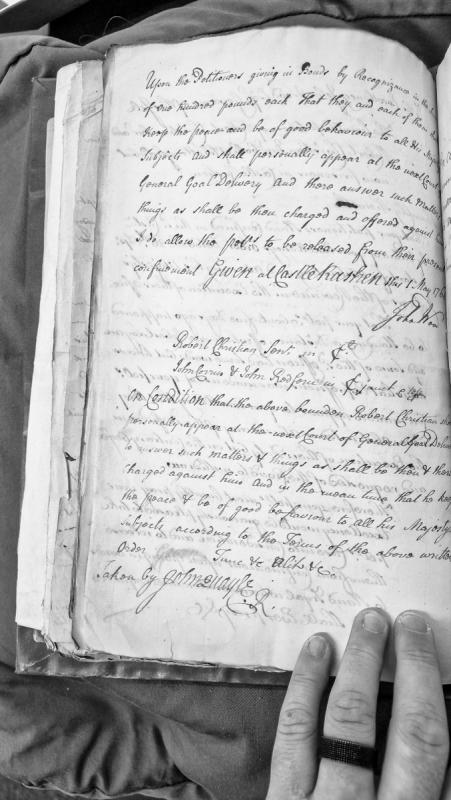
A recognisance document ordering the release of petitioners from Castle Rushen Goal on condition they provide bonds of £100 each to keep the peace and appear at the next Court of General Goal Delivery. Robert Christian is bound by sureties John Corrin and John Rodfone to answer charges.
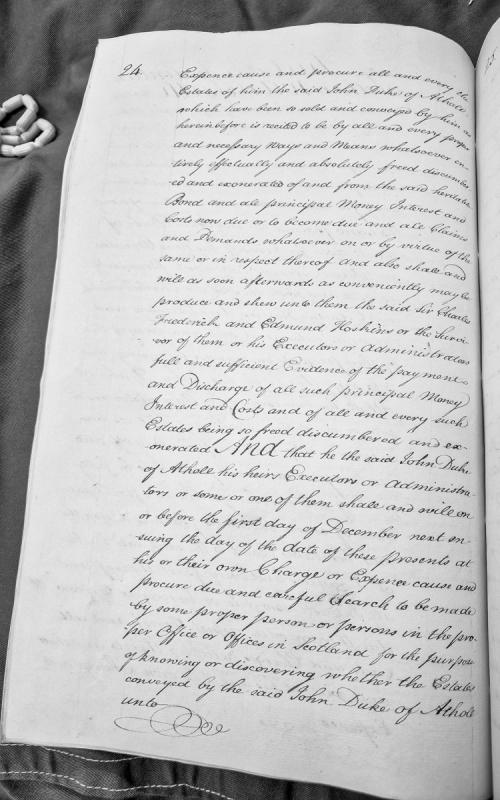
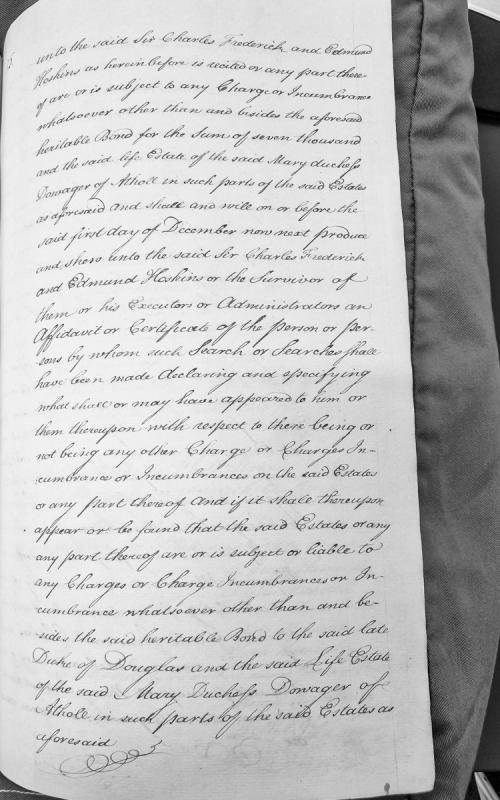
This document is an excerpt from a legal bond or contract concerning the estates of Sir Charles Frederick and Edmund Hoskins. It details conditions requiring searches for charges or encumbrances on the estates, with stipulations about disclosure and affidavits to be produced by December 1st, referencing a heritable bond of seven thousand and life estate interests of Mary, Duchess Dowager of Atholl.
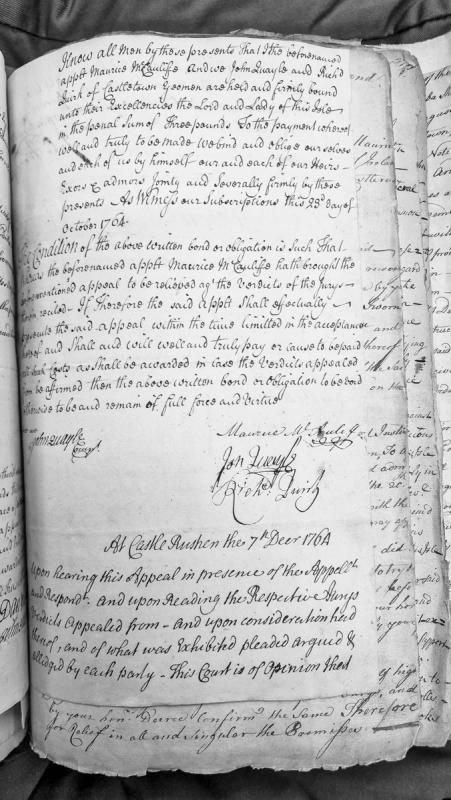
A recognisance bond dated 23 October 1764 in which Maurice McAuliffe (appellant) is bound with sureties John Quayle and Richard Quirk of Castletown for three pounds. The bond conditions require McAuliffe to prosecute an appeal against jury verdicts and pay awarded costs if the verdicts are affirmed. A subsequent court decree from Castle Rushen dated 7 December 1764 confirms the jury verdicts.
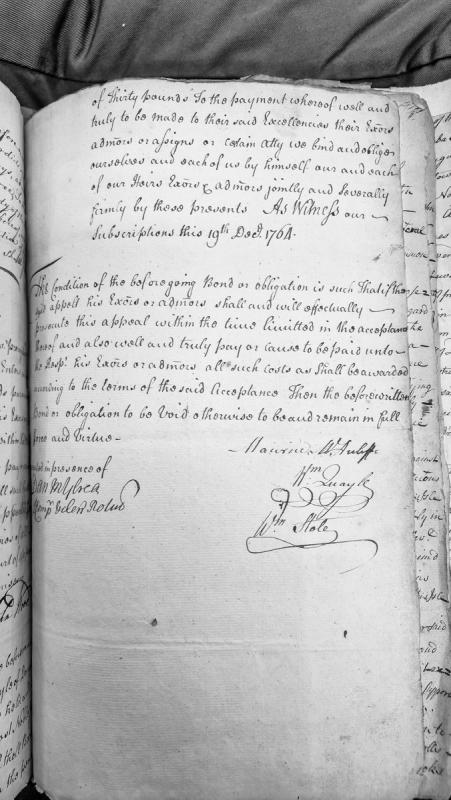
A recognisance bond dated 19 December 1761 binding the appellant Maurice McAuliffe to prosecute an appeal within specified time limits and pay costs as awarded. The bond stipulates a thirty-pound penalty payable to the Crown's representatives if conditions are not met.
A recognisance bond dated January 17, 1763, in which Luke Christian of Kirk Braddan and John Cannell of Peel Town bind themselves in the sum of three pounds to ensure that Thomas [obscured]ain lays his appeal before the Staff of Government within twenty days and provides authentic copies of proceedings. The bond conditions compliance with the judgment of the Spiritual Court if affirmed.
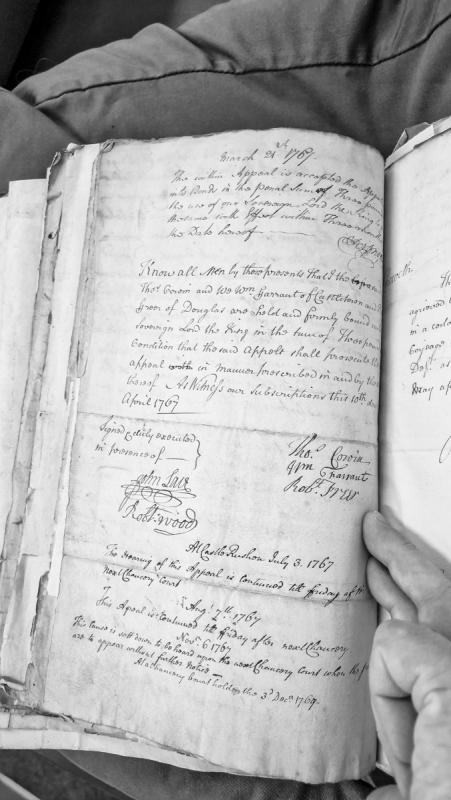
A recognisance bond dated April 16th 1767 binding Thomas Corrin, William Garraut of Castletown and Robert Freer of Douglas in a sum of three pounds to prosecute an appeal according to prescribed manner. The document includes subsequent hearing continuances recorded from July 1767 through December 1769 at Castle Rushen Chancery Court.
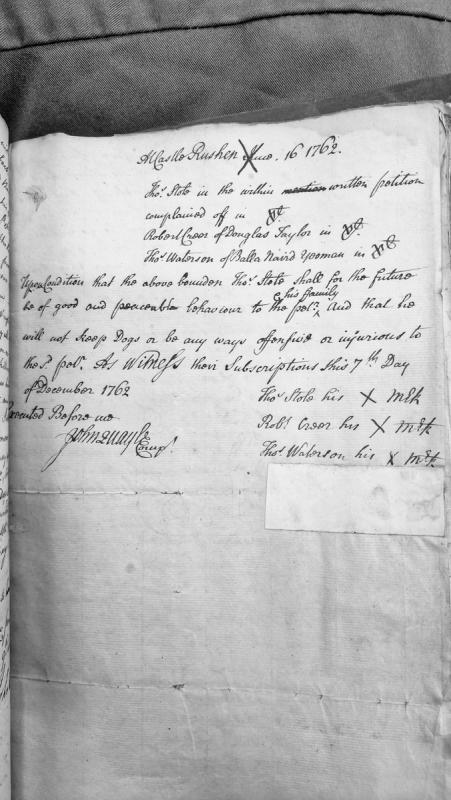
A recognisance bond executed at Castle Rushen in which Thomas Stole agrees to maintain peaceable behaviour toward the petitioner and his family, and to refrain from keeping dogs or causing any nuisance. Robert Croor (Taylor of Douglas) and Thomas Waterson (Yeoman of Balla Naird) stand as sureties.
A legal document detailing the obligations of John Duke of Athole regarding the discharge of a heritable bond on estates he has sold and conveyed. The document specifies requirements for freeing the estates from encumbrance and providing evidence of payment to Sir Charles Frederick and Edmund Hoskins.
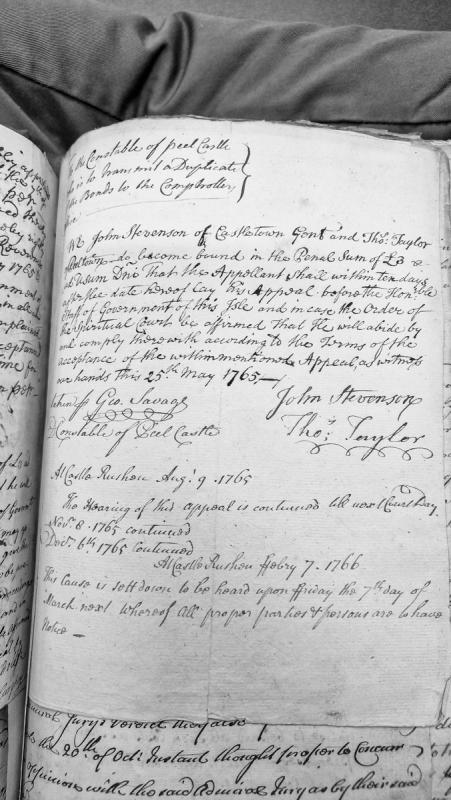
A recognisance bond executed by John Stevenson and Thomas Taylor, binding themselves in the penal sum of £3 to ensure the appellant submits an appeal to the Government of the Isle of Man within ten days and complies with any affirmation of the Spiritual Court's order. The document includes subsequent court continuations and scheduling notes dated through February 1766.
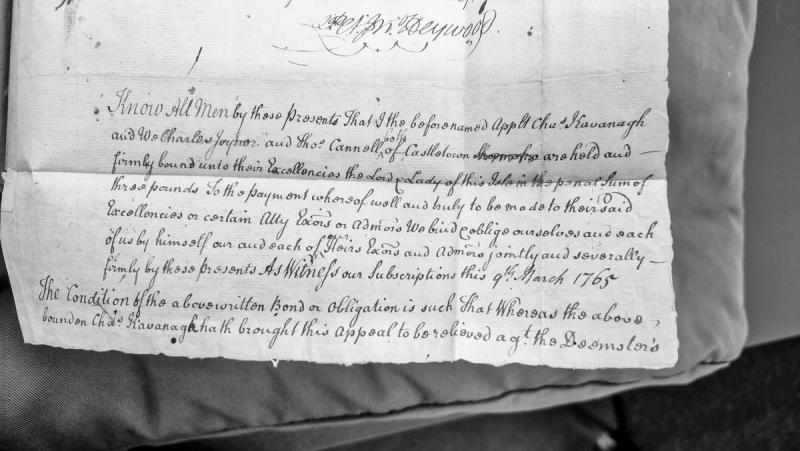
A recognisance bond dated 9 March 1765 in which Charles Kavanagh, Charles Joynor, and Thomas Cannoll bind themselves in the penal sum of three pounds to the Lord and Lady of the Isle. The document indicates that Kavanagh has brought an appeal to be relieved against a Deemster's judgment.


![Bond for Appeal to Staff of Government by Thomas [obscured]ain](https://historicallymanx.com/files/large/02ebcc485387d2f706e9db24343aad01daf86e6a.jpg)