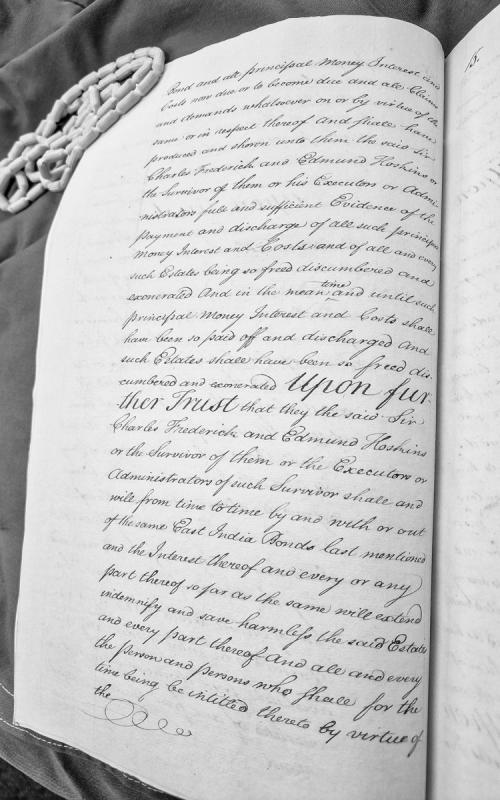
A legal instrument establishing a bond arrangement whereby estates are held in trust as security for payment of principal money, interest, and costs. The document outlines conditions for freeing the estates from encumbrance upon full discharge of obligations and includes indemnification provisions using East India Bonds.
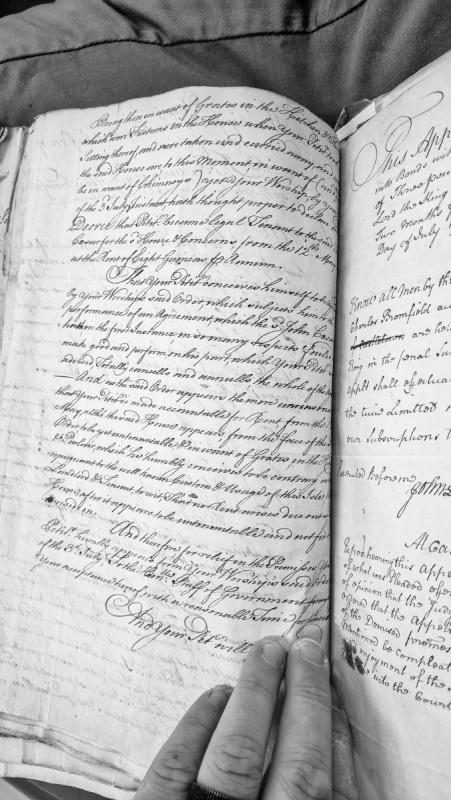
A partially legible bond document mentioning an appeal, with references to a penal sum of three pounds and obligations relating to property (demised premises). The document includes signature and judicial consideration of the appeal with orders regarding completion and enjoyment of the demised property.
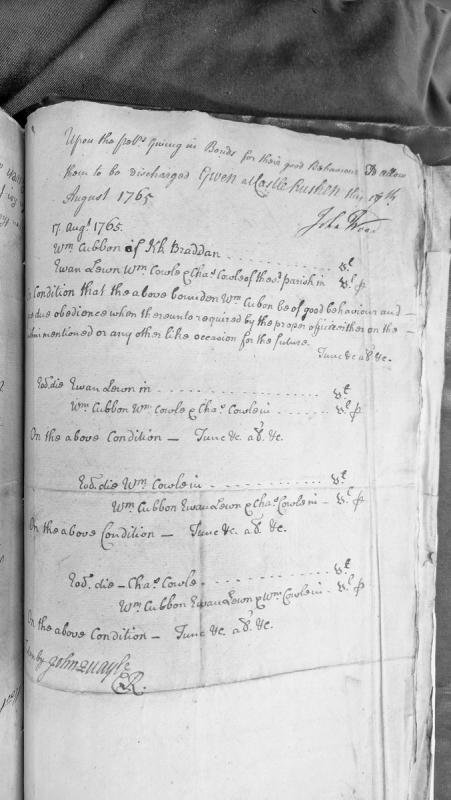
A legal document recording the posting of bonds by prisoners William Cubbon, Ewan Lown, William Cowle, and Charles Cowle at Castle Rushen. Each prisoner and three sureties enter into recognisances conditioned on good behaviour and obedience to officers.
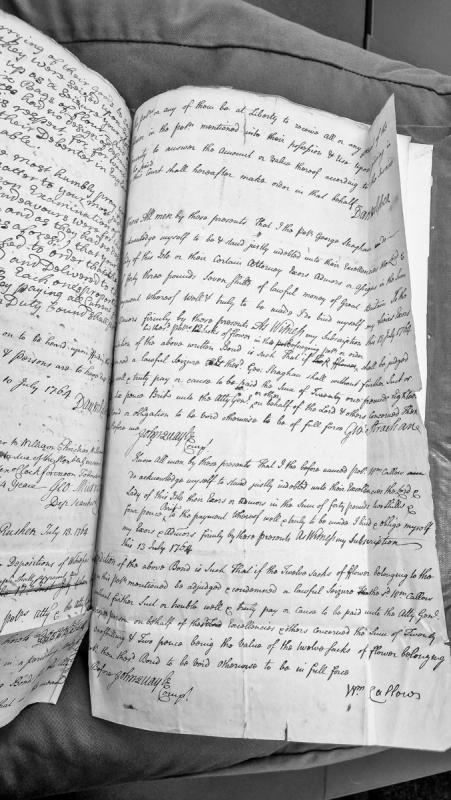
Two recognisance bonds dated 13 July 1764, executed before John Quayle (Comptroller), binding George Strahan and William Callow respectively to the Lord and Lady of the Isle of Man for the seizure of flower (flour). The bonds secure payment of specified sums if the seized goods are judged a lawful seizure.
Undated standing stone.
This large white quartz boulder stands close to the crest of a south-facing slope overlooking Skibrick Hill, which lies just to the south.
It stands 1.5m high and is more than 2m broad across on its widest face. It has a clear view across the valley south towards a similar stone on Skibrick Hill.
There is a well established local tradition that the Billown 'Circle' (PRN 0146) and the standing stones surrounding it are closely associated.
A 1692 tariff schedule establishing customs duties on goods imported and exported from the Isle of Man, along with official fees payable to the Water Bailiff, Customer, and Searchers. Approved by the Earl of Derby (Lord of Man) at Castle Rushen Council. Relevant to understanding pre-Revestment Manx revenue administration and the smuggling trade context.
A 1692 tariff schedule approved by the Lord of Man, detailing inward and outward customs rates on goods, anchorage fees, and official fees for customs officials (Water Bayliff, Customer, Searchers). This document establishes the revenue system governing Isle of Man trade in the pre-Revestment period and provides context for smuggling incentives and fiscal administration.
A record for a corn mill based on a reference in manorial records from 1515, 1643 and 1703. A corn mill is shown in the Glen Wyllin valley on the 1869 1:2500 scale Ordnance Survey map.
The Hill of Day Watch and Port of the Night Watch (Watch and Ward) for Michael parish was at 'Borodaill' according to a document in the Castle Rushen Papers dated 1627.
William Cubbon thought the name was related to 'Bordall Mill' mentioned in a Manorial Roll of 1515, and placed it at Glen Mooar, adjoining Ballagawne where there was a mill.
Many of the Watch and Ward posts may well used the same sites since the medieval period. In the case of Michael parish, the exact site, or sites, at which the respective day and night watches were kept, are not precisely known: the grid reference provided is near the present mouth of the glen, and is for indicative purposes only
A possible Viking sword and battle-axe were reportedly discovered in a burial cist at Borrance. Oswald refers to a report given by the proprietor of Borrane of 'a basket-handled sword of great size and a battle axe... discovered in a stone coffin, rudely formed'.
Borrane is the name of an earthwork on the quarterland of Ballelby (at SC 21527892) as well as the name of another quarterland in the neighbourhood.
Boston is a major port city in Massachusetts on the east coast of the United States. Manx sailors and emigrants passed through Boston during the eighteenth and nineteenth centuries, and Manx people were present in the New England states from at least the time of the American Revolution.
One Manx ship was built there. George Moore of Peel, the merchant whose letter books are the fullest record of the Island's pre-Revestment trade, had shares in a number of ventures, but his chief interest lay in two vessels: the Peggy, of a hundred and fifty tons burthen, of which he owned five-eighths, and the Lilly, of a hundred and twenty tons, newly built to his order at Boston. Both were snows, the two-masted ships popular at that period and almost identical with the brig.
Site of the battle of 22 August 1485, closely connected with the Stanley family who then held the Lordship of Man.
Thomas Stanley, Lord Stanley, and his brother Sir William Stanley entered the campaign while Richard III and Henry Tudor contested the English crown. The Stanley forces remained separate during much of the battle rather than committing themselves immediately to either side.
When Richard attempted a direct attack on Henry Tudor, Sir William Stanley intervened with his troops. Richard was killed and Henry won the battle. Later Stanley family histories credited Thomas Stanley with placing the dead king's crown on Henry's head after the fighting.
Thomas Stanley was subsequently created Earl of Derby by Henry VII. The Lordship of Man remained with the Stanley family, and his descendants governed the Island for more than a century and a half.
Bosworth continued to matter within the family's own political memory. A seventeenth-century account of James Stanley, seventh Earl of Derby, records that opponents at Charles I's court invoked the action of his ancestor at Bosworth when casting doubt upon James's loyalty. The argument was that Lord Stanley had abandoned a reigning king when the crown itself was at stake.
The same family tradition remained visible at Lathom, where nineteenth-century editors noted older memories of the Stanleys' actions at Bosworth and Flodden.
Medieval grave.
A single lintel grave was found in May 1930 by workmen extracting sand from a small sand-pit in Bowling Green Road, Castletown. The grave was found to be covered by a worn and cracked upper mill-stone with a bold design worked upon its upper surface, in place of the usual transverse slabs.
The sand-pit in which the grave was discovered was visited by J.R. Bruce in 1966 whilst researching for the Manx Archaeological Survey published in 1968. The sand-pit was almost completely filled in and grass-grown, and there were no signs of other graves.
There is no known tradition of either a chapel or a graveyard in the area, and no record of any other similar finds ever having been made.
The Ordnance Survey 1:2500 First Edition mapping of 1867 marks a rope works at this location together with the annotation 'Old Rope Walk'.
The rope walk is shown extending approximately E-W for a distance of 180 metres.
This three storey terrace of Victorian houses is cement rendered and has slate pitched roofing. The major portion of the terrace, which has slightly higher floor-floor heights, is occupied by the senior section of the Buchan School for girls. Since the terrace was not designed for this purpose there has been extensive renovation to the interior of much of the terrace, none of which is visible to the outside. The vertical proportion of the rectangular windows is repeated on all floors and the main facade is devoid of decoration except at the northern end of the ground floor where a molded cornice links the end of the terrace with a portico over the main entrance. The panel of cement rendering enclosed by the cornice and the portico is treated to look like cut stone. Several of the openings at the ground floor consist of lanes through to the rear of the property. The building for the most part is in extremely poor repair. There is nothing to distinguish this terrace other than its scale which tends to dominate an otherwise two storey neighbourhood. The presence of the Buchan School constitutes a problem rather than an advantage. There would seem to be no strong reason to consider this terrace for preservation in a community rich with more worthwhile buildings. The terrace does not occupy an important site in the community.
The above assessment was prepared prior to the existence of Registered Building and Conservation Area legislation on the Isle of Man in order to evaluate whether the buildings were worthy of individual protection on inclusion within a conservation area. In the event neither the buildings nor the area have received formal protection.
The grid reference is centred on the five taller properties which comprised the former Buchan School accommodation and were originally built as a piece.
The findspot of a Mesolithic Heavy-blade type flint scatter, found near the lower of the two Norse buildings and thought to have possibly been derived from roofing turves.
Prehistoric flint scatter.
A single worked prehistoric flint was recovered from Brack a Broom by CH Cowley, from the 'Curragh'.
No further details concerning the discovery were recorded and the grid reference relates to the farmstead for indicative purposes only.
The antiquary Charles Harry Cowley was an avid collector of worked flint and coarse stone artefacts revealed by agricultural activity, mainly on farms located around Peel, and occasionally from further afield. He was active from 1900 until 1943. His entire collection of artefacts, together with a daybook cataloguing his discoveries, was later donated to Manx National Heritage.
An alleged stone circle has been reported in this area. At SC 19927149 a "Circle of small stones about.... foot diameter in stony area.' has been noted. The site and its vicinity is on land falling precipitously to the north where survey would be difficult. When visited conditions for field investigation were ideal as much as the heather and grass had been burnt off beforehand, but though the area was closely examined no trace of a circle was found among the numerous erratic boulders. Owing to the steepness of the slope it is doubtful if a circle of archaeological interest ever existed here. Several visits have failed to find any evidence of the reported stone circle.
Bradda Head is a rugged headland rising 116 metres (382 ft) above Port Erin Bay on the island's south-west coast, its old copper-mine workings still visible on the hillside. On its summit stands Milner's Tower, built in 1871 in memory of William Milner, a manufacturer of fire-resistant safes and local philanthropist; the tower is famously built in the shape of a key and lock, a form only fully apparent from above.
Oral tradition indicates that individuals mined copper in this area in the early nineteenth century but traces of fire-setting here may be older. Both lead and copper were mined in the 1860s, as part of the Bradda United Mines operation and, from 1866, that of Bradda Mines Ltd.
Surviving remains here include an engine house with chimney, smithy, various adits and shaft to 72 fathoms, on a platform some 4 to 6 metres above sea level. Spittall's shaft from the cliff top reached a depth of 79 fathoms and connected the North and South Bradda workings which were apparently also linked by an exposed (and long disappeared) walkway around the cliff face. A collapse scar below and east of the Milner Tower may mark the location of the main mineral lode exposed in the cliff faces.
Recorded nineteenth century outputs were low in comparison with Ballacorkish. Between 1850 and 1863, 203 tons lead and 146 tons copper were mined.
Attempts to access this mine are NOT recommended but quite attractive mineral samples can still be found in the area at the end of the track from Bradda West.