An official Treasury account comparing the number and tonnage of vessels belonging to the Isle of Man before and after the Crown's purchase of sovereignty from the Duke of Atholl. The document categorises vessels into foreign trade, legal trade with Britain and Ireland, and smuggling operations, providing concrete evidence of the collapse of smuggling infrastructure following the Revestment. Submitted by Charles Lutwidge, Receiver General.
Charles Lutwidge's detailed letter to the Treasury Commissioners describing the failed prosecution of a tea seizure case in the Isle of Man Court of Exchequer. The letter documents procedural disputes over jury trial rights, the claimant David Angus's appeal to the Privy Council, and Lutwidge's critique of how these proceedings undermined revenue enforcement. Highly relevant to understanding post-Revestment judicial authority and smuggling enforcement challenges.
This is a detailed Treasury account documenting salaries paid to civil and revenue officers in the Isle of Man from 5 July 1767 (when the Revestment Act commenced) to 5 July 1769. It includes quarterly revenue receipts from imports at the four main ports (Douglas, Darby Haven, Peel, Ramsay), arrears of salaries owed to the Governor and civil officers, and specific payments to Charles Lutwidge for his roles as Surveyor General and Water Bailiff. The document provides crucial financial evidence of how the newly acquired island was administered and funded during the immediate post-Revestment period.
Treasury account documenting salaries and incidental expenses paid to revenue and civil officers in the Isle of Man from 5 July 1767 (when the Revestment Act commenced) to 5 July 1769, with arrears due. Includes detailed breakdown of payments to the Governor, Deemsters, Attorney General, revenue officers, constables, and administrative staff, plus receipts from imports at Douglas, Darby Haven, Peele and Ramsay ports.
Official Customhouse record documenting the value of seized goods (primarily tobacco and related products) illegally imported from the Isle of Man into Scotland over a five-year period. The account shows annual seizure values totalling £36,741 and specifies quantities of leaf tobacco, tobacco stems, and snuff destroyed by condemnation. This document provides direct evidence of the smuggling trade's scale immediately before the 1765 Revestment.
Official Customhouse account listing the annual value of seized goods imported illegally from the Isle of Man into Scotland over five years preceding the Revestment (1760–1765). Records £36,741 in total seizures, with detailed breakdown by year and supplementary note on tobacco products destroyed. Directly demonstrates the scale and nature of smuggling trade that prompted Parliamentary interest in acquiring sovereignty.
A detailed first-hand account from a Whitehaven customs officer (Joseph Burrow) reporting on smuggling operations in the Isle of Man. The informant, identified as John Dexter, provides comprehensive intelligence on smuggling routes, merchant networks, vessel operations, cargo handling methods, and distribution channels to Ireland, Scotland, Wales and England. This document reveals the scale and sophistication of the smuggling trade circa early 1765, just months before the Revestment Act.
A detailed contemporary account of smuggling operations from the Isle of Man to Ireland, Scotland, Wales, and England, submitted by Joseph Burrow (Customs House, Whitehaven) to Treasury officials. The document describes the methods used to import prohibited goods (especially tea, spirits, and silk), the ships and crews involved, and smuggling routes and techniques. It includes specific merchant names, cargo details, and operational procedures, providing crucial evidence of the scale and sophistication of the illicit trade that prompted the 1765 Revestment.
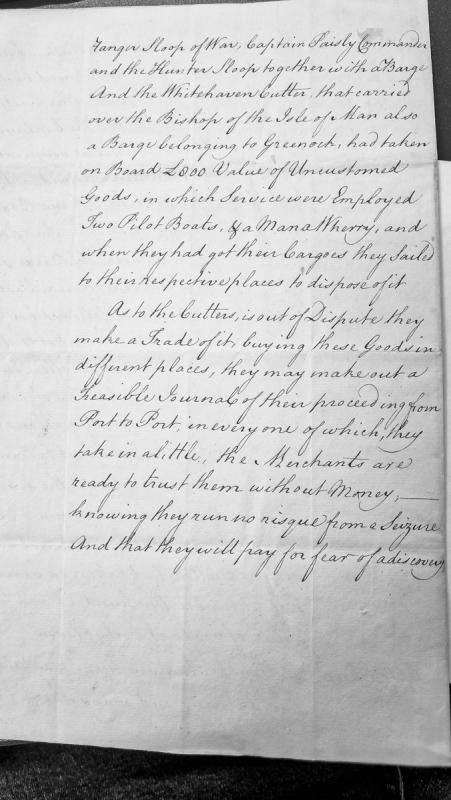
A narrative account describing smuggling activities involving several vessels including the Ranger Sloop of War, Hunter Sloop, Whitehaven Cutter, and various barges. The document details the transport of £800 worth of uncustomed goods and describes the systematic nature of the smuggling trade, noting how merchants trust cutters and maintain port-to-port operations.
This is a detailed financial account submitted by Charles Lutwidge, documenting the subsistence payments (daily allowances) and operational expenses for customs officers and additional staff deployed to the Isle of Man from June 1765 onwards, following the passage of the anti-smuggling Act. The document provides evidence of the immediate administrative implementation of the Revestment and the scale of customs enforcement activity launched to suppress illicit trade.
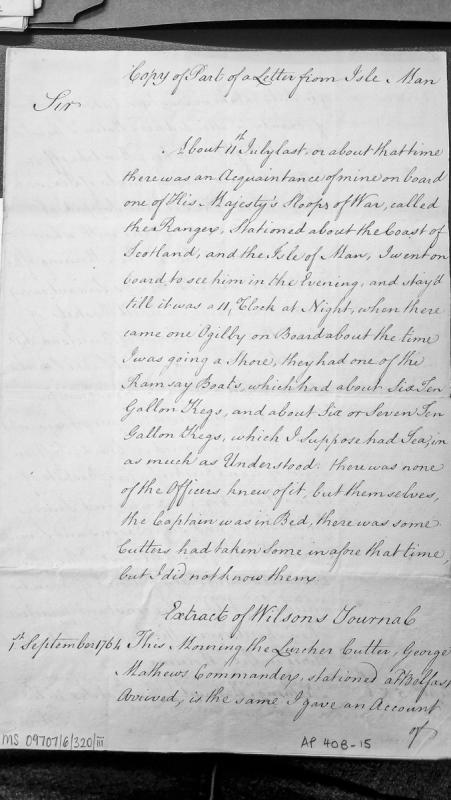
A fragmentary letter describing an incident circa July 1764 involving contraband kegs (suspected tea) brought aboard HMS Ranger by an acquaintance and a man named Ogilby. The letter is followed by an extract from Wilson's Journal dated 1 September 1764 regarding the Lurcher Cutter and its commander George Mathews stationed at Belfast.
Neil Mathieson's scholarly paper examining the life and correspondence of Sir George Moore (1709–1787), a Manx merchant, House of Keys member, and Speaker, and his three sons (Philip, George, James). The document draws on Moore family letter books (1750–1760s) held by the Manx Museum, detailing business ventures, emigration to America during the Revolution, smuggling activities, and the family's complex financial and personal troubles. Directly relevant to understanding Manx merchant life, trade networks, and social context during the Revestment period.
A scholarly article by Neil Mathieson examining the life and correspondence of Sir George Moore (1709–1787), a Manx merchant, landowner, and Speaker of the House of Keys, and his three sons (Philip, George, and James) during 1750–1790. The paper uses Moore family letter books and documents held at the Manx Museum to chronicle their mercantile ventures, involvement in smuggling, American colonial settlement schemes, and personal crises, providing insight into Manx merchant society, trading networks, and family dynamics during the period of the Revestment.
A genealogical and biographical study by Neil Mathieson of the Moore family of Ballamoore, Isle of Man, based on letter books and correspondence held by the Manx Museum. Focuses on Sir George Moore (1709–1787), a Manx merchant and House of Keys Speaker, and his three sons (Philip, George, and James), whose trading ventures in America, France, and India during the American Revolution and post-war period are documented through their correspondence. Directly relevant to understanding Manx merchant networks, smuggling practices, and economic life during the Revestment period.
A scholarly article by Neil Mathieson examining the life and business affairs of Sir George Moore (1709–1787), a prominent Manx merchant, and his three sons (Philip, George, and James) during the late 18th century. Draws on letter books and family correspondence held by the Manx Museum to trace their commercial ventures, family relationships, and involvement in trade (including smuggling), American colonisation schemes, and financial difficulties. Provides valuable detail on how prominent Manx merchant families operated during the Revestment period and beyond.
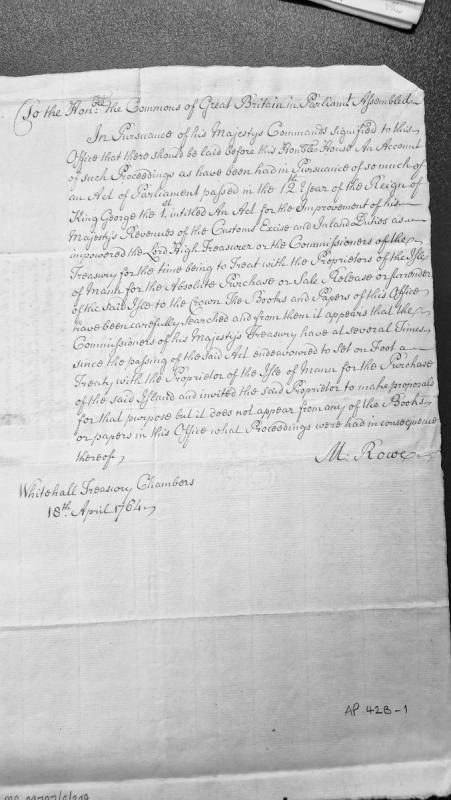
A Treasury Office report to Parliament detailing efforts by the Commissioners of the Treasury to negotiate the purchase of the Isle of Mann from its proprietor under powers granted by an Act of 1714. The document notes that while multiple attempts were made to initiate such a treaty, no records survive detailing the outcomes of these negotiations.
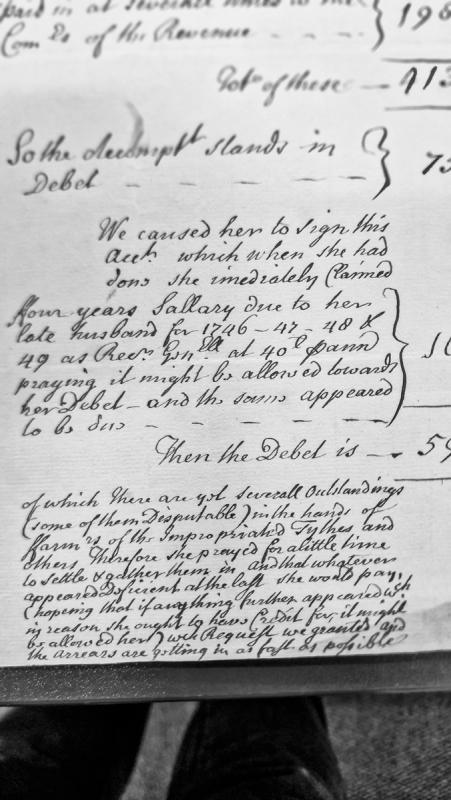
A revenue account document recording the settlement of accounts with a widow, including her claim for four years of salary (1746-1749) owed to her late husband who served as Receiver General at 40 shillings per annum. The document details outstanding debts and arrangements for collection.
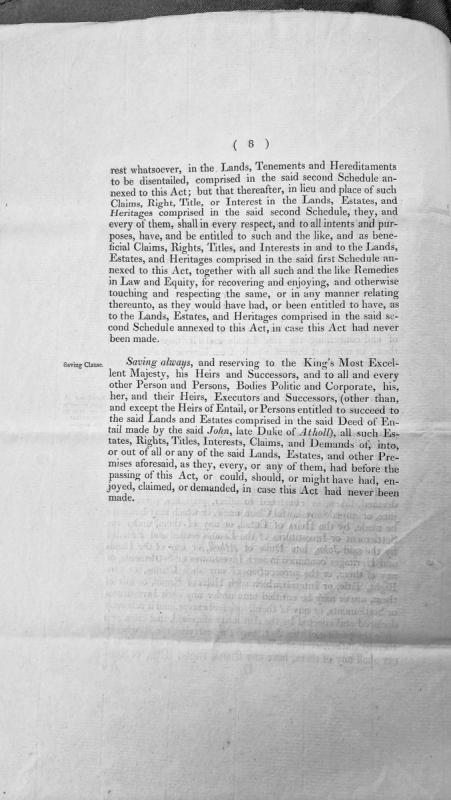
This is page 8 of an Act of Parliament dealing with the disentailment of lands and estates. It establishes that parties relinquishing claims to lands in the second schedule shall receive equivalent claims and remedies regarding lands in the first schedule, with a saving clause preserving the King's and other parties' pre-existing rights and interests.
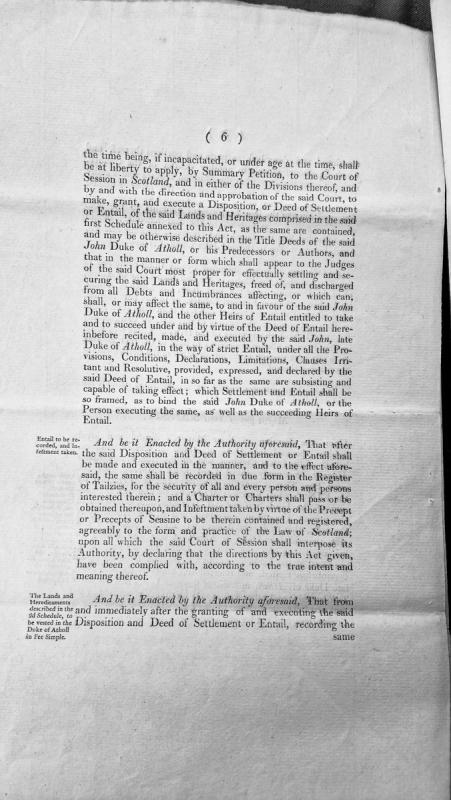
This is an excerpt from an Act of Parliament regulating the settlement and entail of Scottish lands belonging to John, Duke of Atholl. It outlines procedures for executing a Disposition or Deed of Settlement through the Court of Session in Scotland, registration requirements in the Register of Tailzies, and provisions for vesting lands in fee simple.
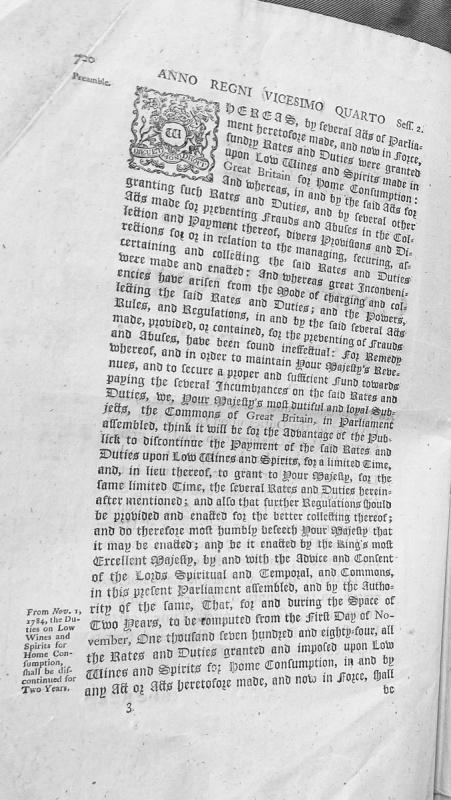
Preamble to a Parliamentary Act (regnal year 24, session 2) proposing to discontinue existing rates and duties on low wines and spirits made in Great Britain for home consumption for a two-year period commencing November 1, 1784, and to enact new regulations to prevent fraud and abuse in collection.
A comprehensive legislative act passed at Tynwald-Court in 1703 by James, Earl of Derby, establishing and confirming the customary tenure system, fines, rents, and services owed by Isle of Man tenants. The act codifies proposals negotiated between the Lord and tenant representatives (including Ewan Christian and John Stephenson) to resolve longstanding disputes over inheritance, alienation, mortgages, and land improvements. Accompanied by explanatory acts on carriages, mortgages, intacks, and quarries. Directly relevant to understanding pre-Revestment Manx constitutional and economic structures.
A comprehensive legislative act passed at Tynwald Court on 4 February 1703 by James, Earl of Derby, establishing customary tenures, inheritance rules, fines, rents, and services for Isle of Man tenants. Ratified by Derby's confirmation in 1704, it also includes supplementary acts addressing carriages, mortgages/alienations, intacks/cottages, and quarry rights. This is foundational documentation for understanding pre-Revestment Manx property law and lord-tenant relations.
The Act of 1709 was an Act of Tynwald passed to regulate the currency of the Isle of Man. It addressed the scarcity of small coinage that had resulted from the growth of trade following the Act of Settlement of 1704, ordering that the copper pence and halfpence coined by Earl James should be current and passable within the Island, and imposing severe penalties for counterfeiting.
The best record of the Act at work is a case of 1723, and it did not go as the court intended. On the day the information was laid, the Deputy Governor sent men to search John Wilks's house. The searcher told George Wilks he had authority to search him on suspicion touching the counterfeit pence, and Wilks said he was at liberty to do so, but the officer, watching him, judged he had a coin about him and on a close search found a counterfeit penny hidden in the back of his breeches. Wilks admitted he had run it himself, both then and openly in court afterwards, saying he had done it to try his flasks and see how they would cast, and to try the metal. The pot for running metal, the flask or mould, and a piece of copper were taken up at the house, and he was committed to close prison.
The jury would not convict. Three of John Wilks's apprentices, Thomas Taubman, David Curlett and John Wattleworth, swore they knew nothing of the making of the pence though they usually worked with Wilks and his father. On 21 May 1723 the jury of indictment acquitted the accused, signing their verdict with their marks. A second body of jurors said they would rather impute that verdict to misunderstanding than to wilful error, and recommended the first jury to the court to be favourably used in their fine and punishment. At the Debt Court on 10 October 1723 the court fined the Grand Jury twenty shillings apiece and declared them incapable of serving on any jury or inquest in future. The Governor afterwards heard their petition, reduced the fines and restored them, holding that their error came of ignorance and a misunderstanding of the law.
English Act of Parliament whose application to the Isle of Man became central to the legal aftermath of William Christian’s execution.
Christian was tried in Mann for treason arising from the events of 1651 and executed at Hango Hill on 2 January 1663. His son George Christian subsequently complained to Charles II that his father had been condemned and put to death despite claiming the benefit of the Act of General Pardon and Indemnity.
The matter was heard before the Privy Council. The Deemsters Thomas Norris and Hugh Cannell, Deputy-Governor Henry Nowell and other members of the Manx court were summoned to England to answer the complaint.
On 5 August 1663 the Lord Chief Justice of King’s Bench, the Lord Chief Baron of the Exchequer and the King’s Counsel gave their opinion that the Act “did and ought to be understood to extend into the Isle of Man” in the same way as to the King’s other dominions and plantations beyond the seas. Because it was a public general Act of Parliament, they held that the Manx judges should have taken notice of it even though it had not been pleaded and no proclamation of it had been made on the Island.
The Council ordered restitution of William Christian’s estate to his widow and children. A later order directed that the Council’s decision should be printed in the form normally used for Acts of Parliament so that the King’s intention to observe the Act of Indemnity should be publicly known.
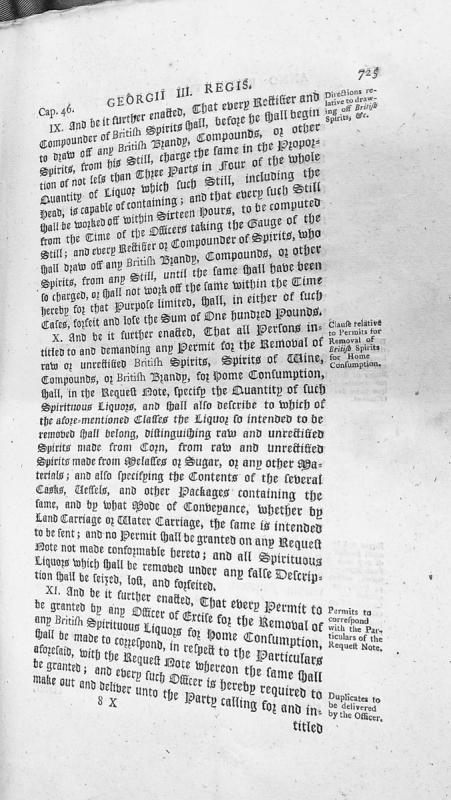
Sections IX-XI of Cap. 46 of an act under King George III regulating the rectification, compounding, and removal of British spirits. The text establishes procedures for charging stills, working them off within time limits, and issuing permits for removal of spirituous liquors for home consumption, with penalties for non-compliance.