Prehistoric flint scatter.
A single worked prehistoric flint was recovered from 'the Brooghs between Cass Struan and Whitestrand' by CH Cowley.
No further details concerning the circumstances of the discovery were recorded and the grid reference relates to the clifftop midway between the two beaches for indicative purposes only.
The antiquary Charles Harry Cowley was an avid collector of worked flint and coarse stone artefacts revealed by agricultural activity, mainly on farms located around Peel, and occasionally from further afield. He was active from 1900 until 1943. His entire collection of artefacts, together with a daybook cataloguing his discoveries, was later donated to Manx National Heritage.
The Castle Arms Hotel on The Quay, nicknamed 'The Glue Pot', is thought to date from around 1750 and was used by soldiers of the garrison stationed just yards away at Castle Rushen. It was operating as a hostelry by 1845 under the name the Queen's Arms and was known simply as 'the Castle' by 1853. Its nickname is said to derive from smugglers who called in for refreshment and reputedly found it hard to leave. One of the oldest public houses on the Island, it was saved from closure by public outcry in the late 1980s and refurbished in the early 1990s, and it holds the distinction of being the only pub in the British Isles depicted on a banknote, appearing beside Castle Rushen on the Manx five-pound note.
Castle Hill House stands on Castle Hill in Douglas (IM2 4AD) and appears on the Isle of Man's Registered Buildings list. No verifiable historical detail beyond its address and registration could be confirmed online for this specific building, as distinct from other similarly-named buildings on the Island.
The original square stone building of the Castle Mona Hotel consisted of two three storey wings front and back joined by a two storey 'link' of similar plan size. The flat roofs of the wings are concealed behind parapets decorated with roundels and garland motifs except over the entrance where castellations indicate the substantial protruding porch with its columns and wrought iron balustrade to a flat roof. The central link has a slate pitched roof visible through a castellated parapet. The well proportioned rectangular windows decrease in their vertical dimension with each succeeding storey but receive the same treatment on all elevations of the structure. The building is crowned by a circular castellated tower rising from the rear of the main facades toward Douglas bay. A recent extension to the sea creates a large terrace with wrought iron balustrade on the roof of the single storey alteration which is fronted by shops onto the main pavement of the Cresent. No interior inspection has been made. Although the developments of the promenades at Douglas has detracted from the siting of Castle Mona by leaving it behind the main visual facade, the building is still impressive both for its quality of architecture and its historic significance as the early residence of the Duke of Atholl (Governor General of the island 1793-1830).
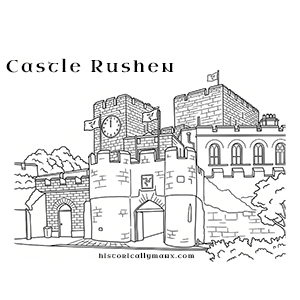
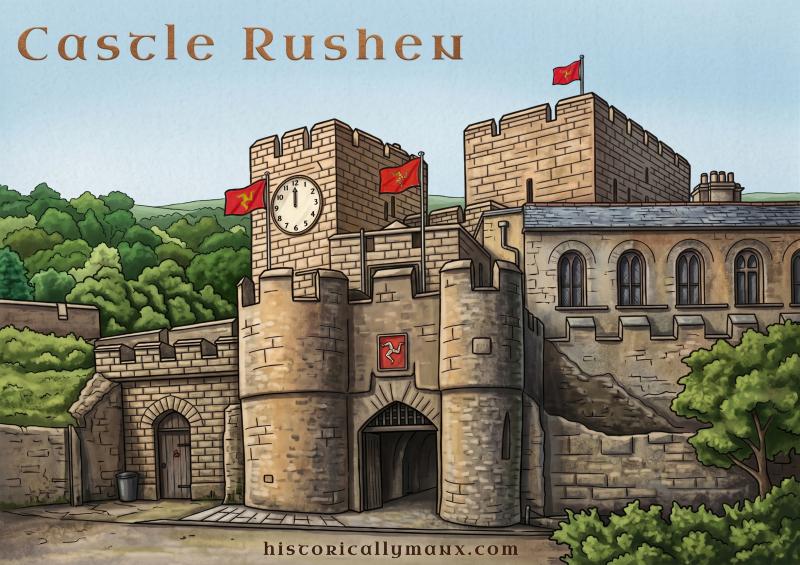
Castle Rushen in Castletown is one of Europe's best-preserved medieval castles, with origins likely in the 10th-11th centuries under the Kings of Mann and the Isles; an oak beam dated to 947 was found in its walls during 19th-century repairs. It was besieged and captured by Robert the Bruce in 1313 after a three-week siege, bringing the island briefly under Scottish control. From 1405 to 1738 the Stanley family (Lords of Mann) governed the island from the castle, which also served as an administrative centre, mint, and law court. Its defensive role declined through the 18th century and it was later used as the Isle of Man's prison until 1891. Restored by Manx National Heritage, it reopened as a heritage museum in 1991 and remains a dominant landmark of Castletown, the island's former capital.
The royal castle at Castletown, seat of the Lords of Mann since the Norse period. A limestone fortress that has served as royal residence, garrison, prison, and seat of government across eight centuries. The castle the Lords held, the Governors occupied, and the Crown inherited. Its continuous use across every period of the Island's history makes it the physical thread connecting the Norse kings to the modern Crown dependency.
For much of the 19th century (1813-91) the keep was the focus of prison activity whilst the castle served as the Island's main gaol. Major alterations included the insertion of a stairwell within the SW corner and various breaches through the walls to reach new accommodation blocks and exercise yards constructed within the inner bailey. Some of these changes were restored once the castle ceased to be a prison, during a restoration programme conducted under Lt Governor Lord Raglan between 1904-10.
Medieval mantlet.
The keep was strengthened in the first half of the 14th century by the addition of a drawbridge and mantlet protecting an entrance facing north and inland along the west bank of the Silverburn. It is thought that a small bailey may have been attached, which is reflected in the layout of nearby streets in the modern town.
Medieval gatehouse.
The gatehouse was added in the mid- to late- 14th century, as part of the gradual development of a curtain wall circuit around the keep.
Modern courthouse.
The upper level of the gatehouse served as a courthouse until the early 21st century, preserving administrative and judicial functions connected with the castle as the gubernatorial seat, and the surrounding town as the Island's capital until the late 19th century.
Medieval curtain wall.
The castle's defences were gradually strengthened and extended through the 14th century by the development of a curtain wall circuit protecting the keep. Development began with the early construction of the mantlet, and continued in an anticlockwise direction culminating in the development of the outer gatehouse and eventually the barbican. From as early as the third quarter of the 14th century the curtain wall defences included provision of artillery, positioned in turrets.
Post medieval barbican.
The barbican was developed from the 14th through to the 16th century. Its masonry shows a varied development history, complicated by the scars left after the removal of a police station around the turn of the 20th century.
Post medieval counterscarp and glacis.
During the second quarter of the 16th century, protection of the curtain wall against artillery was provided on the east and south sides by the addition of a counterscarp wall faced with a glacis. Now covered in turf, the glacis was originally faced in stone.
Medieval stone castle.
Castle Rushen is widely regarded as one of the most complete medieval fortresses in Europe. It was begun by the Norse kings of Man in the later 12th century, probably by Reginald (1187-1226), though its form was influenced by Anglo-Norman design. It was captured by Robert Bruce during a Scottish raid in 1313 that was intended to frustrate English activity in the Irish Sea, but seems to have undergone repair and significant development soon after.
In 1417 it was the location for a Tynwald assembly and again in 1422 for an assembly held before Sir John Stanley, the new English overlord. At this time it had attained its modern height and a curtain wall had been added. By the 16th century further development had taken place, transforming it into an artillery fortress protected against cannon-fire by an outer glacis.
In the mid 17th century the castle was refortified by James Stanley the 7th Earl of Derby as part of his defence of the Island against Parliamentary forces. In spite of this the castle fell due to a rebellion by the Manx against the Stanley family in 1651 in the face of a threatened siege by Parliamentary forces.
More recently the castle served a more administrative function, acting as the governor's residence and as a prison. In the early 1900s the many late accretions resulting from its development as a prison were removed, restoring it to some of its former glory as a medieval fortress and the seat of kings whose power held sway over the Irish Sea and the Western Isles of Scotland.
Castle Rushen is among the best-preserved medieval castles in Europe, its origins lying in a Norse-period stronghold raised to guard the entrance to the Silverburn River. The keep, the oldest surviving part of the castle, dates to the late twelfth or early thirteenth century, the time of the Kings of Mann and the Isles, and was besieged by Robert the Bruce in the early fourteenth century. The castle was steadily developed over the following centuries: by 1313 the keep had been reinforced with towers, and through the fourteenth century an east tower, gatehouses and curtain wall were added. Beyond its role as a royal residence, Castle Rushen has served over the centuries as a mint, a law court, an administrative centre for the Island's government, and, for more than a hundred years until the late nineteenth century, a prison. It is now run by Manx National Heritage as a museum and educational site at the heart of Castletown.
Post medieval round tower.
The south and east-facing aspects of the outer glacis were once strengthened at this point by the presence of a substantial tower, now demolished to below ground level as a consequence of road widening.
Post medieval tower.
The approach to the castle from the north was protected from the early 16th century by the construction of an outer artillery tower. Unlike the other outer defensive strongpoints constructed in this period, the Round Tower was not physically connected or incorporated in the glacis.
Castle View, at 1 Parliament Square, is a Registered Building entered on the Protected Buildings Register in 1984. No further documented history was found beyond the bare registration record.
The Castlemona (Castle Mona) was built between 1803 and 1804 as the residence of the 4th Duke of Atholl during his time as Governor of the Isle of Man, designed by the Duke's Perthshire retainer George Steuart and completed at a cost that ran well over budget. Before 1850, Queen Victoria reportedly considered buying the house as a royal residence in preference to what became Osborne House. The building was converted into a hotel in 1831 and, by the mid-twentieth century, had become the Island's premier hotel, hosting its first licensed casino; a further accommodation and dining wing was added in the early 1960s and a bowling alley extension followed in the early 1990s. The 98-bedroom hotel closed its doors in 2006, and although the Sefton Group acquired the building in 2007 with plans to restore it, those plans were never carried through, leaving the once-grand hotel on Castle Drive standing empty in recent years.
Historic capital and harbour town in the south of the Isle of Man, built around Castle Rushen.
Castletown developed at the head of Castletown Bay where the Silverburn enters the sea. Castle Rushen dominated the harbour and provided the seat of government, court, prison and residence of the Governor. The settlement which grew around it became the principal administrative town of the Island.
A church dedicated to St Mary was established at Rushen or Castletown by the thirteenth century. The church was dedicated in 1260 during the episcopate of Bishop Richard. Later descriptions record the old church, chapel and free school among the public buildings of the town.
The castle brought a concentration of officials into Castletown. The Governor, Deemsters, Attorney-General, Clerk of the Rolls and other officers attended courts there, while the House of Keys met close to the castle. Government business therefore took place within a few streets of the harbour.
Castletown bridge was described in the eighteenth century as a stone bridge of handsome breadth, sufficiently high for a boat carrying its mast to pass beneath it. Across the river stood the property later known as Bridge House, associated with the Quayle family and the yacht Peggy.
The harbour connected the town with the southern roadsteads at Derbyhaven and Ronaldsway. Castletown itself was one of the appointed ports of the Island, while nearby Derbyhaven provided a broader natural anchorage. The surrounding district contained many of the Island's principal southern estates and lay close to Rushen Abbey and the fertile plain around Malew.
Markets were held on Saturdays. One eighteenth-century account remarked that butcher's meat was commonly bought by several households joining together to purchase a whole carcass, while herrings and potatoes formed a much more regular part of the diet.
Castletown remained the seat of the Island's government into the nineteenth century, although Douglas increasingly overtook it in population and commerce.
Modern harbour breakwater.
The outer breakwater at Castletown was begun in 1844 and completed in 1845, by the Island's Harbour Commissioners. The cost was £2,700, and its construction created the New Basin, sometimes known as the 'dry harbour'.
Its creation was criticised in an offical report published in 1845 as 'unnecessary', and was stated not to have been built in line with the recommendations of engineers or local fishermen and pilots.
The breakwater was extended by 30 yards in 1849, and marked with a masonry beacon. Its total length is 185m.
Modern brewery.
The Ordnance Survey 1:2500 First Edition mapping of 1868 shows a brewery centred at this location. Brewing appears to have been conducted at the site for several decades prior to this.
The brewery complex ceased operation in 1986, and was demolished in readiness for a residential redevelopment which was completed a few years later. The site, and the road alongside, is now known as Brewery Wharf.