The site of a fortification which has been said to be the only medieval motte and bailey castle on the Island, but which has been generally accepted to be an Iron Age fort.
The field in which it stands was known as Magher y Caggey or Field of the Battle. In 1929 it was visited by the Cambrian Archaeological Association when Dr Gardner said that the work was of feudal, not tribal construction. If found on the mainland, it would be known as a Motte and assigned to the 12th century. A letter to the Ordnance Surveyor in 1867 claimed this was the remains of a Cromwellian fort. There is no corroboration in history to support either of these opinions and the site has not been excavated.
This could not have been a place of defence in historic times as the fact that it is over-looked by the nearby ridge to the west would make it untenable.
A two storey, double-fronted house. During its lifetime the property was converted into two dwellings, resulting in a pair of front doors, and extensions to the rear. Following a return to single occupancy, and later acquisition by the Manx Museum, the rear extensions were combined and the ridgeline raised to achieve a more uniform form.
The property was acquired by the Manx Museum and National Trust in 1996.
Two storey, double-fronted house. Originally constructed before 1868 (present on Ordnance Survey 1:2500 1st edition map of that date).
During its lifetime the property was converted into two dwellings, resulting in a pair of front doors, internal alterations, and extensions to the rear. Following a return to single occupancy, and later acquisition by the Manx Museum, the rear extensions were combined and the ridgeline raised to achieve a more uniform form.
The property was acquired by the Manx Museum and National Trust in 1996.
The deep ground before governance. The physical island, the spiritual landscape, the keeills and holy wells, the accommodation principle that would define Manx life for a thousand years. Celtic Christianity layered over older traditions without displacing them. Manannán's rent paid in rushes at midsummer. The spirit taxonomy — phynnodderee, buggane, mooinjer veggey — all carried Manx Gaelic names, not Norse imports. The world before Tynwald was recorded, when the Island's identity was already formed.
The Central Hotel on Bowring Road occupies the site of the former residence of High-Bailiff Frederick Tellet, father of the later Dr Tellet, according to local reminiscences published in the Ramsey press; Tellet's house had a large attached garden, and the hotel's stables were later built on the garden's former ground. It operated as a public house for many years, closing temporarily after flooding in December 2015 before reopening in March 2016, and is now recorded on the Isle of Man's Registered Buildings list as a former hotel.
The former Central Hotel stands at the lower end of Broadway, a road linking upper Douglas to the bay, and was reportedly a large red-brick hotel building opening around 1888. It has since been converted into apartments while retaining its Victorian street presence. Detailed archival confirmation of its architect and opening date could not be independently verified from a primary source, so this description is kept cautious.
A royal certificate from the Exchequer Treasury documenting the surveyal and valuation of Furness Abbey's properties following the Dissolution of the Monasteries. The document lists temporal and spiritual possessions in the Isle of Man, including land holdings (Rouat wathe) and appropriated parsonages (St Mawlde and St Michael), with annual rental values. Relevant to understanding pre-Revestment Manx landholding and ecclesiastical structures.
A certified statement and oath documenting provisions (bread, coals, candles) delivered by John Younger, agent to Anthony Bacon, to His Majesty's Troops in the Isle of Man between 6 April and 7 July 1770. The certificate is sworn before Calcot Heywood, a Deemster, and countersigned by Captain John Hedges of the 48th Regiment. Relevant to post-Revestment military administration and supply logistics on the Island.
Official certificate and sworn statement certifying delivery of provisions (bread, coals, candles) to the 48th Regiment of Foot stationed on the Isle of Man between April–July 1770. The document shows military provisioning arrangements on the island and was submitted to the Lords of the Treasury for accounting purposes.
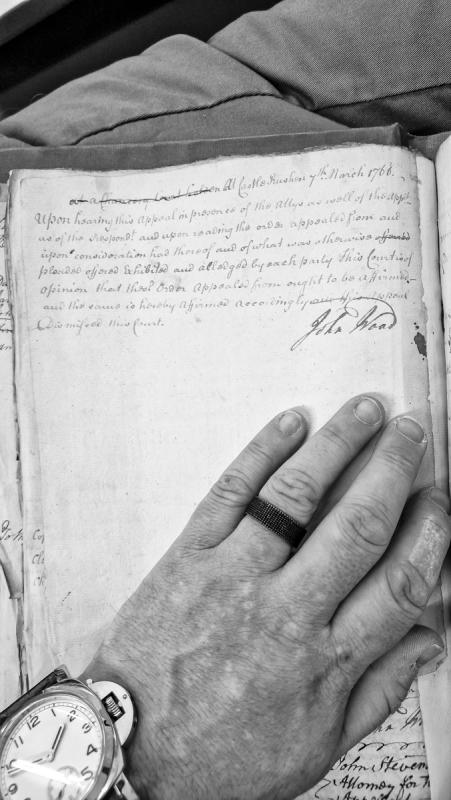
A Chancery Court judgment delivered on 7 March 1766 at Castle Rushen, affirming an appealed order following oral arguments from both appellant and respondent counsel. The court dismissed the appeal after reviewing the original order and hearing evidence from both parties.
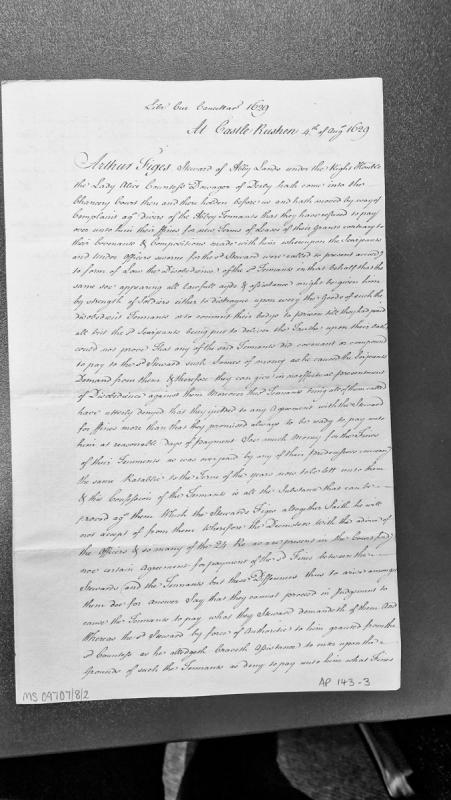
A Chancery Court record from Castle Rushen documenting a complaint by Arthur Figes, Steward of Abbey Lands under the Countess of Derby, against tenants who refused to pay fines for lease terms. The court examined whether the tenants had covenanted to pay specific sums, ultimately finding no certain agreement existed between the steward and tenants.
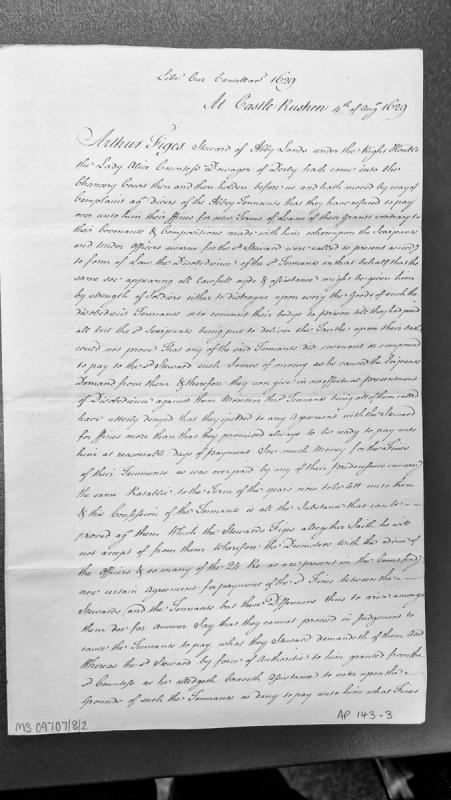
Record of a Chancery Court hearing at Castle Rushen where Arthur Figes, Steward of Abbey Lands under the Countess of Derby, brought complaint against abbey tenants for refusing to pay fines for new lease terms. The Deemsters and court officers find no certain agreement for payment and decline to compel the tenants to pay the demanded fines.
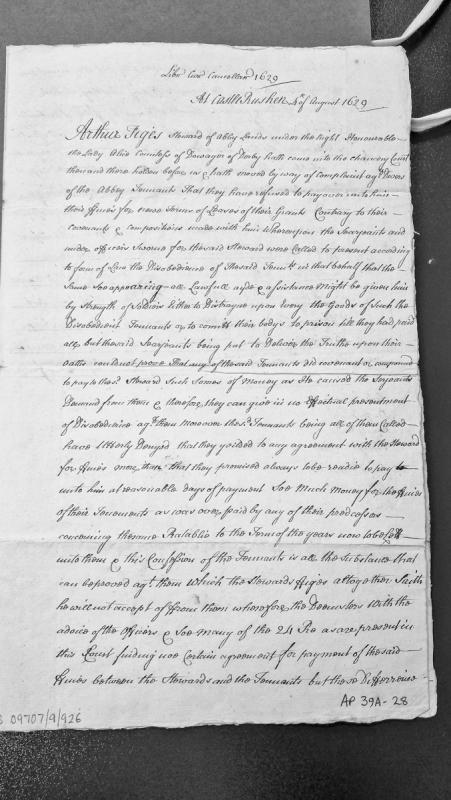
A Chancery Court record from Castle Rushen documenting a complaint by Arthur Jiges, Steward of Abbey Lands under the Countess Dowager of Derby, against abbey tenants who refused to pay fines for new lease terms. The court found no binding agreement between the steward and tenants regarding payment amounts, ruling the tenants need only pay fines consistent with historical precedent.
A worked stone found at Chapel Hill, close to the chapel and enclosure bank at the west end of the hilltop.
The stone was used for grinding, smoothing or sharpening, and is bar-shaped: rectangular in outline and cross-section. It measures 150 x 45 x 20mm.
The natural stone in the immediate vicinity is limestone.
The stone is in the Manx National Heritage collections, accession no. 1954-1635.
A pebble of dark igneous rock found in a ploughed field below Chapel Hill. The location appears to indicate the field to the north-west of the hilltop, and the grid reference reflects this.
The stone appears to have been used for rubbing or smoothing, and measures 65 x 50 x 25mm.
The stone is in the Manx National Heritage collections, accession no. 1984-0226.
A circular depression 0.4m deep and 7m in diameter is apparent at this point. Excavation in 1918 revealed an extended burial orientated EW in a rock-cut grave. It is not clear whether the depression results from the excavation or was previously apparent.
A stone-lined cist orientated NW-SE lies near the northern edge of the hilltop. It is exposed at the surface, but sunk 0.1m below ground level, and there is no trace of either a capstone or mound. The cist measures 0.6 by 0.4m internally, and the lining slabs are 0.4m high and 0.1m thick. Fragmentary remains of human bone were found within the cist, which was evidently disturbed in antiquity and had an upper fill consisting of later occupation debris.
Two deposits of cremated human bone were found just a metre from the cist, one to the north and the other to the SE. The former made use of a fissure in the underlying bedrock, and also included the burnt remains of a bone pin.
The excavator suggested that all three features were once protected by an overlying mound, and remarked that the cremations were probably secondary to the cist, but that it could not be ascertained how much later they were added.
The earliest antiquarian investigations of Chapel Hill, reported by the Archaeological Commissioners in 1878, describe the presence of graves around Keeill Vael, and excavations centred on the keeill in 1918 and the ship burial in 1944-45 also found burials. The 1918 investigations took the opportunity of excavating narrow trenches across the hilltop and the encircling banks, and recovered further evidence of burials some distance from the keeill.
The excavation of the ship burial at the east end of the hilltop by Gerhard Bersu showed that the ship had been placed above a cemetery of lintel graves, and suggested that some of the burials might have been quite recent at the time the ship was moved into position. This has led to suggestions that the cemetery was deliberately slighted, but there is no clear evidence for this assumption.
A scatter of Mesolithic worked flints was found during the excavation of Chapel Hill in the 1940s by G. Bersu.
It would appear that collection of the artefacts was not restricted to the area of the excavation itself, and the grid reference is therefore only centred on the hilltop for indicative purposes.