
Make Your Own Smuggling Boat
Fold a paper boat, waterproof it, add a sail — and learn why smuggling was the engine of Manx life for over a hundred years.
The Running Trade
For over a century before 1765, the Isle of Man sat at the heart of a vast smuggling network. The island’s customs duties were far lower than Britain’s — because the Manx government wasn’t fighting wars on three continents or paying interest on a colossal national debt. Goods could be landed on the island, entered legitimately through the Duke of Atholl’s customs, warehoused, and re-exported. What happened to those goods after they left the island was, strictly speaking, not the island’s concern.
This was the running trade, and it was the engine that drove everything. Small, fast boats ran cargoes of tea, brandy, tobacco, and silk across the Irish Sea to the coasts of England, Scotland, Ireland, and Wales — landing at night on quiet beaches, where networks of carriers were waiting to move the goods inland before dawn.
The geography was perfect. The Isle of Man sits in the middle of the Irish Sea, within reach of every major port on every coast. And the Manx people — born to the sea, raised on boats — were very, very good at it.
Today you’re going to build your own smuggling boat. You’ll need a sheet of paper, a few minutes, and a willingness to get your hands wet.
What You’ll Need
Basic Kit
- A sheet of A4 paper
- Scissors
- A pen or pencil for the sail
Optional: Waterproofing
- Wax crayons (any colour)
- Or kitchen foil
- A basin or sink of water
Turn your A4 into a square
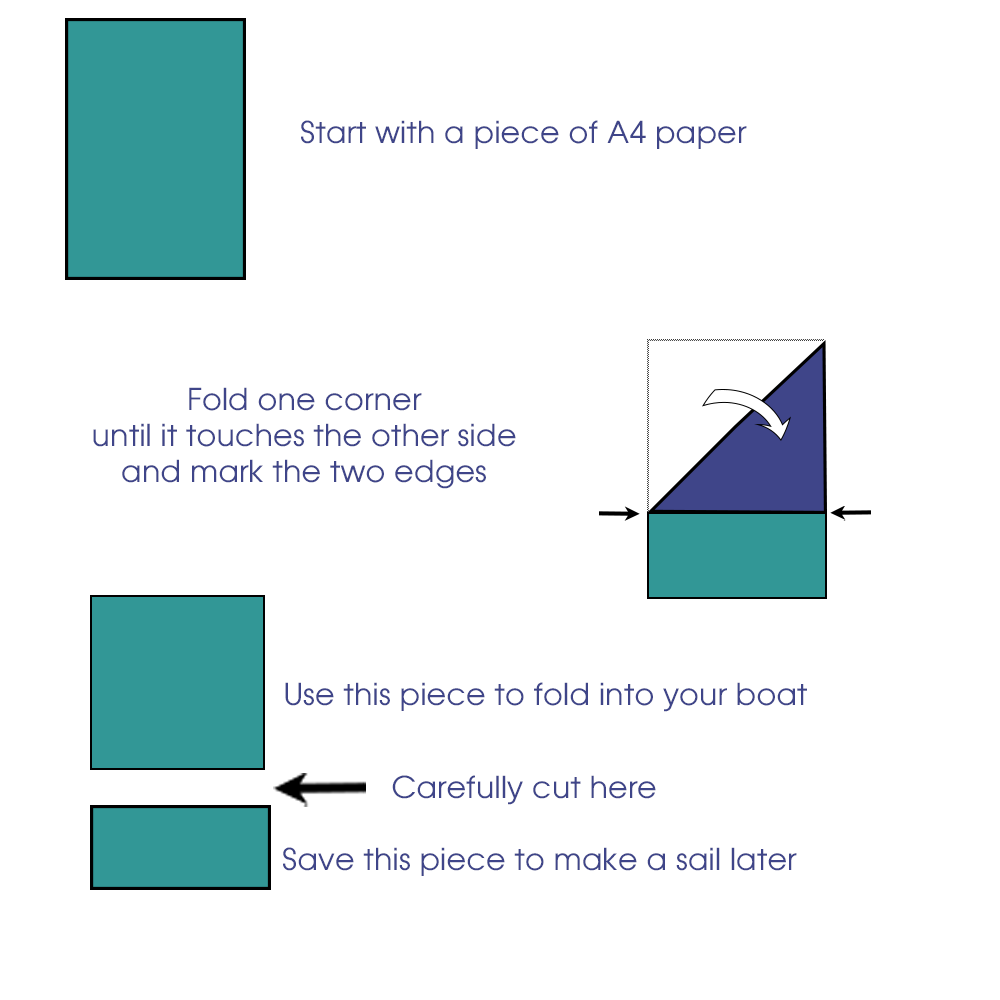
A4 paper is rectangular, but you need a square to fold a boat. Take the top corner and fold it diagonally down to the opposite edge, lining it up perfectly. Cut off the strip at the bottom — but keep the strip! You’ll need it later for the sail.

Before you fold, protect your boat
A real smuggling lugger was tarred and caulked to keep the sea out. You can do the same with your paper boat before folding it.
The crayon method: Colour both sides of your square heavily with wax crayons. Press hard — you want a thick, waxy layer. The wax repels water just like tar on a hull. Any colour works, but if you want to be historically accurate, go dark.
The foil method: Wrap your square in kitchen foil before folding. This gives you a stiffer, more waterproof boat — but it’s harder to fold neatly. Real smuggling boats were built tough, not pretty.
Fold your boat
This is the classic paper boat fold. If you already know how to make one, go ahead. If not, this video walks you through it clearly:
Video: “How to Make a Paper Speedboat” — Easy Origami and Crafts
Add a sail
Remember that strip you cut off in Step 1? Roll it tightly around a pencil to make a mast, then cut a small rectangle of paper for the sail. Thread the mast through two small holes in the sail, and fix it into the centre of your boat with a small blob of Blu Tack or tape.
If you want to name your boat, write it on the sail. The Manx smuggling fleet included boats with names like Peggy, Lilly, Sincerity, and Good Intent — names that wouldn’t raise suspicion at a customs checkpoint.
Launch Your Fleet
Fill a basin, a sink, or a bathtub. Launch your boat. If you made more than one, race them. The smugglers of the Isle of Man ran fleets of small boats across the Irish Sea for over a hundred years — your kitchen sink will do just fine.
Share a photo of your smuggling boat! Tag it #HistoricallyManx
The Real Thing: The Peggy
In 1789, twenty-four years after Parliament seized the island’s sovereignty to end the running trade, a Castletown banker and politician named George Quayle built himself a yacht. He armed her with six small cannon and two stern chasers — heavier guns mounted at the back, designed to fire on a pursuing ship. Not a hunter’s weapons. A runner’s weapons.
He named her the Peggy, after his mother. When he’d finished, he housed her in a purpose-built dock beneath his home, Bridge House, with sea gates opening directly onto Castletown harbour.
The Peggy survived, sealed inside her boathouse for nearly two centuries, and today she is the centrepiece of the Nautical Museum at Castletown, run by Manx National Heritage. She is one of the oldest surviving boats of her type anywhere in the world.
You can also find out more about George Quayle and Bridge House right here on this site.